
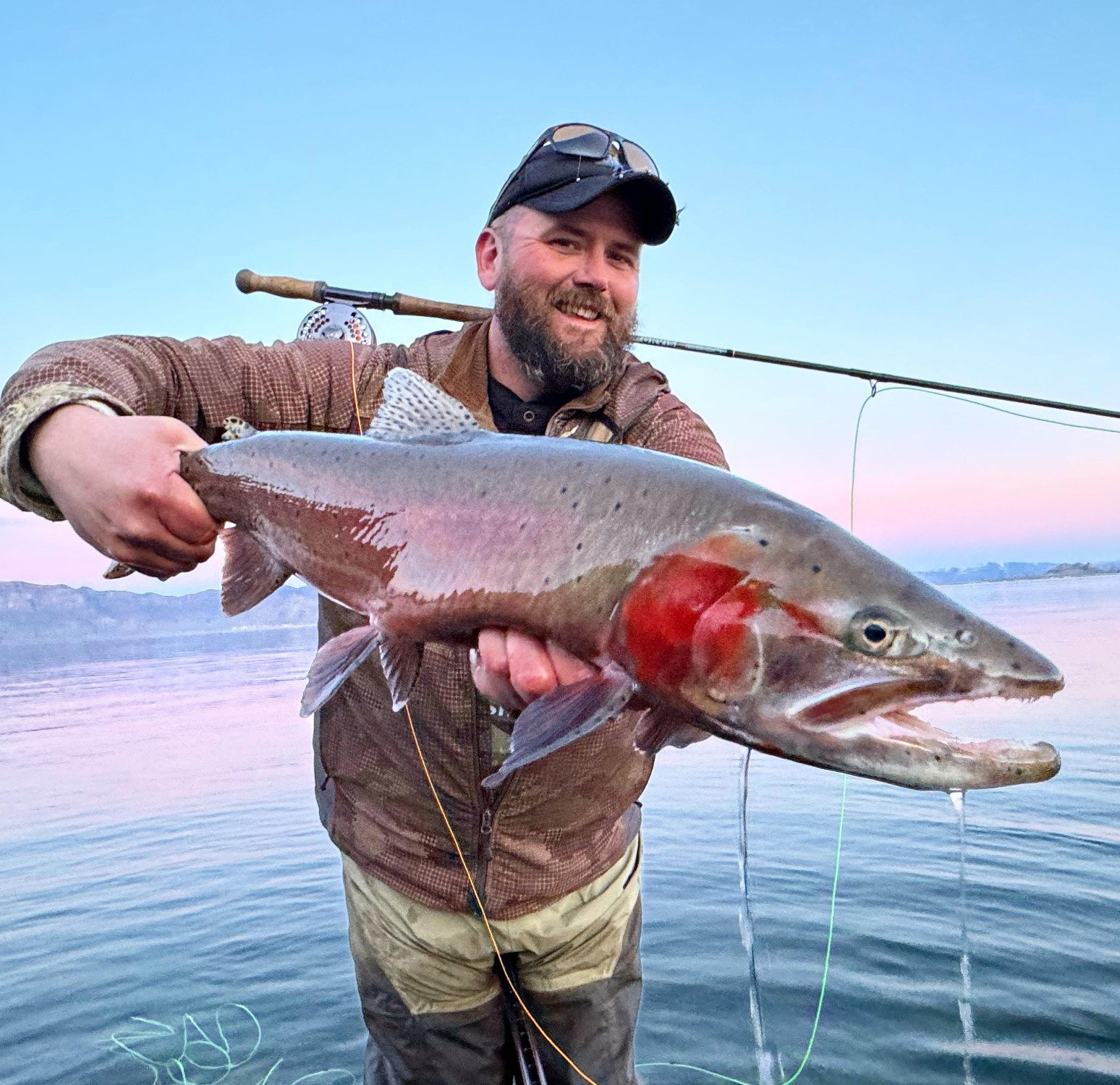

If it’s true that the tug is the drug, I’m completely addicted. Whether I’m after salmon, steelhead, or stripers, there’s something about getting a hard grab on a Spey rod that makes me understand the need for rehab. It’s an almost unhealthy obsession that would be a lot worse if I lived anywhere with a ready supply of anadromous fish nearby. Thankfully, I live in Montana, which is far enough away from any coastal rivers that I can keep my addiction under control…or at least I used to. Because once I discovered Trout Spey, it took my fly swinging mania to a whole new level.
For the uninitiated, Trout Spey or Micro Spey is just classical Spey fishing, on a slightly smaller scale. It uses lighter rods and lines that allow you to Spey cast and swing flies for nearly everything from trout to bass to panfish. In short, with a Trout Spey rod, any fish that lives in a river can be caught on a swung fly, allowing every angler to get in on the once exclusive Spey party and try it for themselves. That is, so long as they know how to get started.
The Right Stuff
The first and most important step to starting Trout Spey is finding the right rod. Trout Spey rods come in two styles: traditional Spey rods and shorter Switch rods. Both styles are available in multiple weights and sizes, with Spey rods being 12 feet or longer and Switch rods running between 10 and 11 feet. Generally, Spey rods work better on larger rivers and even lakes, while shorter Switch rods work best on smaller rivers, streams, and creeks.
Your style choice should depend on the water you fish and the specific species you’re targeting, with longer rods providing more leverage for longer casts and larger, harder-fighting species. Both Spey and Switch rods with longer lengths also mean you should choose a rod weight that’s slightly lower than a traditional single-hand rod you would use in the same situation. In short, if you trout fish with a standard 5-weight rod, a 4-weight or even a 3-weight Spey or Switch rod will most likely suit your needs. However, if you’re exclusively targeting smaller fish on smaller rivers, a 1- or 2-weight Switch rod will fit the bill.

Reels for Trout Spey setups are relatively simple. There are many Spey-style reel designs on the market, but most aren’t designed for the lighter rods and lines of Trout Spey. While many companies do make Trout Spey reels, it’s just as easy to use a simple and inexpensive large-arbor reel. However, if you do this, make sure to select a reel that’s at least two sizes larger than your rod to accommodate thicker Trout Spey lines (i.e., pair a 3-weight Spey rod with a 5-weight reel, etc.)
While Trout Spey reels are relatively simple, lines and leaders can be infinitely more complicated. First, you have to fill the reel with a running line, which is a slick, untapered line that runs easily through the rod guides. Next, you need to attach a shooting head to help load the rod to cast. Generally, shooting heads come in two styles—Skagit and Scandi—with Skagit heads being shorter and thicker and Scandi heads longer and thinner. Skagit heads are perfect for casting weighted leaders and small to medium-sized streamers, while Scandi heads are better suited to unweighted leaders, nymphs, and soft hackles.
Spey leaders are the final step in a trout Spey setup and perhaps the most crucial. Trout Spey set-ups demand a selection of both floating and sinking polyleaders, with sinking leaders working for nymphs and streamers in deep water, and floating leaders being ideal for smaller flies and shallower water. You’ll find that most polyleaders come with different sink rates for different water depths printed on the side of the package. Finally, you’ll want to attach a 2-foot to 4-foot length of tippet to the polyleader before tying on a fly.
Finding Spey Water
Generally, most anglers think of Spey water as long pools and runs that flow roughly at walking speed. While this is generally true, you can still get a good swing in the slower-moving pockets and pillows around faster-moving water. You can also swing up fish in fast-flowing shallows as well as incredibly deep, slow-flowing holes, so long as you know how and when to adjust your presentation.
In ideal areas of the river, present your fly with a traditional 30 to 45-degree cast down and across the stream. Next, mend your line and then allow the slack to tighten so you can “swing” the fly across the river until it’s directly downstream. Generally, you’ll want to allow the fly to hang in the current before picking it up to cast again. Then, you continue to cast and swing on repeat, stepping downstream between each cast until you get a strike or come to the end of the run.
While this is the traditional way to Spey fish, if you’re fishing in faster or slower water or extremely deep or shallow water, you want to adjust your swing accordingly. In faster runs, you can make shorter casts, then follow your fly with your rod tip to slow down your swing. In deeper, slower-moving pools, you can cast at a steeper angle and then lead your fly with your rod tip to speed up your swing.
Keeping Casts Simple
There are a lot of different types of Spey casts, from the Double Spey to the Snake Roll, which are all relatively complex to learn. However, all Spey casts stem from one place, the D-Loop. Once you understand how to form and use it, you can easily cast and swing flies on a Spey rod and make every Spey cast easier to learn.

Begin by standing in the river with the line in front of you in the water. With the line aligned off your casting shoulder, lift the rod with both hands to break the surface tension and lift the tip of the rod past your head to just above your shoulders. This allows the belly of the Spey line to drop back slightly behind you in what is known as the D-loop.
The D-loop creates tension by slightly bending the rod with the weight of the line behind you while lining up the cast with the intended target. To cast the line once it’s in a D-Loop, pull the handle of the rod sharply towards your chest and guide the rod forward towards the target with your dominant hand. This is known as a “Single Spey” cast and is the foundation of all other Spey casting.
Can’t Stop, Won’t Stop
I think Spey casting is so addictive because of the contrast. It’s hours of rhythmical casting where you flow in a continuous rhythm downstream as you cover the water in a serene reflection of the river’s natural movement. It sends you into a peaceful trance, which you’re sharply and abruptly jolted out of when you get a strike.
With your line tight, anything that hits your fly is an abrupt shock to the system that takes you from zero to 100 in a millisecond and drops you right into the center of the action. There’s just no other feeling like it in the fly fishing world, and once you get a taste of it…you only want more. Thankfully, once you get started in Trout Spey, you can get your fix each and every time you head out onto the water.