
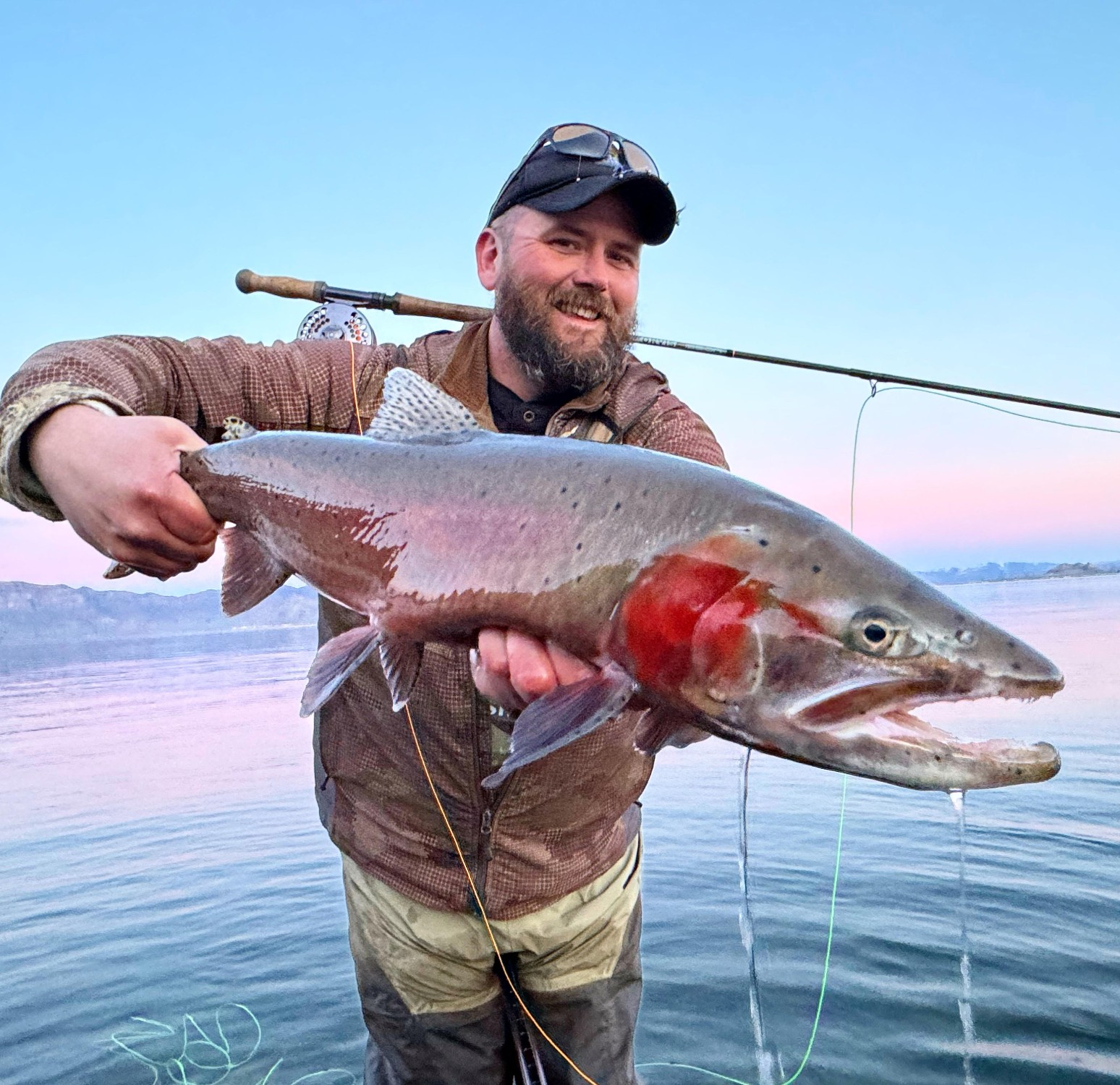

Almost every sport or hobby out there has its own boss level. It’s the upper echelon, double black diamond, Ivy League version of whatever activity we love best, which we take on to challenge ourselves, test our skills, and possibly find out what we’re made of. While this can range from anything from chess moves to super marathons, there’s no doubt that if you’re a fly angler, your boss level is probably a slough or spring creek.
While they are different structurally, both sloughs and spring creeks are similar in that they are full of gin-clear water and packed full of trout that are pickier about what they eat than a toddler on a beige diet. To fish both sloughs and spring creeks properly, everything from your cast to your leader to your fly must be perfect. It’s the type of fishing that can have you pulling your hair out and is the reason that so many anglers sell their fly rods and take up golf. Yet when you know how to do it right, fishing on sloughs and spring creeks can put you on top of the world.
Equipment For Sloughs and Spring Creeks
Mastering the art of spring creek and slough fishing is all about finding a balance. You need gear to help you make accurate casts while fishing with what are often tiny and delicate presentations that can still handle battling big fish on light leaders and tippet. In addition, part of what makes sloughs and spring creeks so challenging is that a trout’s mood can change on an almost hourly basis. In a single day, you may go from fishing small size 22 midges in the morning, to small flashy nymphs in the afternoon, to mayfly spinners in the evening, so you need gear that prepares you for anything.

Fly rods for spring creek and slough fishing should have a relatively slow action for long tight-looped casts and delicate presentations. Your average 5-or 6-weight rod will work in most scenarios, but it’s best to use one with a full-flex action. If I had to choose one absolute perfect utility rod for catching trout in both sloughs and spring creeks, it would be a mid-flex 4-weight. These rods are the best of both worlds, with both a soft tip to absorb energy and drop your flies gently in the water, while still having enough backbone and flex to handle hard-fighting trout on light line.
Leaders for spring creek and slough fishing should be as long as you can make them while still being able to easily cast, mend, and set the hook. Generally, somewhere between 10 and 15 feet is best. You’ll want to choose a light tapered leader in 5X or 6X range with 6X or 7X fluorocarbon tippet material to add a bit more stealth to your presentation.
Staying Low and Moving Slow
Whether you’re walking the meandering banks of a spring creek or slowly approaching the calm flat waters of a slough, the key to success is stealth. Even when the fish are rising or feeding steadily, the slightest sound or shadow from your approach can make them scatter like puddle ducks on opening day of gun season. Accordingly, if you want to consistently hook up on sloughs and spring creeks, you must plan your approach and then stay low and move slow.

Anytime you’re on the banks of a creek or slough, crouch down or even belly crawl if you must until you get a lay off the land. Try your best to keep the sun in front of you so you won’t cast a shadow on the water, and then use the terrain to your advantage. When you get ready to cast, try to do so from high grass or from behind brush or trees, which will help break up your outline and your movement.
When you’re moving along a creek or slough to look for fish or to make your approach on a rising trout, you want to move slower than molasses in the wintertime. Move gently and deliberately with no sudden jerks or fast movements, even when you cast. In addition, as a trout’s lateral-line system in the slow water of a slough or spring creek can essentially detect a pin drop, try to stay out of the water unless or until it’s absolutely necessary. When you do wade in a spring creek or slough, move as slowly as you can without splashing or shifting any rocks or weeds along the bottom. Try to only get as close to the trout as necessary and then peel off some line and try to make that first shot count.
Patience Is A Virtue
Patience is key whenever you’re fishing on a slough or spring creek. Whether you see fish rising in the current of a creek or trout cruising around the edges of a slough, you have to wait to cast until you have the perfect opportunity and then take your shot as flawlessly as you can—because you’re probably only going to get one.
On a spring creek, unless there are a lot of large insects like grasshoppers or stoneflies around to provide enough consistent feeding for blind casting, you have to wait for your window. Usually, this will be a large trout riding consistently on a particular insect along a specific current seam, not a fish rising sporadically. Try to position yourself so that you’re across and slightly upstream of the trout, and then make sure you have the right fly tied on to match whatever the fish is eating. Pull enough line off the reel (more than you think you’ll need) to drift over the trout and then make a slow, accurate cast at least 3 feet to 5 feet upstream of the fish. Make a mend to both slow down and make certain that your fly will drift into the specific seam, and then wait for the trout to eat before setting the hook.

Sloughs are an entirely different beast from spring creeks, as there is no flowing water and it will often seem that trout are feeding randomly. However, if you pay attention and watch the fish, you’ll usually find that slough trout will swim in a long slow circle and will return to the same basic spots to feed. If the trout is rising, tie on a dry fly that matches whatever the fish is eating and then wait for it to approach before casting 3 to 5 feet ahead of the fish. However, if trout are feeding on nymphs, you must take a slightly longer lead and then treat the trout more like a carp or permit.
Tie on a likely looking nymph (no indicator) and then cast it 5 feet to 7 feet in front of the fish. Allow the fly to sink to the bottom and then, once the fish is a few feet in front of your bug, begin making long, slow strips to run your nymph along the bottom to get the trout’s attention. Most of the time this will cause the trout to turn and casually inhale the fly.
Rising To The Challenge
Many fly anglers avoid fishing on sloughs and spring creeks because they find them too challenging. Yet the challenge is all part of the fun. While there are a lot of other types of waterways where you can and will catch more trout, the difficulty of hooking up with a slough or spring creek trout makes every fish you bring to the net special. It’s a game of quality over quantity where every trout feels like a reward that was well and truly earned.