Moments before landing the fish they have been after for months…
“Joe, Graham, and I have been shooting content together for a few years now, chasing surf, fish and stories everywhere from home to Costa Rica.
We’d been quietly watching this redfish honey hole near one of our houses for months—super secluded with easily spooked fish. We spent most of the afternoon blowing our chances. With about an hour of light left, they dropped me at a dock and I sent the drone up.
In a mix of luck and good timing, I ended up right over Joe as he dropped his fly right in front of the bull red. I got to watch it all unfold from a few hundred yards away on my drone monitor. I just remember at the end we were all hooting and hollering like little kids across the water in triumph. It really amazes me that one of my favorite shots is nothing but a well framed look into the raw art of fly fishing.”
Angler Story of the Week from Joe, Ted, and Graham, be sure to check out their Instagrams listed above!
Grant Wiswell, over at Castaway Films, has quietly put together one of the more moving fly fishing films I’ve ever seen. The film’s story centers on Danny Para’s journey to become a marlin guide in Magdalena Bay, while dealing with plenty of life’s vagaries. From a father who walked away, and feeling lost in life, Danny’s entire story is on full display in the film, giving it that much-needed depth and relatability that’s so often missing in fly fishing films. The Light Beside Me isn’t just a stoke reel for someone’s once-in-a-lifetime trip to chase marlin on a fly rod. It’s a real story, told beautifully, that just happens to feature fly fishing.
We had the chance to sit down with Wiswell to discuss what went into making this film, from both the technical and human viewpoints.
Flylords: Your film opens with some incredible shots of marlin underwater. How difficult is it to get shots like that? What goes into pulling off those sorts of shots?
Wiswell: The underwater filming ended up being one of my favorite parts of the entire project—but it didn’t start that way. I had some real trepidation about jumping off a perfectly good panga into a thousand feet of water. The first day I got in, I refused to swim more than five feet away from the boat. That doesn’t work very well when you’re trying to film bait balls.
Eventually, I worked up the courage to swim toward the sardines – and as luck would have it, they immediately used me as cover during a massive dorado blitz. I lost a chunk out of my left leg and took a few hits to the face in that swirling white vortex. And on my way back to the boat, about ten feet below me, a Bryde’s whale cruised past and ate the entire bait ball. None of that was great for a novice’s confidence.
But when I saw the footage later, I knew underwater work had to be a major part of the film. The sardines are the heartbeat of Magdalena Bay. The way the marlin, dorado, and everything else interact with them is so wild and so beautiful that I couldn’t tell the story without putting the audience right in the middle of it.
From that point on, every time I returned to Baja, I pushed myself further. I got more comfortable in the water, spent hours and hours shooting, and eventually decided to get scuba certified just to access the angles and approaches I needed. A team in Missoula helped get me ready, and thankfully, Baja is a lot warmer than Flathead Lake in the fall.
Technically, I had a steep learning curve. We’ve used underwater housings in previous films, but once you start going deeper, pressure affects everything—buttons stick, dials don’t work, the camera behaves differently. I had to work with the housing manufacturer to make sure the rig was actually usable at depth. And then there were all the classic underwater headaches: autofocus issues, white balance shifts, jittery footage, too much motion, blown shots. Every mistake you can make, I made it—usually more than once.
But by the end, things clicked. I was finally getting the kind of consistent, usable shots that really shaped the final film.
Flylords: Let’s talk about the dorado shots – those fish eating flies on camera. What went into setting those shots up?
Wiswell: Magdalena Bay is one of those places that never feels the same twice. Every trip is a new experience. We spent three different fall seasons there—2023, 2024, and 2025—and each year had its own personality. One of those seasons was an El Niño year, and with the warmer water came the dorado. The numbers that year were unbelievable—almost plague-level. In the other two seasons, we barely saw a single one, but during El Niño, they were everywhere, incredibly fast, incredibly aggressive, and constantly beating the marlin to the sardines and the flies. It made marlin fly fishing really difficult.
The dorado pressure was so intense that we finally decided to pivot and build a whole section of the film around them. We caught so many that the real challenge became positioning the camera to actually get usable footage. Eventually, we broke the hooks off and fished a hookless fly. That allowed us to get the camera in tight with minimal trauma to the fish.
I was originally worried the dorado would be spooked by having a diver in the water, but that wasn’t the case at all. Many of those takes happened within a foot of the lens. A few even hit the camera because they were so locked in on the fly.
Another fun part of filming the dorado was using the drone. In Magdalena Bay, you get two kinds of bait balls: static and dynamic. Static bait balls are perfect for underwater work because you can actually stay with them. Dynamic bait balls—where predators are pushing the sardines across the surface—are nearly impossible to follow underwater, but they are an absolute blast to film from the air. Tracking the erratic movement of a dorado blitz with a drone felt like playing a video game.
The challenge, of course, is landing a drone by hand in big Pacific swells. I’m not going to lie— there were some bloody fingers during takeoff and recovery. Technically, it was a demanding section of the film, but I’ve never seen footage like what we captured. It was incredibly satisfying to chase something new and come away with shots that feel unique.
Flylords: How did you meet Danny, the main character of the film?
Wiswell: I’d never told a human-centered story before. All of our past films focused on remarkable species, wild destinations, or environmental issues—like the Pebble Mine project. The first time I went to Magdalena Bay was for something completely different: an exploratory shoot for roosterfish in May of 2023. Danny happened to be the captain of the boat. We started talking and instantly connected.
I’ve lived in Ecuador for two years and spent a big part of my life in Latin America, so speaking Spanish was both helpful and necessary for what this project eventually became. On that first trip, Danny shared that he had been fighting an aggressive form of cancer and had recently undergone surgery and chemotherapy. We talked about the challenges he faced from that initial treatment, and we kept in touch throughout the summer. The plan was always to return for marlin season.
But during that summer, his cancer came back. He needed another surgery and more chemotherapy. Wanting to help, I reached out to several doctors in Missoula to understand his options and then had long conversations with two surgeons in La Paz. His second surgery went well, and he was able to guide us again at the end of that first marlin season.
Becoming that invested in someone’s life—actually caring about them, trying to support them— made this film profoundly meaningful to me. This wasn’t some random fishing captain. This was a friend.
One of the hardest parts for Danny was that doctors told him he wouldn’t be able to have children. For someone who had been abandoned as a child, that news cut deeply. He wanted to break that generational story—he wanted to be the father he never had. It was heartbreaking, and he fell into a significant depression.
I’ll never forget the day he called to tell me that his wife, Yarit, was pregnant. There were tears of joy on both ends of the phone. I can’t put into words how incredible that family is. Danny is humble, hardworking, genuine—just a good man. My life is better for knowing him.
More than anything, I hope this film honors his story the way it deserves to be told.
Flylords: The thrust of the film is about Danny letting fly fishing save him from himself. Why did the human aspect of his story attract you so much?
Wiswell: You have to keep in mind that before George and Rudy—Los Locos—arrived in Magdalena Bay, most local fishermen had never even seen a fly fisherman. They’d never seen a fly, never cast one, never watched someone catch a fish with one. They were familiar with long-range trollers coming up from Cabo San Lucas, but the vast majority of fishermen in San Carlos are sardine fishermen, clam harvesters, or hand-line fishermen inside the bay. Nets, traps, and hand lines—those were the tools they knew. Fly fishing was from another universe.
They certainly had the boat-handling skills, but understanding how to approach a bait ball, position a client, read the birds, or set up a sight-cast for marlin was completely new territory. I’ve fished billfish in many parts of the world, and almost everywhere it revolves around bait and switch: trolling hookless teasers, raising a fish into the spread, pulling the teaser away, and then casting a fly at the lit-up billfish. But George and Rudy pioneered something different in Magdalena Bay. Instead of trolling, they focused entirely on bait balls—finding them, reading them, and sight-casting to whatever predators were underneath.
A typical day starts in a panga, out in the middle of the open Pacific, scanning for birds— specifically frigate birds. If the frigates are riding high, the bait hasn’t pushed to the surface yet. But when they’re down tight on the water, something has forced the sardines up, and that’s your signal to run. Once the panga reaches a bait ball, the goal is simple: cast the fly right into the middle of the sardines and strip it back out.
You see this clearly in the film—there’s safety in numbers inside a bait ball. But the moment a sardine becomes disoriented or strays from the group, that’s when everything attacks. Wahoo, tuna, marlin, dorado—every predator is looking for the injured or the wanderer. George and Rudy treat 300-pound striped marlin like trout. The entire experience is visual, immediate, and electric—so much more engaging for fly anglers than trolling for hours hoping for a shot.
Finding bait balls is everything. The Pacific can be a blue desert, and you can run for hours without seeing life. But if you find the bait, you’ll find the marlin. That entire approach—bird reading, bait ball hunting, sight-casting—was completely foreign to commercial fishermen in San Carlos.
And that’s why what Los Locos is doing matters so much. George and Rudy have made it their mission to train local fishermen to become fly-fishing captains and guides. Commercial fishing is brutally difficult in Baja; margins are thin, gear is expensive, and the work is unforgiving. But fly guiding is different. It offers a stable, dignified, sustainable way to support a family.
Los Locos has created a real opportunity in San Carlos. It’s mutually beneficial—anglers get world-class fly fishing, and local fishermen gain a new livelihood built on skill, conservation, and pride.
Flylords: This is your fifth film in F3T over the years. How much has changed in your approach to filmmaking?
Wiswell: It’s hard to believe this is our fifth film in the Fly Fishing Film Tour. Our first project, Equilibrium: The Last Frontier, focused on the Pebble Mine and screened in 2008. That feels like a lifetime ago. Since then, we’ve made all kinds of different films, but with this project, I really wanted to focus on the story. The action can take care of itself, but what separates a good film from a meaningful one is the story behind it.
After Atlanticus premiered in 2018, I didn’t want to just jump into another random project. I wanted something that actually mattered—something I could tell from a true narrative standpoint. Danny’s story gave me that, and I felt a deep responsibility to do it justice. I’m not sure “duty” is the exact word, but I wanted to honor his life in a way that felt earned and respectful.
This film required a lot of personal growth for me because I’m not naturally a storyteller in the literary sense. I spent hundreds of hours studying story structure, watching authors break down narrative arcs and the hero’s journey, trying to figure out how to build something viewers could emotionally connect with. As an independent filmmaker, you wear every hat—cinematographer, editor, screenwriter—and every stage of this project challenged me in new ways.
I’m incredibly grateful for the people who’ve been with us for years. Nathan DeVore, our director of music, and Matt Orton, our creative director, are trusted partners and true confidants in this process. Having people like that in your corner makes all the difference.
One thing I enjoyed about this film was the shift in gear. I love working with cutting-edge equipment, but this time I actually stepped back and used more vintage-style camera gear. The story felt nostalgic, and razor-sharp, hyper-clinical imaging didn’t fit the emotional tone I wanted. The softer, more textured look seemed right for Danny’s world.
Music is another critical piece. I believe it’s one of the most important elements in any film. For this project, I wanted a blend of big, epic sound and moments that dropped into something more mariachi or ranchero—something true to the culture of a commercial fisherman in Baja. The whole film is a balance between two worlds: the new, adrenaline-filled fly-fishing scene and the old-world, sleepy Mexican fishing village where it all happens. Those worlds collide in Magdalena Bay, and I wanted to reflect that visually and emotionally.
If there’s one thing that’s changed in my filmmaking over the years, it’s that early on, I didn’t focus on story as much. With this film, I worked hard to make the story the priority rather than an afterthought. It hasn’t been easy. There have been a lot of revisions, a lot of lessons, and more than a few humbling moments. But I just hope people are as touched by Danny’s story as I have been.
In this week’s “How to Tie” feature, Tiesflies shows us how to tie a versatile grub/larvae pattern that will become your go to in no time, the Simple Grub.
Learn How to Tie This Fly:
Difficulty: Easy
The Simple Grub is one of those patterns that quietly earns a permanent place in your fly box. It’s realistic, super buggy, and intentionally minimal, designed to imitate the countless small aquatic larvae trout feed on throughout the year. Confidence is the feeling you should have when this fly is plucked from your selection of nymphs. When fish are feeding subsurface without giving much away, this pattern is often exactly what they want.
Like other flies in its productivity class, it is built around simplicity and function. With very few materials, it creates the impression of life drifting aimlessly in the water. The key to tying this pattern is restraint, as too much material will take away from the fly’s natural look. Add ribbing if desired for durability and subtle segmentation, then finish with a small, clean head behind the bead or hook eye. The Simple Grub will fill up your nymph box in no time and allow you to fish in debris filled water without losing sleep over lost flies
Fish this fly anywhere trout feed below the surface(everywhere). In all seriousness, it works remarkably well as a dropper behind a heavier nymph or as part of a Euro-style rig. Its natural profile makes it effective in riffles, seams, and slower tailouts alike, giving you a weapon in any fishy nook regardless of destination. When trout are keyed in on small, unassuming bugs, the Simple Grub will consistently get eaten.
Modern fly rods are just too expensive. They’re not worth $1,000, and anyone spending that kind of cash on one should also take a look at this catalog of beachfront property for sale in Iowa.
Those are the common retorts I hear from folks whenever the subject of fly rods gets brought up. Considering how much fly anglers love their gear, it’s a topic of frequent conversation, especially among my close-knit group of fishing buddies. I’m the lone outlier who honestly doesn’t mind what fly rod companies are charging for their top-tier rods these days, even though I agree that $1,000 is a lot to spend for some graphite and fancy cork.
I believe it was the first-generation G. Loomis Asquith that broke the $1,000 mark for a production fly rod, and just about every company has followed suit since then. A common refrain in rod reviews, forums, and at the counter in fly shops has been that “fly rods just shouldn’t be priced so out of reach for the average angler.”
But are fly rods really more expensive now than they used to be? Or has the price just kept up with inflation?
The Real Cost of Fly Rods
Back in 1989, for their 60th anniversary, the R.L. Winston Rod Company sold the first version of the Tom Morgan Favorite for $380.
A top-tier rod from one of the most respected companies in fly fishing for less than $400? Even back in 1989, that must have been a steal! Right?
For someone looking for a bit more versatility than a light-line 8′ 4-weight, Sage sold their 9′ 5-weight RPL in 1989 for $320, per their catalog.
The late ’80s were good for more than grunge rock’s evolution and big hair. A fly fisher back then could have bought a handful of top-tier rods for the price of one in today’s market!
On its face, that’s true. But there’s one nasty little feature we often forget about when comparing the cost of things today to that of…almost 40 years ago.
Inflation.
$380 in 1989 has the same buying power as $1,016.85 in today’s money. That lovely Tom Morgan Favorite from Winston was, technically, a thousand-dollar rod. The RPL from Sage? It’s a better deal, since $320 in 1989 could buy $856.29 worth of goods in 2026.
Is Any Fly Rod Worth That Much?
Now that we’ve dispelled the myth that fly rods were cheaper back in the good ol’ days, the big question still needs to be answered: are any fly rods really worth that much money?
A used 1989 Tom Morgan Favorite I saw on eBay a few days ago had a starting bid of $750. A 9′ 4-weight RPL in the two-piece configuration has a buy-it-now price of $350. A used Sage X (the company’s flagship rod before the R8 CORE series released in 2022) in a 9′ 5-weight has a buy-it-now price of $675, and a Scott G2 8’8″ 3-weight can be yours for $456.50.
It was Tom Morgan himself who said that “a good fly rod is always a good fly rod.” But like any other product, rods do improve and evolve over time. So these great rods of yesteryear are still worth owning and fishing, even if they don’t command the top-tier price tags they once did (that collectible Winston notwithstanding).
Enough folks bought those rods for their sale prices when they released, including the more modern Scott G2 and that Sage X. That’s why a robust used fly rod marketplace exists today, after all. Someone, somewhere, thought those rods were worth it. And I reckon a lot of folks who turn their noses up at the $1,050 asking price of a 9′ 5-weight Sage R8 CORE would have to admit that 9′ 5-weight X is a decent deal for $675.
They’ve Always Been Expensive
This trip down memory lane today has shown us two things: fly rods weren’t as cheap back in the good ol’ days as many folks may have remembered. And if fly rods weren’t as cheap back then, I’m really wondering if all the fish my dad and grandpa caught actually were as big as they are in the stories…
Price is always relative to everything else in life. A $1,000 fly rod is a lot, sure, but a new truck these days is also about $45,000 for a mid-trim level mid-size pickup. Back in 1989, a Toyota Pickup (the Tacoma didn’t exist back then) in a 2-door, 4-wheel-drive, long-bed deluxe trim had a factory MSRP of $12,698 (equivalent to just about $34,000 in today’s money). Shoot, the average home price in January 1989 was $113,000, which is only $302,379 in today’s money. An average home in 2025 was as much as $435,300, far outstripping inflation.
With how crazy expensive trucks and houses are now (both vastly outpacing inflation) we should kind of be happy that fly rods still cost, relatively, what they did almost 40 years ago.
Except for the G. Loomis Asquith. The rod that retails for $1,750 in some models right now would have cost you $653.98 back in 1989. The only rods that sold for that dollar amount back then were likely bamboo, although I can’t find any reliable figures to support that claim. I’m certain graphite wasn’t selling for that price point, though.
They’re Reasonably Priced
On the whole, fly rods have just kept up with inflation. That’s surprising, and probably a tough pill to swallow for some who think rod companies are just out there price gouging the average angler. I think it shows a legitimate amount of restraint, and a good knowledge of the rod market, to keep making rods at essentially the same profit margin for all these years. Especially given the expanded repair and warranty operations many companies have introduced since 1989.
And if top-tier rods aren’t your thing, you have more options than ever before to spend less and still get a great stick. The Douglas LRS sells for a bit under $300 in most places, and it’s a fantastic 9′ 5-weight. The Scott Session is $695, which I think is very reasonable for that rod’s performance and quality.
Many of the mid and low-priced rods for sale today are leaps and bounds better than the cheap stuff that got fished in 1989.
We pulled up to the gravel parking lot, which was completely vacant of other anglers. Most anglers this time of year are holed up tying flies, snow skiing, or just trying to stay warm. The cold, freezing February fog hung low in the valley. Ice formed on the window of the mid-90s Chevy Blazer—a guide vehicle that, like many, had been run into the ground. Even once idling, the Blazer’s heater had difficulty keeping the cold air at bay. The temperature on the dashboard registered an icy –7°.
With expectations set low, we crested the last rise to the river. The air was freezing, yet to our surprise, wide, flat runs, slow bailouts, and flat water on the inside of moderate-speed bends were teeming with rising fish. Porpoising trout, with dorsal fins slicing through the water and wide-open mouths inhaling minuscule insects, could be seen in all directions. The trout behaved just as they would during a green drake hatch—eating recklessly. Black midges blanketed the water’s surface, and on closer inspection, though small individually, many were clumped together in rafts of floating insects, making them the ideal mid-winter meal. The fish were on them, and it created some of the best fly fishing of the season. The lesson that day was clear: a midge hatch can appear at any time, and having the best midge flies is a must.
Winter Fly Fishing and Midge Hatches
Although often overlooked and underappreciated, winter fly fishing can be outstanding. The rivers are quiet, and though cold, trout still need to eat. Tailwaters—usually beaten to death all summer long—are mostly vacant of other anglers in the winter. Midges provide a year-round food source for trout. In the coldest months, on many streams, they are the primary, and sometimes only, forage item. Midges are incredible insects; they are important to both trout and anglers. Yet, their small stature and less-than-sexy profile often leave them, as well as midge flies, unnoticed.
All products featured on Flylords are independently selected by our editors. However, when you buy something through our retail links, we may earn an affiliate commission.
I won’t bore you with the intricacies, scientific names, or a deep dive into the midge lifecycle—there is plenty of information and digital content that explains it better. I do want to point out several aspects of the hatch and why midges are so important to anglers. For the reasons listed below, you should have a variety of midge patterns in your fly box for winter fly fishing.
Midge Life Cycle
First, midges are primitive insects related to common household flies and mosquitoes that go through a four-stage life cycle: egg, larva, pupa, and adult. The latter three stages are important to both fish and anglers, so fly patterns should reflect all three phases. Most importantly, because they are biologically primitive, they can inhabit almost any type of water. Midges live in clear water, dirty water, polluted water, cold water, warm water, lakes, rivers, streams, retention ponds, and even wastewater treatment plants. Their distribution is so widespread that no matter where you are reading this, midges are likely relevant to you as a fly angler in pursuit of trout.
Second, as I mentioned above, midges hatch 365 days a year. The consistent nature of the hatch and the constant presence of midges make them a staple for trout. This is especially true in late summer, fall, and winter. The seasonality and short hatch window of other aquatic insects—and the inevitable waning of summer hatches—leave major voids in a trout’s diet. Midges fill the gap; on many streams and rivers, they are the only reliable insect available.
Third, although small, midges occur in such great numbers that they provide plenty of calories for winter fish. When conditions are optimal, adult midges will blanket the surface of a river. One unique characteristic of midge behavior that differentiates them from other insect hatches is their ability to find other adults and clump together into small, floating rafts. While an individual midge may not offer many calories, a floating raft of multiple adult midges provides a similar caloric value to many summer mayfly and caddis hatches. This behavior makes them easy to catch, high-value targets for feeding trout looking for valuable energy to make it through winter.
Best Midge Flies for Winter Fishing
Fishing a winter midge hatch is an opportunity that should not be missed. There are many excellent winter midge flies to choose from. Below are 10 fly patterns—some of my favorites—that work in a variety of fly fishing scenarios. It is wise to have a few larva, emerger, and adult patterns to cover all phases of the hatch. They are not ranked in any particular order. Hopefully, you will be inspired to store the skis in the garage, leave the warmth of the fire, or store the tying vise and take advantage of the best fly fishing of the year.
Best Midge Flies for Winter Trout
Midge larvae burrow into the soft substrate of rivers and lakes. When available as a food source, midge larvae are found in the deepest parts of the water column near the river floor. As a general rule of thumb, midge larvae are most productive when fished in the lower portion of the water column. Tungsten-weighted nymphs—or incorporating split shot into your nymph rig—are often required to get the flies into the strike zone.
Sometimes, simple patterns are the best. The Zebra Midge is a simple yet effective pattern consisting of thread, wire, and a tungsten bead. The tungsten bead gets the fly deep into the strike zone. Despite its lack of pomp and frill, it catches fish 365 days a year.
Common colors for Zebra Midge patterns are black, red, and brown. Olive and purple can be productive too. I like to start by fishing black in the morning and then switching to red or brown in the afternoon.
If you’re looking for a midge larva pattern with a realistic profile and a little flash, then the Rojo Midge is an excellent fly pattern. It combines the characteristics of an imitative fly pattern with just enough flash to add a dash of attractor characteristics.
Midge larvae contain high amounts of hemoglobin, which oftentimes results in a natural red tint. The red glass bead gives the Rojo Midge a tiny bit of sparkle to imitate a larva’s natural red color. The white gill tuft and elongated nymph hook match a midge larva’s profile. Because it lacks weight, it is best fished under an indicator with a heavy-point fly or by incorporating split shot into your leader setup.
One of the most difficult aspects of fishing midge flies is their small hook size doesn’t allow for much weight to be tied into the fly. This makes getting larva patterns deep enough to reach feeding fish—especially through swift currents—a challenge.
Dawkins DD midge incorporates a second smaller tungsten bead behind the first. Not only does it add extra weight, but it also creates a better profile and a contrast in color. This is an excellent pattern to target trout in shallow water as a dropper in a dry-dropper rig or to fish deep under an indicator in a two-fly nymph setup.
Low, clear water moving at minimal speed can create technical angling conditions. Trout have ample time to inspect flies, and during the winter months, these are likely the conditions you will encounter on many tailwaters. Having a pattern in your fly box that stands out is key.
The Flashy Money Midge is tied with a thread body but incorporates midge tubing creating contrast in the segmentation of the fly. A small amount of flash is tied into the transition between the thorax and the head. That flash is critical—when millions of larvae drift in the current, the minute sparkle of this pattern helps it stand out. This is an excellent pattern for catching tricky trout in technical scenarios.
Midge Emerger Fly Patterns
Emergers represent midge pupae transitioning as they prepare to hatch into adults. To make their way to the river’s surface, they trap air bubbles between their pupal shuck and body. The air bubble helps buoy them to the water’s meniscus—the tough barrier created by air pressure pressing against the surface water. Many emergers die, can’t make their way through, or become stuck in the meniscus, making them easy prey for winter trout.
Emerger fly patterns can be fished anywhere in the water column. They can be nymphed, swung vertically, or fished in or just below the surface film. Porpoising trout and the absence of a visible mouth breaking the surface to feed is a clue that trout are taking emergers. This is the ideal time to present flies higher in the water column utilizing an emerger pattern.
The Hanging Midge sits perfectly in the water’s meniscus. Incorporating hackle and CDC fibers, it hangs in the surface film with the lower half of the fly submerged. This presentation simulates a midge emerger struggling to break through the surface. The white CDC tuft provides the angler with a clear visual marker on long casts.
I love to use this pattern if fish refuse an adult, or a pod of feeding fishing suddenly stops eating a productive pattern. Making a sudden switch will usually result in additional fish opportunities.
When seined in a kick net, it’s remarkable how small and thin the profile of a natural midge emerger can be. The No Mercy Midge is a simple, no-frills emerger pattern that matches the slim profile of the natural insect.
Incorporating a thread body, wire ribbing, a shiny hard-coat body, and a white CDC wing that lies slightly forward, it is deadly when fish are selectively feeding in the surface film. Because of how the wing is tied, the pattern hangs almost vertically in the water and just beneath the surface film. This unique presentation makes it an excellent choice for heavily pressured water.
If you’re looking for an all-around great midge pupae pattern, the Chironoflash Midge Pupae is an excellent option that imitates midges and blue-winged olives. This fly is particularly effective in late winter and early spring when both midges and blue-wing olives can appear.
The midge tubing body and dubbed thorax make this fly sturdy. What sets it apart is the small amount of flash tied directly behind the thorax, simulating the gas bubble of an emerging midge pupa. It is unweighted and can be fished in the surface film on a greased tippet or under an indicator higher in the water column to simulate pupae moving vertically to hatch. Nymphing the fly on long drifts and swinging it through the water column can be productive, too.
Midge Adult Dry Fly Patterns
Adult midges appear similar in shape and size to mosquitoes. Once the pupa breaks through the meniscus and frees itself from its pupal shuck, it spends time on the water’s surface drying its wings before flight.
This period of vulnerability is exploited by trout. Fully exposed snouts and open mouths feeding on adults become visible to the angler. This is your opportunity to present a dry fly pattern to trout feeding on the surface. Below are the best midge flies imitating adult midges that are effective for winter fly fishing.
The Griffith’s Gnat is a high-riding classic fly pattern. Although it doesn’t look like much, it does a tremendous job imitating the clumping behavior of adult midges on the river’s surface. Both the Griffith’s Gnat and the hi-vis Griffith’s Gnat make spotting small flies in flat light much easier than other conventional adult midge patterns. It is also an excellent dry fly to fish in tandem in a two-fly dry fly set up with an emerger as the second fly hanging in the surface film. The emerger pattern will be invisible to the angler, so having a clear sighter fly as a frame of reference to where your emerger is located makes detecting strikes easier.
It is always wise to have a mix of dry fly patterns in the fly boxes—some that sit high on the water and a few that sit flush with the surface film. Trout can be picky, and subtle changes in presentation can make all the difference.
The CDC wing and biot body give Harrop’s CDC Adult Midge a distinct low-riding profile. The CDC wing makes it relatively easy to see, too. CDC also adds natural movement to fly patterns like no other material on the fly-tying market. This pattern rides low on the water, delivering the perfect surface impression capable of fooling the most discerning trout.
I love versatile flies. Pat’s Midge is one of those. It’s my go-to dry fly pattern when I receive refusals on other patterns. With this single fly, you can cover both adult midges and crippled midges that never fully break free of their pupal shuck. In addition, the antron loop wing makes this fly easier to spot than other midge patterns.
When adult midges rest on the surface of the water, they are often accompanied by the pupal shuck from which they just emerged. Unable to break free from the shuck, they spend longer amounts of time drying their wings, or they are never able to leave the surface at all. The presence of the pupal shuck is a dead giveaway to educated trout that these insects are easy targets requiring less energy to catch. This single fly performs well at catching both porpoising trout and trout feeding on fully formed adults.
Final Thoughts:
Winter midge fishing can be a technical but rewarding pursuit. When conditions are right, rivers can be blanketed with midges, rising fish, and entire stretches to yourself. Our picks for the best midge flies for winter fishing give you the options needed to cover larval, emergent, and adult stages of the life cycle. These flies have versatility and have consistently proven themselves over the years of fishing to the most technical winter fish. While there are plenty of options out there, these recommendations will get you started catching winter trout, even on the toughest days.
There are about a million fly rods on the market. When you’re just getting into this sport, picking beginner fly rods can make you feel like you’re a plumber who just got asked to judge a dance competition.
You can certainly get lost in the weeds when it comes to fly rods, but the good news is that the beginner fly rod market has never been more robust than it is now. The gap between good and great fly rods is ever-decreasing, and the rods beginners use today are vastly superior to what I started with.
This guide will not only walk you through the best beginner fly rods in 2026, but I’ll also explain why these rods are so highly recommended for those getting started in fly fishing.
I’ve been reviewing fly rods for over a decade. I also build bamboo fly rods, and I spend a good chunk of my time teaching beginners how to fly fish, over at Ventures Fly Co. I’m no rod engineer, and I don’t like the word “expert,” either, but I know my way around a fly rod. I’ve had the opportunity to fish the latest and greatest from Winston, Orvis, Sage, Thomas & Thomas, Douglas, Hardy, and other rod builders. I was also a guide for a few years, where I specialized in taking out new anglers.
All products featured on Flylords are independently selected by our editors. However, when you buy something through our retail links, we may earn an affiliate commission.
All the rods listed here are 5-weights, and that’s for a reason. The 5-weight is the most popular rod in America, so that’s mostly what I get sent for reviews. But it’s also the most versatile, equally at home in the Appalachians and Rockies.
Every rod on this list is one that I’ve personally used and reviewed in the last ten years. The Douglas LRS is the rod I used for clients on my walk-wade trips in the Rockies. Whichever rod you pick, I’ve spent hours with it on various rivers, and I’m confident in recommending it to any beginner.
The Douglas LRS is my top rod here for a few reasons. First, it has a wonderful medium-fast action that’s quick enough to help beginners form tight, accurate loops, but still soft enough that beginners can feel the rhythm of a good cast. Learning what a good cast feels like is key to becoming a competent angler.
Second, it has enough reserve power to bomb long casts, should the situation call for it. I fished this on both stillwater and rivers, and was consistently impressed at how well it threw bugs out to 70 feet.
Finally, Douglas has an excellent warranty service, so if you break the rod, or anything else goes wrong with it, Douglas will have you back on the water quickly. The LRS’s only downside is that it’s not quite the best rod in the wind, but all its other attributes more than make up for it.
Available in almost any length and weight configuration
Fast action that handles wind
Orvis section replacement program
Cons:
A bit too heavy
The Clearwater is a phenomenal rod that just narrowly missed out on the top spot in our beginner fly rods. It’s a faster rod than the LRS, with more backbone for fighting the wind. However, it still has a soft enough tip for light dry-fly work, and provides plenty of feel to the angler. The only real drawback here is that the Clearwater is just a bit too heavy in-hand.
The Clearwater is also part of the Orvis section replacement program. If you break the tip section of your rod, you just send in a request for a new one (plus a fee), and Orvis ships you the new section. It generally arrives quickly, and you don’t have to ship your entire rod back and forth from Vermont.
The Redington Classic Trout almost needs no introduction. I’m not sure how long this rod has been in production, but it’s one of the few models, alongside the Butter Stick, that hasn’t been removed from Redington’s lineup. Given that Redington refreshes lineups fairly frequently, that should say something.
This rod bends and flexes with a wonderful medium action, perfect for throwing dry flies. That also means it has the backbone to throw a nymph rig, or even a small streamer, should the occasion call for it. This isn’t a distance rod, but at traditional trout fishing distances, it’ll more than perform.
The only real knock against the Classic Trout is its build quality. To keep the price at a startling $169.99, Redington uses bare-bones components. The cork and reel seat are both fine, but it’d be great to see this blank dressed up with top-shelf hardware. It’s a firm contender amongst beginner fly rods.
The Redington Wrangler comes in at $159.99 for just the rod, although you can buy it in a kit with line and a Redington Crosswater reel for $249.99. Redington bills the Wrangler as a medium-fast rod, but it felt a bit faster in my hands. I fished it last year during a blue-winged olive hatch, and was amazed at how well I could lay down small flies (18s and 20s), even though the Wrangler doesn’t give as much feedback as I’d like. The rod feels a bit stiff in-hand.
During that same BWO hatch, the Wrangler had to work against some wind, and did so admirably. This is a 5-weight with backbone, and I wouldn’t hesitate to throw a larger streamer with it. Redington has a winner on their hands with this rod.
The Fenwick Aetos is another rod I’ve used forever. If it weren’t for the Douglas LRS, this would’ve been my go-to guide rod. For a faster, budget-friendly rod, it’s plenty sensitive, and you can easily feel it load during the cast. In fact, I taught my best friend how to fly fish using an Aetos (and I ended up gifting that rod to him). He remarked, while practicing casting in a park one evening, how great the rod felt during the cast.
It’s hard to quantify what makes some fly rods “fun,” but the Aetos has that magic sauce. This rod is lively and quick, with enough guts to handle larger nymphs and streamers, but it also does just fine at dry-dropper work.
Most of the other rods on this list have better warranties, though, so that’s why the Aetos doesn’t rank as high. Beginners, especially, need some grace when breaking rods.
The Echo Carbon XL is a rod that rode in the back of my truck for years. I never took great care of it, but it never broke on me. Echo makes a good product, but I was surprised at how durable the Carbon XL was, given the abuse I regularly put it through.
This rod will do everything you ask of it, and it has a beginner-friendly medium-fast action. It’s not great against the wind, but it’s not terrible. It wouldn’t be my first choice for dry flies, but it handles them just fine. It’s a good nymphing stick, and it’ll throw a woolly bugger without an issue.
And that’s perhaps the only thing about the Carbon XL that didn’t impress me. It’s a jack-of-all-trades rod, but it never felt like a stick that excels at one thing. Most rods have a sweet spot, both in distance and in function. The Carbon XL isn’t bad at anything, but it didn’t blow me away, either.
FAQs
Q: How to cast a fly rod for beginners?
For beginners, the easiest way to learn fly casting is to think of 10 and 2 on a clock. Focus on moving the rod from the 10 and 2 positions, pausing at each one. The next step is to do so while keeping the rod tip on a flat plane. This loads the rod and allows you to gain distance while casting.
Q: What is the best fly fishing rod for a beginner?
The best fly fishing rod for beginners is the one that fits you best. If you can, visit a local fly shop and test a few fly rods. Different actions may fit your casting stroke better. Once you know what fits you best, look for a rod in your budget.
Q: What weight fly rod is best for beginners?
Generally, the best weight rod is a 9-foot 5-weight. This is regarded as the universal rod for a variety of angling scenarios and is a great rod to learn on. A 9-foot 5-weight is great for trout, bass, and panfish, which, for the most part, are great targets to learn on. If you live near an area where saltwater fish are your primary target, then consider a 9-foot 8-weight as a great all-around saltwater fly rod.
Final Thoughts
If it sounded like I was splitting hairs with how I ranked these rods, I was. They’re great. Even the ones that I didn’t click with are still objectively good fishing tools. Yes, a lot of these rods are a bit heavier and a tad less sensitive than your top-of-the-line sticks. But they more than make up for it in price, and the fact that they’ll handle 99% of trout fishing situations just fine. Beginner fly rods have arguably never been in better shape.
Buying gifts for anglers can be a tricky task. Whether you’re a participant or unfamiliar with the sport, picking the perfect gift is often an intimidating and sometimes stressful endeavor, as each angler possesses a unique taste. That being said, we here at Flylords wanted to take the guesswork out of the process and deliver you the Ultimate Fly Fishing Gift Guide for 2026.
Disclosure: The article may contain affiliate links that may result in a commission at no additional cost to the reader.
How to choose (for non-anglers)
When it comes to finding a gift for the angler in your life, it feels like there are a million options. So, when trying to find the perfect gift, focus on the person you’re buying for, not an exact item or brand. If they are someone who always seems to be outside of an airport terminal, focus on a gift that embodies travel, such as a backpack or rain jacket. If they’re more of a weekend warrior, consider smaller gifts like a water bottle built to last or a cool hoodie. By matching the lifestyle of the person you’re buying for, as opposed to their estimated taste, you’re far more likely to find the perfect present they didn’t even know they needed. (But just in case, it never hurts to save the receipt)
Finally, remember that sometimes it’s better to think a little! Whether it’s a holiday or just a token of gratitude, sometimes a hat, shirt, or replacement tool ends up being the gift that means the most. Not everyone needs something big and flashy. Plenty of times, just the simple reminder of knowing you care is more than enough. Below you’ll find our favorite gifts in our Ultimate Fly Fishing Gift Guide.
BUFF is known for its versatile headwear, which can be worn in various ways to provide protection and comfort during outdoor activities. The design is printed on high-quality CoolNet UV fabric, which is lightweight, moisture-wicking, and quick-drying, and is made from recycled plastic water bottles, making it ideal for outdoor use. The Lazs Grey color is one of our favorites. It goes with everything, is cooling, and protects you from the sun.
Duck Camp has taken the hat game by storm with its Game Series hats. From fish, dogs, ducks, and more, each hat features a different critter. Our personal favorite at the moment is the tarpon. If your angler is a hat fanatic looking to up their game, a Game Series hat is a classy addition that lets others know, “I like to fish.”
The Shallow MagPad Fly Puck offers a compact and efficient storage solution for flies, featuring a magnetic bottom that keeps them securely in place. Its shallow design allows for easy access and retrieval, while inset channels on the top and bottom enable stacking and organizing multiple pucks. Constructed from durable TPU material, this reusable container can accommodate flies of various sizes along with other essentials like split shot, rigging accessories, and tippet. The MagPad Fly Puck ensures convenient, organized storage for all your on-river needs.
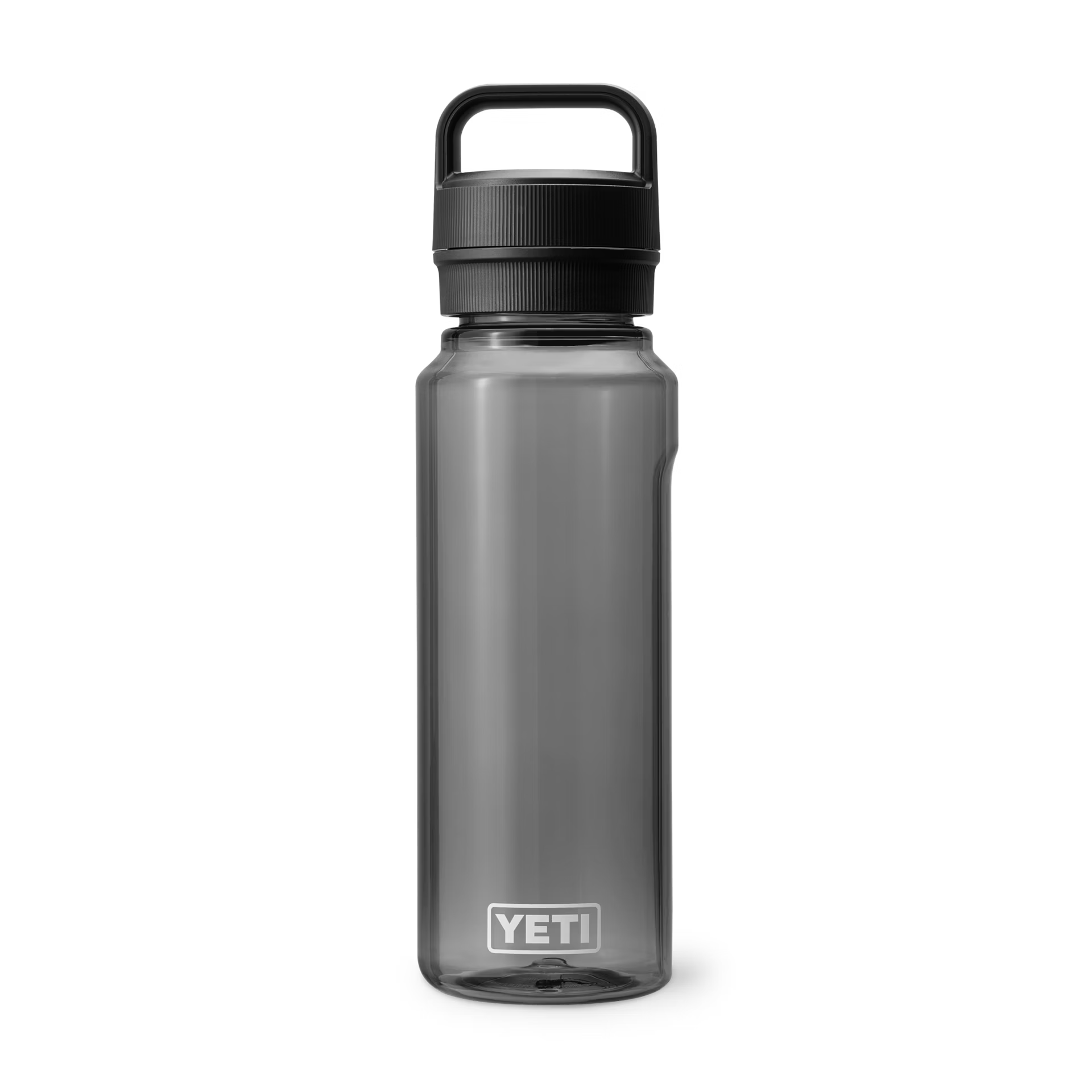
Yeti’s Yonder Bottles hit the scene last year and quickly became an angler’s best friend. The Yonder 1L is a lightweight option for staying hydrated on the water. Paired with the Screw Cap, it’s easy to open and drink from. If your angler is tired of lugging heavy insulated bottles around, consider the Yeti Yonder, and don’t forget to add a few stickers for customization.
Every angler relies on a pair of sunglasses on the water. They are a crucial tool and an investment. Protecting that investment with a Chums Retainer is a must. The Slim Silicone Retainer is a lightweight, soft, and durable retainer with adjustments. We wear them with every pair of shades, keeping our glasses from falling off our hats and into the water.
What better gift to get the fly fishing obsessed than apparel from the American Museum of Fly Fishing? The museum is responsible for preserving the history of fly fishing and supporting its future. The Logo Long Sleeve Tee is a comfortable and subtle tee with the AMFF logo placed on the chest. This is one piece of clothing we always pack in our travels to represent the fly fishing community.
Whether you’re taking a float trip down the river or going for a Friday evening wading session, the right beverage can make your day that much more enjoyable, especially if you’re not catching fish. Dale’s Pale Ale is among our favorite waterside beverages. The combination of caramel and piney hop flavors makes for a sweet, tangy, and refreshing beer. If you’re not quite sure what to get your angler, you can’t go wrong with a few beers.
Have you seen our merch line? Maybe you should take a look at it… Here at Flylords, we take fashion to the next level. Introducing the new White Cord Embroidered Hat. Take a look at our full store by clicking HERE.
If you want the ultimate in stealth, strength, and notability, look no further than the Airflo Premium Fluorocarbon Tippet. Manufactured in Japan to precise specifications, this low-visibility, 100% fluorocarbon tippet not only exhibits incredible tensile strength and superior abrasion resistance but also knots easily for consistent, reliable performance. If you or a loved one needs new tippet, be sure to check out the Airflo Premium Fluorocarbon tippet.
You can never have enough strike indicators when you’re trout fishing. Introducing the Oros Strike Indicators, this design allows a clean setup for rigging your indicator on your leader without kinking. So, if you get into rising fish, you won’t have to worry about straightening your leader, nor will you have to experience a damaged leader before rigging up dry flies. The reason why we love the Oros indicators is that you can adjust them to the appropriate water depth without fully taking them off. Simply loosen the two halves and slide them up or down your leader for the appropriate water depth. We also love these indicators because you can mix and match the different colors if there is bad glare.
The Rumpl Original Puffy Blanket is a durable, versatile, and high-performing blanket that is perfect for a wide range of outdoor activities and environments. Its puffy design, synthetic insulation, and water-repellent coating make it an excellent choice for staying warm and comfortable in cold and damp conditions, while its stylish design and snap loops make it easy to use and transport. This is a great piece to give a non-angler to keep in your car or truck for the next campfire you and your friends have after a day of fishing.
Don’t use a hunting app to go fishing… The onWater App gives you exclusive access to different fishing locations, public fishing spots, and the best part: when you don’t have service, you can download maps directly to your phone so you know exactly where you are. Are you floating? No sweat. Don’t come across a hefty rapid without proper direction; the onWater App will notify you, giving you time to prepare and read your line before entering big waves, trains, and technical rapids. The onWater App offers an annual subscription of $39.99, giving you great access to accurate and interactive fishing maps, local fly shops, real-time weather data, and all the tools you need to get out on the water. If you’re interested in the onWater App, be sure to check out our “behind the brand” article by clicking HERE.
Western wear is in style, and the Schaefer RangeTek Western Guide Shirt is a looker. Available in seven colors, these shirts blend classic styling with modern materials. Breathable and moisture-wicking, they are just at home on the water as they are in town.
Earlier this year, Umpqua released its all-new pack line. Offering three different variations, the Northfork collection of bags is available in a sling, waist, and chest pack. A Flylords favorite for when we head out on the water to wade fish, the sling pack has been an excellent bag for organizing all our needs, whether that’s tippet, leaders, large and small fly boxes, and even specific compartments for floatant and forceps. If you’re looking into a wade bag that you can trust, take a look at what Umpqua has to offer and check out our in-depth ‘First Look’ and ‘Gear Lab’ video!
Anglers love the nostalgic feel of fishing in a button-down. The Simms Big Sky Fishing Shirt delivers just that, but with the added benefits of modern technical apparel. Available in four colors, there are options for everyone. Each shirt features moisture-wicking technology, UPF 50, vented back panels, and classic western styling.
Grundens, relatively new to the fly fishing space, has released some awesome apparel, outerwear, waders, and gear for the avid angler. A Flylords fan favorite from Grundens is their Fish Finder Sandals; not to get too specific, since they are just flip-flops, but these flops have been an excellent addition for float fishing, and once you take off your waders from a day of wade fishing. Made with SeaDek, these flip-flops are comfortable and provide great support for days of finding fish.
It’s no secret that Free Fly makes the comfiest sun hoodies on the market. The Shade series is no different. Featuring a mix of bamboo and polyester, these hoodies are ultra-soft, moisture-wicking, and UPF 50 rated. Free Fly offers this hoodie in a plethora of colors–lately, we’ve been leaning towards vintage camo. Added thumbholes in the sleeves double as hand protection when the sun is high, and you need extra protection.
Marsh Wear is a fishing and lifestyle brand for salt-obsessed anglers. Available in two old-school camo patterns, we couldn’t help but add these to our wardrobe. After a summer of fishing, these shorts check all the boxes for quality fishing shorts. They are lightweight, breathable, and wick moisture like no other. Whether wade fishing, standing on the bow of the boat, or hanging out after a day on the water, these shorts do it all.
The Orvis Sun Defense UPF Hoodie provides exceptional sun protection with a UPF 50+ rating and anti-NIR yarn that reflects heat to keep you cool. Its quick-dry, moisture-wicking fabric promotes evaporative cooling and features OutSmart® Fresh odor control for multiple wears between washes. The hoodie is designed with integrated thumb loops and stretch binding around the hood to ensure secure sun protection for your hands and head. Its ultralight, breathable material and active fit make it perfect for enduring scorching, sun-filled days comfortably.
If you’ve never fished with a wading staff, it might be time to give it a try. A quality wading staff opens up access to other wade fishing spots and keeps your feet planted so you stay dry. Our favorite is the Hareline Folding Wading Staff. Its intuitive design folds up and out of the way when you don’t need it. When you do, simply pull it out and watch it unfold. The comfortable cork grip balances out the package and makes for an excellent addition to any angler’s kit.
Do you know an obsessed striped bass angler who is always looking to learn more? Then there is no better book than Fly Fishing for Trophy Striped Bass. This all-encompassing book is an extensive collection of tips, tricks, and gear needed to consistently fool large striped bass.
Riversmith’s newest line, The Convoy Collection, offers just about anything an angler may need in terms of bags. Want to know more? Check out our deep dive HERE. One of our favorite bags is the PackOut Bag. This small bag is the perfect companion for a quick fishing trip with minimal gear. You can store fly boxes, tippet spools, floatant, and more in the main compartment. Designated tool attachment points keep you organized and prepared for the day ahead. Our favorite feature is the expandable and removable trash bag, hence the name. This little bag gives you a dedicated space to store trash and leave the water cleaner than you found it.
Whistlepig has a knack for making exceptional whiskey, and the Piggyback 100% Rye Whiskey is no exception. Notes of cinnamon, peppercorn, tangerine, and grapefruit make this a well-balanced Rye bursting with flavor. Mix it in cocktails or serve it on the rocks for a bold flavor worthy of any whiskey lover. What better way to wind down after a long day on the water?
Is your furry friend always by your side? Then, a Gunner Dog Bowl may be the perfect gift. This bowl is overbuilt and over-engineered for days on the water. The Punchseal™ lid makes an airtight seal, keeping food or water in place even when upside down. Best of all, each dog bowl can be personalized with the name of your dog. Next time you’re on the water, be prepared with the Gunner Dog Bowl. And if you want to know the best fly fishing dog breeds, we’ve got you covered.
The Wrangler Kit is your ultimate partner for fly fishing adventures, whether you’re targeting local trout, backyard pan fish, or wild Alaskan salmon. This versatile kit comes in six sizes—Pond (4wt), Trout (5wt), Trout XL (6wt), Bass (7wt), Salmon (8wt), and Saltwater (8wt)—and includes a durable Crosswater reel, dacron backing, RIO Mainstream fly line, and RIO tapered leader. Each 4-piece rod offers flexibility and portability, making it easy to tackle various fishing environments. With the Wrangler Kit, you’re equipped to chase the thrill of open water freedom and achieve fly fishing success.
VSSL Gear is a Vancouver-based company whose goal is to make your time in the outdoors more enjoyable. Their newest launch, the Nest Pour Over Kit, is a modular coffee system that allows you to have a quality cup of joe wherever you are. It features two mugs, a V60 pour-over, a grinder, and a reusable mesh filter in one package. Pair it with your favorite beans and hot water for coffee on the go. As self-proclaimed coffee aficionados, this is one piece of gear we won’t leave home without.
Voormi has crafted one of the lightest, full-cover merino hoodies that isn’t your ordinary base layer or sun shirt. Made with precision-blended wool, this lightweight shirt wicks away sweat while keeping you protected from UV, wind, or that morning chill. Built-in hidden thumbholes and a buttoned, full-cover hood add extra comfort and adaptability to transform this from a fishing shirt into a fashionable exception, allowing for an all-day, casual, everyday shirt.
The Benchmade Intersect is part of the new Water Collection, designed specifically for anglers. It is a small fixed blade with a versatile sheath and the perfect addition for adventurous anglers. It’s paired with a CPM Magnacut blade to prevent corrosion and hold an edge better than anything we’ve used in the past. Best of all, it is made in Oregon and comes with a lifetime warranty.
Getting into fly tying? Check out this fly tying kit Loon Outdoors put together. If you’re just starting off on the vice, this is a great kit to get you tying in seconds. In this kit, you’ll find ten different tools, all you need, and more. One thing we like about this kit is that it comes in a hard case. Once you’re done twisting some flies up, put them away neatly and take them on your next adventure.
Costa’s newest frame, the Grand Catalina, is actually a redesign of the original Grand Cats worn by fly fishing legends Stu Apte, Flip Pallot, and more. These stylish and technical glasses come with removable side shields, added ventilation, and sweat drain grooves to maximize performance. Our favorite lens, the Gold Mirror, is just as at home on a small trout stream as it is on the tarpon flats.
Dry fly fishing for selective risers on technical rivers, spring creeks, and stillwaters requires a specialized rod, tuned for sophisticated trout. Your tool of choice demands a smooth-loading action capable of delivering precise casts with ninja stealth, while maintaining enough authority to turn over long leaders in the wind, mend with total control, and produce positive hooksets at distance. The new St. Croix Technica series answers the call of PhD-level trout fishing. With lengths and line sizes dialed for hunting heads everywhere from wide, windswept rivers to intimate limestones, Technica is a must-have stick for the trickiest of trout fishing situations.
If your angler loves to tie flies, chances are they’ve dreamed of a Dyna-King Vise. Known for making the best American-made tying vises, these are truly a generational gift. The Barracuda Deluxe features full rotary capabilities, a bobbin holder, six adjustment points, and can hold hooks from size 32 to 8/0. This is one gift you can be sure your angler will be thrilled to open.
Hardy is synonymous with fly fishing, and the Marquis is a timeless classic. It is part of Hardy’s Heritage line of reels–revamping classics into functional works of art. With updated styling, improved drag, and additional porting, this reel looks like the original, with modern features anglers expect in their reels. Retro is in style, and the Marquis is the perfect way to pay homage to fly fishing’s roots.
The Turtlebox Audio Gen 2 Speaker is a high-performance, portable speaker designed for outdoor use. The speaker is housed in a durable, waterproof case that can withstand exposure to water, dust, and extreme temperatures. Additionally, the speaker is shock-resistant and can withstand impacts and drops. The Turtlebox Audio Gen 2 Speaker is also designed to deliver powerful, high-quality sound. Not only does the speaker have great sound, but the battery life is incredible. This speaker is fully rechargeable and provides up to 50 hours of continuous playback time, so users can enjoy music all day without worrying about running out of power. We love this speaker for evening campfires, enjoying tunes floating down the river (quietly), and for its durability.
The Ross Animas is a go-to at Flylords. Its blend of styling and functionality is simply too good to pass up. It is available in sizes ranging from 4 to 8-weight and three colors. Our personal favorite is the Matte Olive.
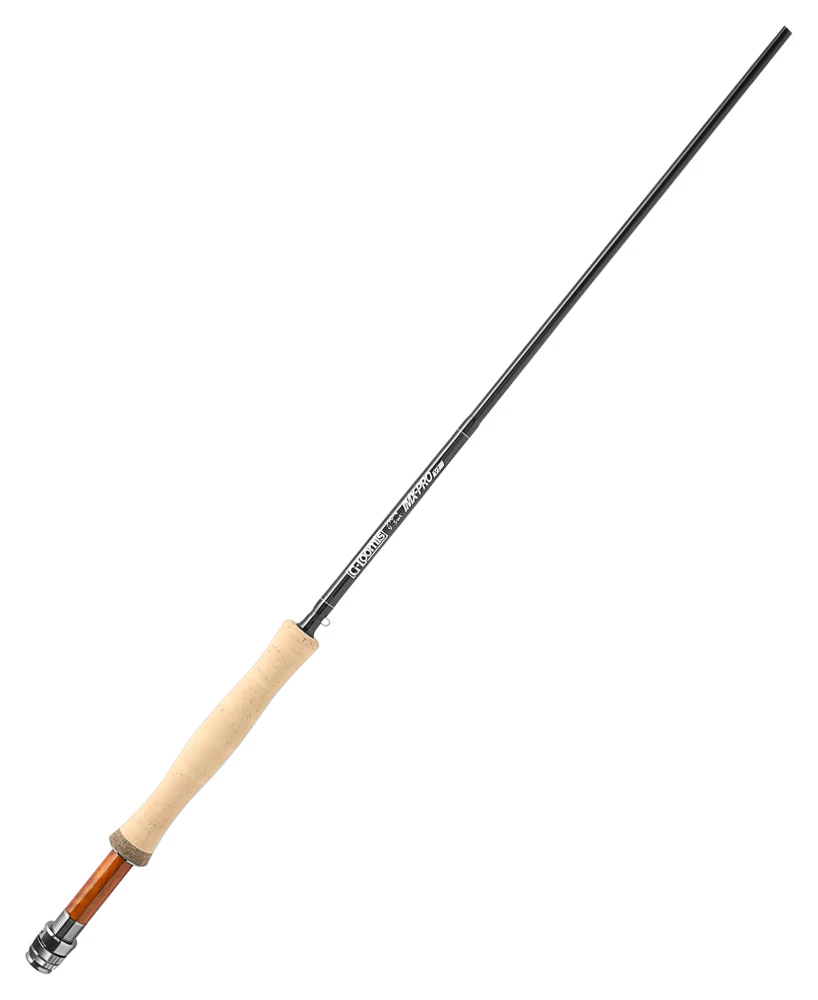
Gloomis has a reputation for building some of the most technically advanced rods. This stems from Gary Loomis, the legendary rod designer who started it all. The IMX-Pro V2 is the middle price point rod from Gloomis. But, make no mistake, this rod’s performance and quality components translate to any fishery. We have fished both the 9ft 5-wt and 9ft 8-wt from everything from trout to redfish. The rods are accurate, lightweight, and powerful, delivering flies on demand. For an exceptional rod at a budget-friendly price, look no further than the IMX V2.
While relatively new to US markets, Guideline has a cult-like following in Canada and beyond, especially amongst Spey anglers. They build premium rods, and reels are designed to tame big water and powerful fish. The ULS 2.0 Switch is available in 5 to 8-wt configurations for everything from trout to steelhead. It’s an easy rod to learn the art of spey casting, delivering consistent and crisp casts. Whether new to spey fishing or a seasoned veteran, the Guideline ULS 2.0 Switch will serve you well.
Are you looking to spice up your jewelry box or want to give someone a thoughtful, handmade gift? Sight Line Provisions offers a lot of different pieces to keep you in fashion. One of our favorites here at Flylords is the Sight Line Provisions bracelets. In this model, we introduce the Sight Line Provisions Dry Fly to you. This piece is made from the best quality leather and stainless steel. One thing we love about Sight Line Provisions is the attention to detail. Each product is thoughtfully made and comes out looking great. This is always a crowd favorite in our fly fishing gift guide.
Add to your fly tying room, or give Amanda Willshire a ring with one of her custom fish or logo sculptures. These jaw-dropping displays are completely custom-made out of steel and are made in the Front Range of Colorado. Whether you just caught your best brown trout or returned from the flats and caught a grand slam, be sure to share your story with Amanda; she can create something special for you! Check out our ‘Artist Spotlight’ with Amanda HERE!
One reel to rule them all. Hit the water with an all-new, customized Rove reel from Abel Reels. Abel enables any of their reels to be customized with a hand-painted finish that can be modified to incorporate over 89 different designs! Show someone you truly know them with the unique gift that will distinguish them from anyone on the water. The Abel Rove Reel is available in light 4-6 weight models and up to 12+ weight models for the saltwater angler.
Not all gifts have to come in boxes with ribbons. If you’re struggling to find the right gift for the guy who has it all, consider giving the gift of giving back. With over 300,000 members across the country, Trout Unlimited is a non-profit organization responsible for preserving some of the most important trout waters in the US. Coming in at only $35, this is one of the most affordable gifts you can give, but one of the most meaningful.
Still can’t decide what to get the angler in your life? With the complexity of the fly-fishing market, we can’t blame you. Instead of losing sleep over it, just Google your local fly shop’s website and look for a gift card option. This will save you the hassle of pondering over our fly fishing gift guide, and be sure they hit the water prepared. Check out Blue Quill Angler for all your guide trips, fly tying materials, or just for a simple dozen flies.
Final Thoughts:
Our Ultimate Fly Fishing Gift Guide is designed to take the guesswork out of gift giving. Whether it’s a holiday, birthday, or just a gift for someone you love, this guide will set you up for success. Remember, it’s not about giving the most expensive gift, but rather a gift that is meaningful to your angler.
An aptly-named “snow drought” has much of the Western United States in its grasp, threatening water supplies in reservoirs, and flows in many of the country’s favorite trout rivers.
A quick glance at the National Weather and Climate Center’s snow-water equivalent map paints a stark picture. While some basins in Idaho, Montana, and Wyoming are above normal, much of Utah, Colorado, and almost all of Oregon are in dire straits.
To compound matters, the current snow-water equivalent map is a bit misleading. While high-elevation basins in Montana, in particular, are near or slightly above normal, lower elevation areas are almost completely devoid of snow. That trend is playing out across much of the West.
Snow in the mountains, but none in the valleys, sounds to many like an ideal winter. But it poses significant risks to the spring water collection season, threatening both reservoir supplies, and river flows. With warmer temperatures, and no snow in mid-to-low elevations, when runoff arrives, more water could end up soaking into the ground instead of making its way into streams and reservoirs.
This could lead to warmer streams and rivers earlier in the year, prompting hoot-owl closures in Montana, and perhaps similar restrictions in other Western states.
It appears that some officials are cautiously optimistic, despite the odd winter conditions. Florence Miller, a Natural Resources Conservation Service hydrologist, said in a press release specifically addressing Montana’s snowpack, that “summer streamflow will depend on how the rest of the winter and spring unfold. For now, the snowpack in the mountains is on track, despite the unseasonable absence of snow in the valleys.”
The snow drought is more pronounced in Colorado and Utah, where many ski resorts have delayed opening, or have only limited terrain available. It’s also prominent in the Pacific Northwest, where they’ve received ample precipitation, but most of it coming as rain instead of snow. Without a thick, healthy snowpack, many rivers throughout Oregon and Washington could face low, warm flows throughout the year, hampering the survival of both steelhead and salmon.
Those same rainstorms also destroyed some of the snowpack in the Pacific Northwest, causing it to melt early. This led to catastrophic flooding near the town of Libby, Montana, and elsewhere a few weeks ago.
Without some good late winter and early spring snow, the Western US could face one of the worst fishing seasons in memory.
The Boundary Waters Canoe Area Wilderness, located in Northeast Minnesota, is a national treasure but is once again threatened by Congressional action to permit industrial mining activities. At one million acres with over one thousand lakes and a thousand miles of canoe routes, the Boundary Waters provides incredible outdoor recreation opportunities for thousands of Americans. In 1978, Congress approved protections for this region, formally preserving the Boundary Waters pristine habitats and placing restrictions on industrial activities. Today, the US Congress is working to allow industrial copper mining adjacent to the essentially untouched wilderness to industrial mining activities.
The looming withdrawal of protections for the Boundary Waters came through a Congressional Review Act resolution promoted by a Republican from Minnesota, Representative Pete Stauber. The House of Representatives approved the measure 214-208, largely along party lines. This Resolution now heads to the Senate, where outcomes are less clear. The Senate’s 60-vote threshold remains a major threshold for any piece of legislation, and last summer the Senate rejected a public lands sell-off effort after intense public criticism.
“Hunters and anglers are uniquely positioned to help determine what happens next—not just for the Boundary Waters, but for the future of conservation in America. We know the value of public lands, public access, and the outdoor economy. Now is the time for Congress to prove that commitment in a meaningful way. Wrote BHA President and CEO, Ryan Callahan and MeatEater’s Steve Rinella.
“We urge all Members of Congress—including Montana’s delegation—to oppose HJR 140 and its wrongheaded goal of dismantling Boundary Waters protections.Some places are worth fighting for. And just like Theodore Roosevelt and the conservation-minded leaders who came after him, we believe the Boundary Waters is one of them.”
Sign this BHA Action Alert to stand up for the Boundary Waters and keeping our remaining wild public lands wild.
If you’re anything like me, boats probably take up more headspace than you’d care to admit—not just how they look and run, but how they fish. This past year, the possibilities for dialing in a boat became a reality when I purchased my first technical fishing skiff, a Delta Boatworks Delta 18.
In this article, I’ll break down how I configured my skiff into a true shallow-water workhorse. It poles quietly in inches of water and still has the range and backbone to make long runs across choppy bays, giving me access to the full spectrum of fisheries in my area. There’s no such thing as a do-it-all boat, but this rig comes pretty damn close.
The hardest part about any skiff build is finding the right boat. I looked long and hard before finally pulling the trigger. After months of digging through forums, making phone calls, combing the internet, and lining up sea trials, it became clear the Delta 18 was the skiff for me.
The Delta 18 (built by Delta Boatworks, a subsidiary of Xplor Boatworks) is a purpose-built poling skiff with thoughtful details throughout. It measures 18′4″ with an 84″ beam, a 2° deadrise, and drafts around 5″—a true skinny-water craft. The hull is infused VE/glass and fully cored, with 316-stainless hardware and reinforced engine-mount plates for long-term durability. It’s offered in both tiller and center-console configurations and is rated for a 50–75hp outboard. I went with the center console paired with a 75hp Suzuki, which gives the boat a quick hole shot (even with extra anglers onboard) and an honest 40 mph on the top end.
Putting along to the next spot.
A big part of the Delta 18’s fishability comes from its wide gunwales, which open up the deck without adding unnecessary bulk to the hull. There’s plenty of room to move, cast, and change angles without feeling crowded. I chose the green/tan colorway so the skiff can pull double duty during duck season, though all the color options look sharp. It’s a clean, capable skiff built for folks who actually use their boats, and I’m confident it’ll be my flats skiff for life.
I went with a Humminbird XPLORE unit, and I’m very glad I did. The side imaging is the star of the show—MEGA Side Imaging+ delivers crystal-clear, high-resolution detail way out to the sides. My confidence in picking apart structure and locating bait or schools of fish in deeper water has skyrocketed. The down imaging is equally as sharp, and the dual-spectrum CHIRP gives me reliable 2D sonar when I need it. I opted for the 9″ screen, though it’s also offered in 10″ and 12″ options.
In-dash flush mounted Humminbird Xplore 9 unit.
I loaded the unit with a CoastMaster chart card, which has been huge for navigating the bays, flats, tidal rivers, and creeks that define Chesapeake Country. To keep things clean, I flush-mounted the XPLORE into my dash—one less thing for fly line to tangle around on windy days. I also mounted a Humminbird GPS heading sensor on top of the console for accurate heading data and better positioning. If you go the flush-mount route, I highly recommend doing the same.
Another big advantage: the XPLORE supports the One-Boat Network, allowing it to communicate with a Minn Kota trolling motor to share waypoints, sonar, and mapping data. You can also run a NMEA 2000 cable from your outboard to display engine data right on the unit. This level of integration keeps the rig clean and simple but still gives you all the features modern anglers have come to rely on.
The scariest hole I’ve ever cut.Humminbird GPS Heading Sensor mounted on top of the console.
If you spend time on the Chesapeake, you’ll notice most boats share one thing in common: a Minn Kota mounted on the bow. They’re everywhere for a reason—they work. After putting mine through the wringer in saltwater, I can vouch. The composite shaft is guaranteed for life, the lower unit is heavily corrosion-resistant, and the GPS features (Spot-Lock, AutoPilot, Jog) make boat control nearly effortless. I’m running the 54″ shaft with 80-lb thrust, which is perfect for my skiff.
Bow-mounted Minn Kota Riptide Terrova and plug/receptacle.
The wireless remote is intuitive, but if you forget it—which I’ve done—the One-Boat Network app turns your phone into a fully-functional impromptu remote. That alone has saved more than a few outings.
Even when the trolling motor is not deployed, the bow is still very open.
Of course, there are days when a trolling motor isn’t needed—a quick run to a waterfront bar, a lazy sandbar hang, or a laid-back cruise where fishing isn’t part of the plan. That’s why I installed a quick-release bracket along with a plug & receptacle. It gives me the option to pull the motor off in seconds and leave it at home. If I know I won’t be fishing for a week or more, I’ll remove the motor and store it in the shed to keep it out of the elements (and to help my boat cover fit properly). The Minn Kota Terrova has become an integral part of my success on the water and a tool I’d hate to go without.
Thick HDPE walls, AnchorPoint tie-downs, non-slip base
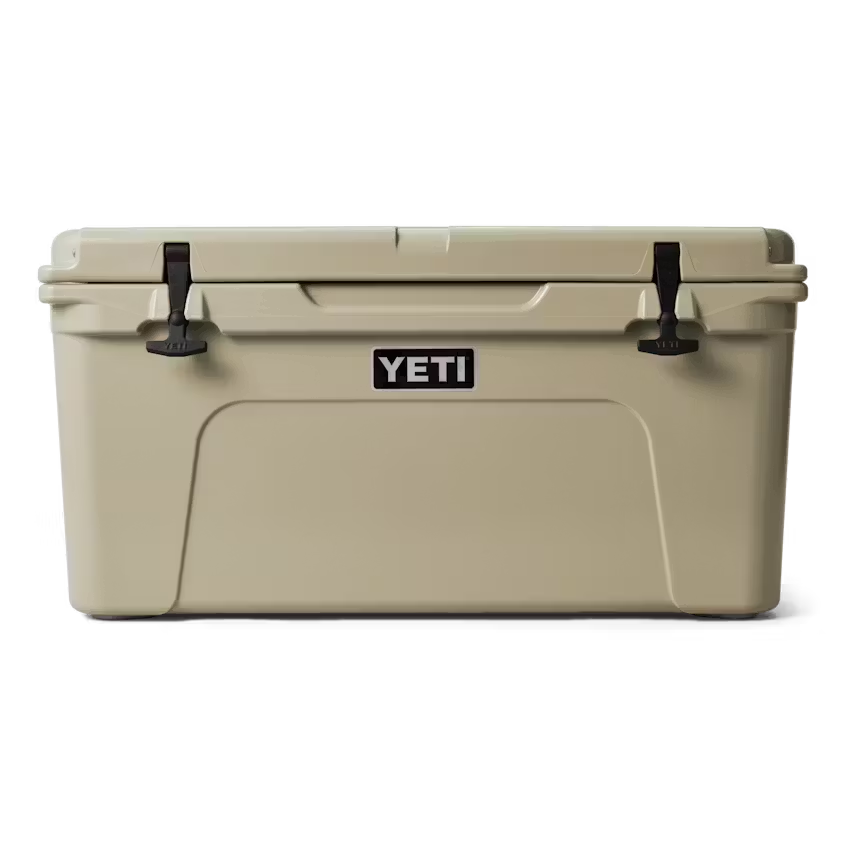
YETI likes to say their gear is built for the wild, and after more than a decade of heavy use, I can confirm—it is. I run a YETI Tundra 65 in front of my console, which doubles as a cooler and a seat. A lot of Delta 18 owners prefer the Tundra 45 (and I’ve run that setup too), but as long as you turn the 65 sideways, it fits perfectly. Both sizes work well on this boat.
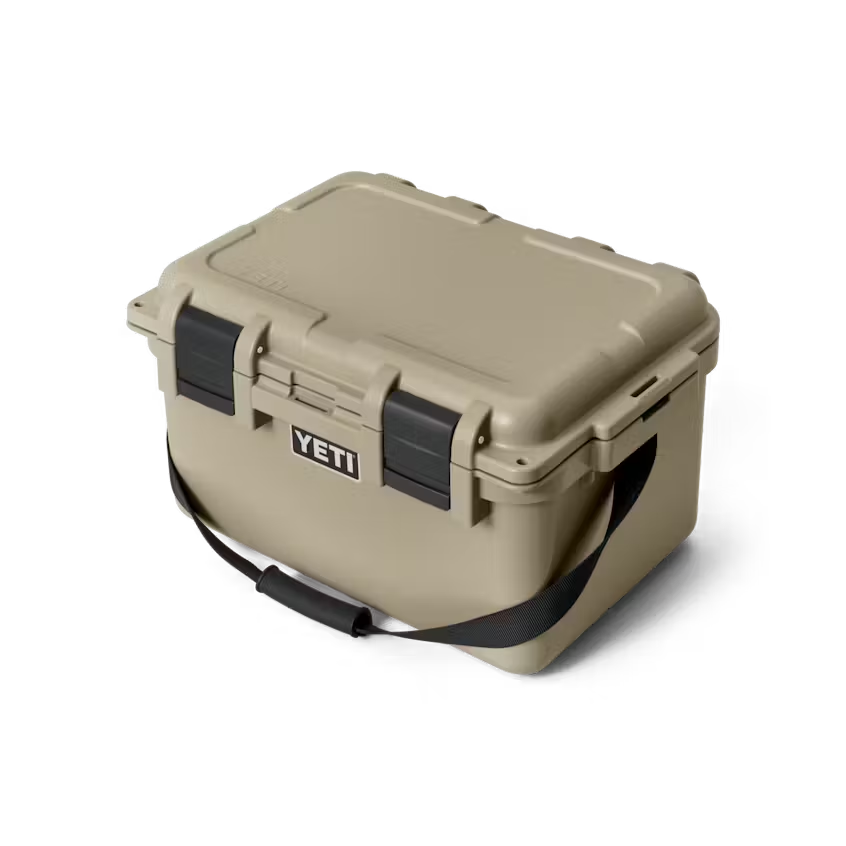
Under the bench, I stash two YETI GoBox 30s—one for tackle and one for camera gear. They slide in clean, stay bone-dry, and don’t eat up deck space.
Two Yeti GoBox 30s under the bench seat.
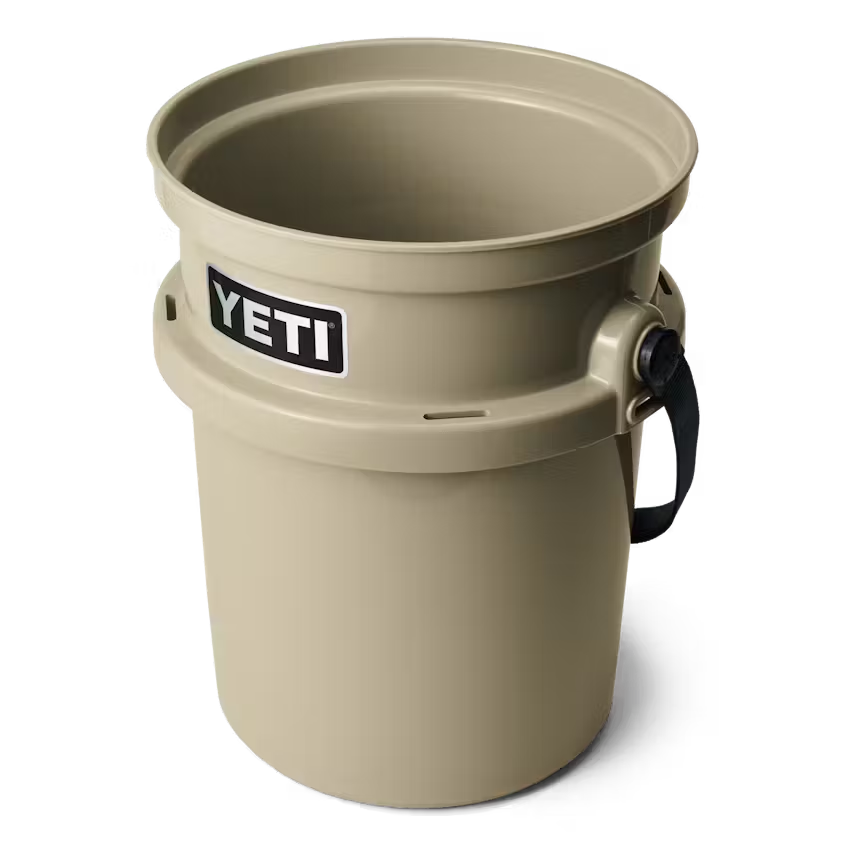
On the poling-platform ladder, Delta Boatworks welds a dedicated bucket holder. I drop a YETI LoadOut Bucket in there with an elastic mesh trash-can lid, which turns it into the perfect storage solution for trash, a small stern anchor, wet gear, or live bait (if you’re into that sort of thing). Every piece serves a purpose and fits seamlessly into the boat’s layout.
Having a dedicated boat bucket has come in clutch time and time again.
I wanted music on the skiff, but had zero interest in drilling holes in a brand-new boat for speakers that would almost certainly corrode, crack, or short-circuit given enough time. The TurtleBox Original (Gen 3) solved that conundrum instantly. It’s a portable, bombproof speaker that cranks—loud enough to cut through wind, open water, and engine noise—without needing a permanent install.
TurtleBox keeps the vibes up even when the fishing is slow.
The build quality is exactly what you’d expect from something designed for hunters, anglers, and guides. It’s fully waterproof, dustproof, shockproof, and even floats if it goes overboard. The sound stays crisp at high volumes, the battery lasts all day, and the long-range Bluetooth connection is rock-solid (I say that as someone who is highly critical of Bluetooth). I went with the tan model because it matches my deck paint perfectly, but they offer four other base colors plus rotating limited-edition runs, so no doubt, you’ll be able to find something that complements your rig. It’s one of those pieces of gear that just makes sense on a skiff.
I run two Abyss lithium batteries, and they’ve completely changed my onboard power setup. In the console, I’ve got a 12V 120Ah Dual-Purpose battery that cranks the engine and powers my lights, bilge pump, and Humminbird. Up front, in the bow hatch, I run a 24V 100Ah battery for the Terrova. Dedicated lithium for each system gives me far more runtime and shaves serious weight.
That’s all well and good, but it’s the tech under the hood that really sold me. Both batteries use a Bluetooth Battery Management System (BMS) so I can check charge level, temperature, and overall health right from my phone—which gives me peace of mind out on the water and before ever leaving the ramp. Abyss also engineers their cells with a strong internal structure to resist vibration and impacts, which is ideal for boat use. The 12V model is rated IP67, the 24V is IP65, and both are designed to handle thousands of cycles, which means outstanding long-term value, especially when compared to lead-acids.
Abyss Battery: 24V 100Ah trolling motor lithium ion.
Wiring the trolling motor & mounting the battery.
Notable Mentions
MHX 23′ Carbon Push Pole: My go-to for poling. Ultra-light 100% carbon with a replaceable stainless tip. Available in 19’, 21’, and 23′ lengths.
V-Marine Push Pole Holders: Low-profile and secure. Several mount options are available (permanent, quick-detach, locking plate). I use the quick-detach version to free deck space when not needed.
V-Marine push pole holders mounted on the starboard gunwale.
V-Marine Push Pole Caddy: Simple caddy that swivels to temporarily stow the push pole while on the platform. Comes in super handy when taking a cast yourself or hopping down to land someone else’s fish.
Carbon Marine LineLair²: Fly-line management mat that floats, won’t UV-degrade, and comes with adjustable spikes so your line stays at your feet, not blown all over the boat. Diameter ~21″ and weighs ~2.5lbs.
Benchmade Fishcrafter Fillet Knife: My fillet knife for the boat: thin, sharp Magnacut blade available in 7″ and 9″ lengths — great edge retention and corrosion resistance for saltwater work.
Hoss Straps: Strong, quick-release straps I use to secure the TurtleBox and miscellaneous gear.
Stern Saver / Transducer Puck Mount: Low-profile puck mounted to the stern (instead of screwing into the hull) that I used to attach the transducer. Keeps the hull clean and avoids additional holes while giving a solid mounting point.
Final Thoughts
Building out a skiff is a lot like building out a good kitchen or tackle bag—the tools you choose shape the experience, not just the outcome. Every piece of gear on my Delta 18 was chosen because it solves a real problem and adds capability without clutter. When you spend enough time poling flats, crossing open bays, dodging weather, and fishing dawn to dark, you learn quickly what matters and what doesn’t.
What I ended up with is a flats skiff that feels like an extension of how I fish: quiet, efficient, and tuned to my home waters. From the power system to the electronics to the little accessories that make life easier, this boat is the product of trial, error, and a whole lot of time on the water. There’s no such thing as a perfect skiff, but this one checks the boxes that matter most to me. That’s the point after all—to build a platform that helps you focus less on the boat and more on the fish.
Until next time, good luck out there!
Article by Flylords Food Editor Kirk Marks, an angler, photographer, and culinary aficionado based in Kent Island, Maryland. Give him a follow at @kirkymarks.