
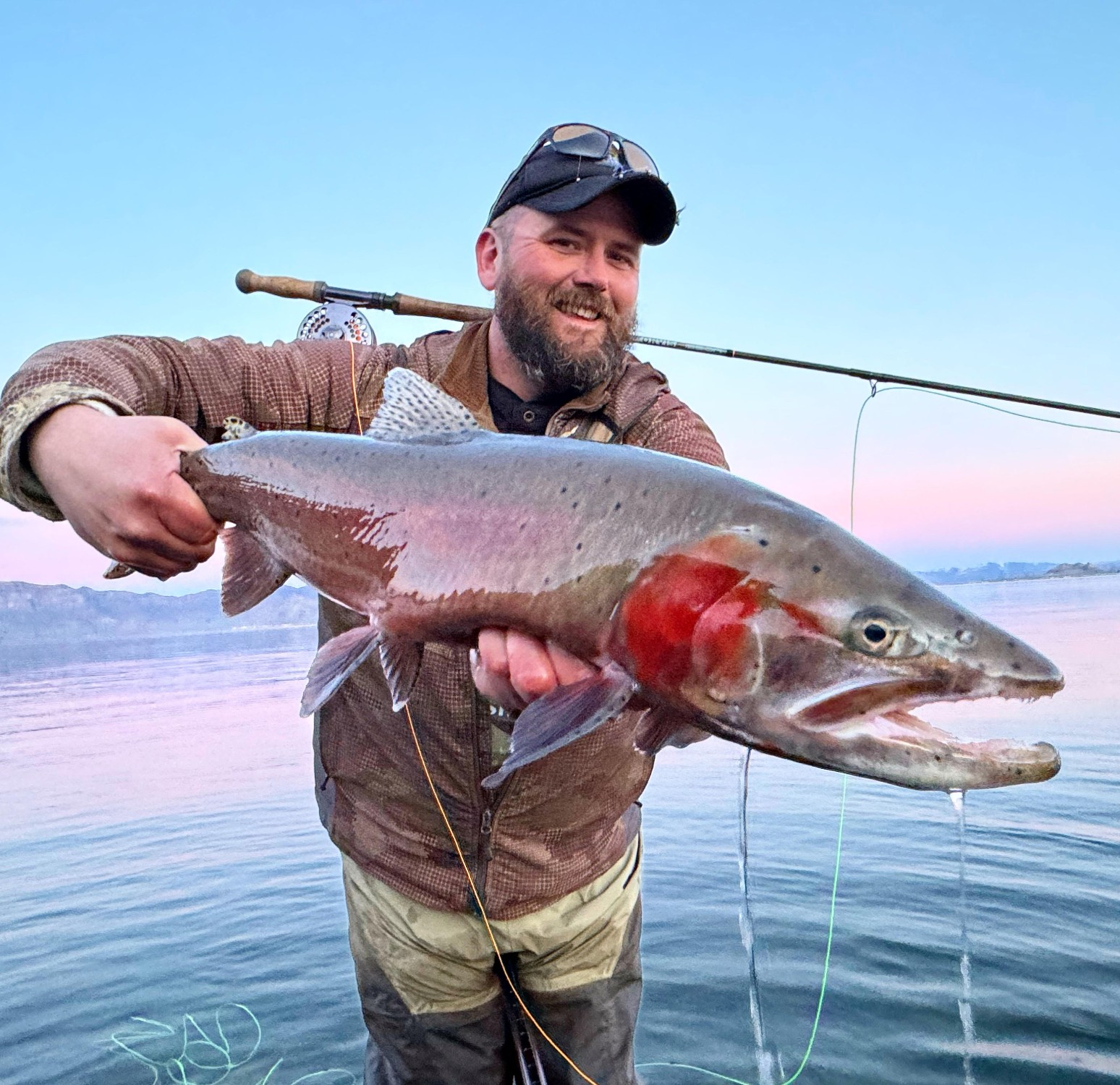

I have a pretty serious mouse problem. Now I don’t mean that they’re infesting my house, building nests in my backyard, or chewing up the wiring in my truck (at least not entirely). No, my real mouse problem is that I can’t stop fishing for trout with mouse flies.
While I enjoy watching trout sip dry flies or feeling the hard tug on the end of my streamer, I truly believe that having a big trout come rocketing up to explode on your mouse fly is the ultimate fly fishing thrill. To witness a creature as delicate and beautiful as a trout become a complete predator by mauling a mouse like a shark on a seal just crosses the wires in your brain so that you want to see it again. So, whether you’re a new mouse-curious angler or a complete mouse junkie, here are five ways to make sure you get your rodent fix every time you’re on the water.
Micky On Ice
Skating mice across the surface of the water is one of the most thrilling and underutilized ways to get a trout to eat a mouse. It’s done by casting a mouse fly at a 45-degree angle down and across the stream and then tightening the line and swinging it across the surface of the water, so it creates a wake. Not only does this method create explosive, violent strikes from trout, but it’s also done on a completely tight line so that you’re instantly yanked right into the center of the action.

Generally, it’s best to skate mice at dusk in long, flat runs or at the shallow tailouts of deeper pools. These are the areas where trout will stage up, and in the low light of sunset, they’ll be more reactive to sudden disturbances on the surface. You can also have luck skating mice through shallower, fast-moving riffles where trout will strike first and ask questions later.
Mouse patterns for skating should be almost flat with a turned-up head to prevent them from diving beneath the surface once they’re under tension. My favorites include the Moorish Mouse and the Mr. Hanky, as well as skating flies designed for salmon and steelhead such as the Klamath Skater and Ska-Opper.
The Speedy Gonzales
Most mouse enthusiasts strip mice with the same rhythmic pattern. They’ll make a couple of long strips followed by short pauses designed to entice hungry trout to the surface. While this method can be effective, there are certain times and conditions where you’ll have more luck stripping your mouse as fast as you possibly can.

When you’re fishing in deep water or casting into thick cover where a lot of underwater timber, log jams, and boulders create a lot of swirling water, speed catches fish. Trout in these areas can be hard to pull away from cover unless you trigger them to react, and few things do that better than a fast-moving mouse. Instead of long strips and pauses, make short, fast strips that move your mouse quickly and continuously across the surface of the water, and it’s almost guaranteed you’ll get a reaction.
My favorite patterns for speed fishing are mouse patterns with a fatter head, which will push water and create splashes that will draw attention from the trout. Some of the best include the Two Footer, Mouse Rat, and Nervous Neda, which, when stripped fast, will all trigger trout to chase them down like a grizzly going after a fleeing hiker.
Fievel Goes Western
Traditional Western-style trout fishing usually entails floating down the middle of the river and casting and drifting flies along the banks. Most anglers know that this is a fantastic way to fish hoppers and other terrestrials, as well as large stoneflies. However, few anglers realize that it is also a great way to fish mice.

Like every other animal roaming the land, mice need water to survive, and when they move down to drink, they’ll often fall into the river. This happens most often around riverbanks with heavy current and a lot of growing wheat, cattails, and other grasses, which also provide mice with food. As the rodents crawl out onto the stems over the river to feed, they lose their grip and splash into the river.
The trick to fishing these spots with mice is to add a bit of English to your presentation. Mice don’t freeze like a hopper when they fall into the water but struggle for a few seconds before swimming off downstream. To imitate this, splash your mouse down as close to the bank as you can and then add a small downstream mend which will tow the mouse downstream. To make it look more alive, raise and wiggle the rod tip as the fly drifts so that it wiggles like a drowning mouse trying to get back to shore.
An Afternoon Minnie
Most mouse anglers only fish mice during dawn, dusk, or at night when trout are more active. However, under the right conditions and with the right patterns, you can get trout to inhale mice during the middle of the day. It’s a great way to catch active trout when you can’t quite match the hatch, as the fish will rarely pass up a chance for some serious protein.

The trick to fishing mice in the afternoon is to wait for a cold, gray, rainy day or during higher, off-colored water. Under both conditions, trout are more energetic and willing to take on a larger meal. For the most part, you want to target areas along deep drop-offs or foamy edges where big trout will often lock down and hold up while they wait for food. Splash your mouse down and then give it a few jerks and pauses, and it usually won’t take long for a trout to smash it.
Smaller, more discreet mouse patterns work better during daytime mouse sessions. My favorites include the Master Splinter, Minnie Mouse, and Midnight Express. All these patterns have thinner profiles and create the kind of discreet yet crude action that drives daytime trout wild.
Playing Cat and Mouse
My hands-down, absolute favorite way to fish mouse flies is by sight fishing. It gives you a chance to see the entire process of the trout spotting and stalking a mouse before suddenly moving in for the kill. However, it’s a method that can only be done in the right places under the right conditions.
To sight fish with mice, you need clear water where you can easily see the fish, ideally in a place with a lot of trout. My favorite areas are where high water conditions have flooded a rocky shoreline and shallow, slow-flowing riverbanks early in the morning before the wind picks up. It’s also an effective method for shallow lakes and ponds.
Once you spot a couple of trout circling around, it’s important to lead them as far as you can. Don’t cast the mouse right at the trout, but cast it where the fish is going to be by dropping the fly 5 to 10 feet in front of it. Allow the ripples to disappear, and then once the trout approaches within a few feet, begin to slowly strip the fly across the surface of the water. You’ll be surprised at how many fish go from meandering to deadly mouse-seeking-missiles as soon as they spot your swimming fly.
A Better Mouse Trap
Part of the appeal of mousing is the addiction. It’s a style of angling that appeals to anglers who like to make something happen. Once you do it enough, you’ll eventually crave seeing trout explode on the surface and will continue to go out onto the water every day and every night to get your fix. The thrill of mousing lies comes from interacting with trout on a raw and predatory level that is absolutely guaranteed to have you coming back for more.