
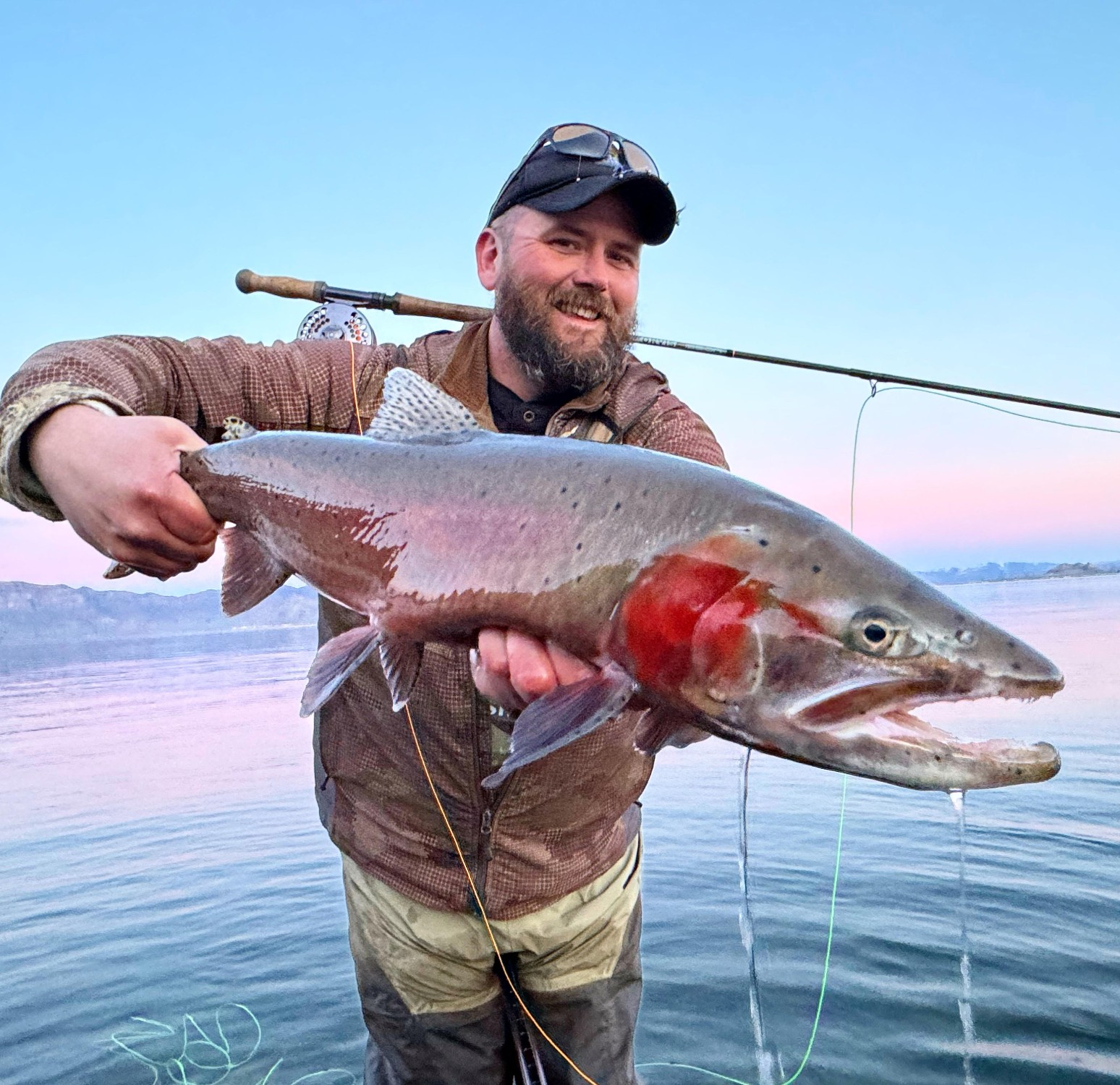

When you’re used to fly fishing in the bubbling riffles, foam-covered pools, and easy-to-see buckets and pockets of small streams, going to fish a big river can feel intimidating. Like a barren desert made of water, all the obvious flow changes and fishy-looking structure you see on smaller streams and creeks are missing from large waterways, replaced with a seemingly endless swirl of flowing nothingness.
Many anglers will fish big rivers by casting flies aimlessly into the depths with their fingers crossed or by concentrating their efforts around smaller, off-shoot tributaries. Yet if you’re only fishing large rivers this way, you’re missing out on some of the best opportunities and possibly some of the biggest trout of your life. So, if you’re intimidated by big rivers, here are a few ways to make them more manageable.
Breaking Them Down
Part of what makes large rivers so difficult to fish is that there’s a hell of a lot of water to cover. Every stretch seems like it’s full of potential, and if you’re not careful, you’ll bite off a lot more than you can chew. Trying to fish too much water at one time is one of the biggest reasons that fly anglers don’t have a lot of luck on larger rivers, so before you head out onto the big water, you’ll want to break it down on a map.

Start out any big river fishing adventure by looking at a map. Try to find either a bathymetric map or an in-depth mapping app on your phone that gives details about river depth, flow rates, and river channels. At the very least, give the section you’re planning to fish a good once-over on Google Earth, which will show you some of the different shallow and deep spots and help you locate structures that will hold fish.
Maps and mapping apps will also help you figure out where to find both wadable and floatable sections of river as well as any easy-to-access spots. Once you’ve found a few likely places, try to pick out a few fishy-looking areas that are close enough to one another so that you’ll be able to quickly change spots on foot or float through them all from a boat without having to waste a lot of travel time.
Fish With The Right Techniques
As previously mentioned, covering water is the name of the game on big rivers, so you’ll want to choose your fishing technique accordingly. Unless you’re planning on camping out and hitting the same spot day after day, small water strategies like Euro Nymphing and bow and arrow casting in small pockets should be thrown out the window. Instead, replace small water tactics with techniques that will present your flies to large chunks of water at once.
Fishing with streamers is one of my favorite ways to find trout on large rivers. Whether you’re swinging or stripping, there’s no better way to at least get a reaction from trout in big water than running baitfish patterns like a Clouser Minnow or Deceiver, or even just a simple Wooly Bugger, right past their noses. Whenever I’m fishing on a big river I’ve never been on before, I’ll either walk the banks or row my way down different sections in a boat, working a streamer the entire way until I begin to consistently find trout that will either eat or at least roll on or chase my fly. Once I’m locked on to a good concentration of fish that seem like they’re willing to play, I’ll finally slow down and start working over the area with other techniques.

If streamers aren’t your cup of tea, you can do the same type of water coverage with dry flies and nymphs as well. If you’re using dry flies, try to use a larger attractor pattern such as a Stimulator or a Water Walker, which look like a variety of different insects. If you’re using nymphs, fish a two-fly setup beneath an indicator with a larger beadhead nymph such as a Prince Nymph, Zug Bug, or even a San Juan Worm as your lead fly with a smaller Pheasant Tail or Hare’s Ear as a dropper.
Cast your flies systematically so that you can thoroughly work every section of water within reach. Starting with a five to ten foot cast and drift and then pull out one to two feet of line and cast and drift again. Once you’ve reached the end of your casting limit, reel up and then walk or float twenty to fifty yards downstream and start your casting and drifting sequence again.
Fishing Bends, Edges, and Structure
If systematically covering all the water within your reach isn’t working out for you, or if you’re limited on time, there are still a lot of places to find trout in large rivers. Though they’re less obvious than they are on small streams, there are still big water areas where trout are likely to gather to both rest and feed, making them fantastic spots to get on top of fish.
River bends are some of the most productive and important spots you can find on any large river. With the water slowing down and often deepening, bends are ideal spots for trout to feed as they gather prey like baitfish and large insects. However, not every river bend is created equal, and each one fish needs to be approached differently.

Inside bends are areas where the river makes a turn so that the main body of the river flows around it. These bends tend to have a lot of slow water, and debris like logs, brush, and other drifting vegetation will pile up there during high water. This debris can create deep water pockets by blocking the current and provides a lot of cover, making inside bends ideal spots for indicator nymphing and for fishing smaller, more hatch-accurate dry flies, as trout will gather in the slow water to feed.
Outside bends of rivers can also be extremely productive spots as the main body of the river flows directly into them. This creates a steep drop-off of faster, highly oxygenated water where hard rock bottoms, large boulders, and other sunken structures create current blocks. Outside bends are ideal spots for streamer fishing as well as for casting large, attractor-style dry flies and nymphs towards trout that are often less picky and more reactive in the faster, churning water.
Another way to find trout on large rivers is by targeting edges. Look for long straight runs where shallow water runs directly off the bank towards deep drop-offs in the main river channel. These are ideal spots for trout to hold and cruise as they hunt for prey. You can fish edges with a wide variety of techniques, including drifting nymphs or dry flies along the color changes of the drop-off or by casting and stripping streamers to and from the bank.
Finally, you can also almost never go wrong fishing big rivers around structure. Things like gravel and sandbars, bridges, and wood and rock piles will almost always gather concentrations of trout along their edges as well as in the pillows of slow water both in front and behind them.
Go Big or Go Home

Part of the fun of fishing in big rivers is the adventure. Unlike small streams and creeks, which you can rapidly become familiar with, on a big river there is a seemingly endless amount of water to explore. With new depths, new structure, and even entirely new ecosystems around every bend, you never know what a big river is going to throw at you, which in the end is all part of the fun. For so long as you don’t let big rivers intimidate you, they can reward you with a new fishing experience every day you brave the big water.