
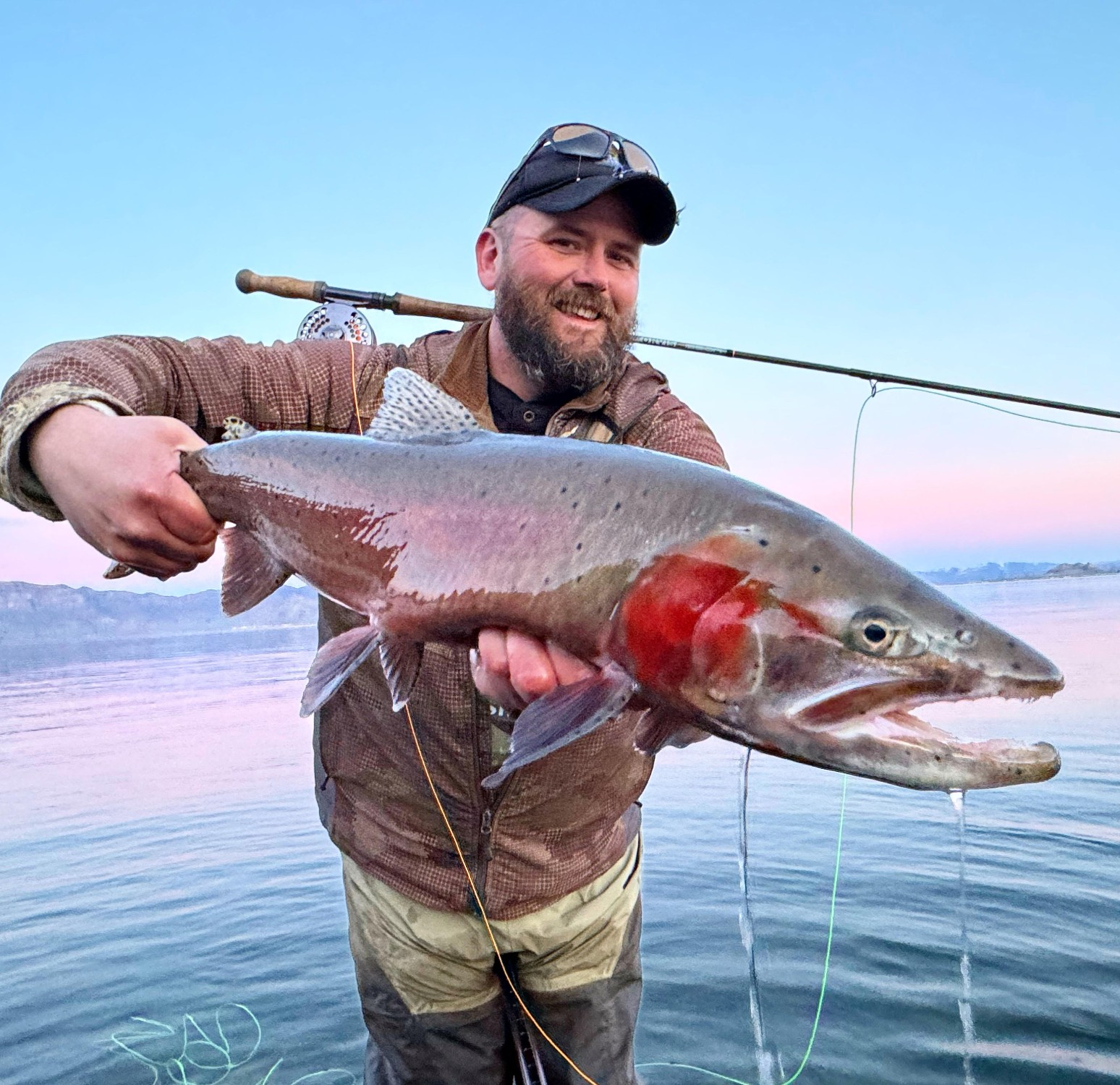

As an admitted streamer junkie, I fish with big bugs all year long. I sink streamers into deep holes during the dog days of summer, cast and rip them through big water in the fall, and even slowly work them along the bottom during the winter. Yet, when someone asks me what my favorite time of year to fish streamers is, there’s no question that it’s spring.
A lot of fly anglers dislike the gray, dirty water of the early season. Yet, when the water is high and colored up with run-off from snow melt and torrential rains, big trout are meat-hungry and hurl themselves on streamers with reckless abandon. It’s a time of year that provides both consistent action as well as some truly big fish. However, to capitalize on the spring streamer bounty, you need to fish in the right places with the right techniques and above all—use the right flies. Spring streamers need to be big and juicy-looking, while still providing the right action for the different water conditions you may encounter. So whenever and wherever I’m chasing trout in the spring, these five streamer patterns are always in my box.
Coffey’s Sparkle Minnow
Coffey’s Sparkle Minnow

The smallest streamer on the list, Coffey’s Sparkle Minnow, still packs a big punch. It’s especially effective during the earliest part of the spring, when runoff has just begun, and the water hasn’t quite shaken off winter’s chill. Trout are sluggish during this time of year and will push into extremely shallow water to look for a meal that both stands out in the slightly cloudy water and that they won’t have to work hard to catch. The Sparkle Minnow just checks all these boxes.
With a body made of Wing-n-Flash and a brightly colored marabou tail, the Sparkle Minnow is a perfect wounded/dying baitfish imitation. It has a large conehead, which makes it sink fast, and is ideal for casting into the shallow, sandy flats along bank edges where early spring trout first begin to show up. I prefer to fish it with a couple of quick strips and then long pauses that allow the fly to sink all the way to the bottom, where it can click and bounce along the rocks. This action calls in slow-moving trout and gives them plenty of time to both see the fly and decide to strike.
Mike’s Meal Ticket
Mike’s Meal Ticket

Once run-off begins in earnest and the water gets high and discolored, trout push up into the soft water right against the bank and other structure to look for big meals that are within easy reach. Catching fish during this time requires a fly with a big profile that makes an impression, so it will get a quick reaction from the fish. Nothing is better for that sort of work than Mike’s Meal Ticket.
Invented by infamous big bug tyer Mike Schmidt, this largish streamer comes with heavy dumbbell eyes, rubber legs, and a lot of flash. Yet the fly maintains a sleek and easy-to-see profile as soon as it hits the water. It’s the perfect pattern for smacking along the edges of undercut banks, pitching under bushes, and dropping into the center of big boulder gardens, log jams, and other cover where big trout hold during high water. The Meal Ticket is not a fly that you want to work and strip all the way back to the boat. Instead, splash it down and twitch it a few times, and if it doesn’t get absolutely smashed within a few seconds, move on and drop it into the next likely looking spot.
Double Deceiver
Double Deceiver

As run off begins to subside slightly so that the fish have a bit more room to move, big trout begin hunting along bank edges for baitfish and small trout that have been swept up by the current. Once this happens, start fishing streamers that can be drifted and twitched downstream to offer them an easy meal. My favorite pattern for that kind of presentation is the Double Deceiver.

Essentially a beefed-up classic Deceiver fly, the Double Deceiver is a large baitfish pattern made up of two hooks and a bucktail body with long schlappen tail feathers. The pattern is neutrally buoyant, so that it only sinks a few feet below the surface while creating a long and very realistic-looking profile and a lifelike swimming action. My favorite way to fish DD’s during the spring is to cast them a few inches off the bank and then make one or two strips so that the fly is right on the edge of the main current. Then, I’ll make a slight downstream mend and allow the fly to dead drift downstream while making the occasional twitch or jerk with my rod tip to imitate a wounded baitfish and an easy target.
CJ’s Sluggo
CJ’s Sluggo

When run-off has begun to die down and flows close to normal, the water usually remains extremely stained. In these conditions, big trout will often begin to chase and roll on streamers without actually striking them. It was the kind of thing that used to drive me crazy and almost caused me to put my streamers away and start nymphing (yuck). Yet, as luck would have it, I finally found a streamer pattern that changed these chases into hard grabs—CJ’s Sluggo.

In stained, post-heavy run-off water, big trout will chase almost anything, but really need a target they can line up on before they’ll eat, making the Sluggo the perfect weapon. Invented by Chad Johnson, who guides the fabled waters of the White River in Cotter, Arkansas, the Sluggo has an articulated body similar to a Double Deceiver, which presents an appealing and meaty profile for big hungry trout. However, the real magic of the pattern is in the fly’s head, which is made of stacked and contoured deer hair. Designed for sharp turns when it’s stripped hard and then paused, the thick head of the Sluggo causes the fly to turn sharply sideways, offering any pursuing trout the perfect broadside shot. Once I start having a lot of follows without a lot of grabs, I’ll send in the Sluggo by stripping it hard and fast off the bank and then suddenly pausing it mid-river, where it almost always gets the trout to commit.
Dolly Llama
Dolly Llama

All these streamer patterns have their place and are incredibly effective during specific conditions. However, if I had to pick a Swiss-Army style streamer pattern that will work fairly well during the spring in almost any water condition, it would be the Dolly Llama. Designed in Alaska during the late 90s to target big hungry rainbows, char, and even salmon, the Dolly Llama just screams “eat me” at big spring trout.

Tied with a heavy cone head, a shaggy rabbit zonker body, and a long strip of gaudy flash, the Dolly is a great fly for both banging against overflowing banks and for stripping through heavy run-off where trout hold in deeper pockets of slower-moving water. The rabbit strips also give the fly a very lifelike, undulating motion beneath the surface, making it ideal for swinging through the pillows of slower-moving currents that are surrounded by faster flows. While the Dolly isn’t always the most consistently effective spring streamer, I’ve found it to be dependable, as it will usually get a tug or two when nothing else seems to be working.
Spring Fever
After a long winter of slow and sluggish fishing (or hiding on your couch watching fishing videos), fishing streamers during the spring is a fantastic way to cut loose and shake off the cobwebs. The trout are usually hungry, and casting a big fly for a long length of time is the perfect way to get the blood flowing and to start your fishing season off with a bang. Plus, when you fish with the right streamers, the action can be hot enough to make you forget those beautiful, clearwater days of summer and make fishing in the dark, dirty water of spring your favorite time of year.