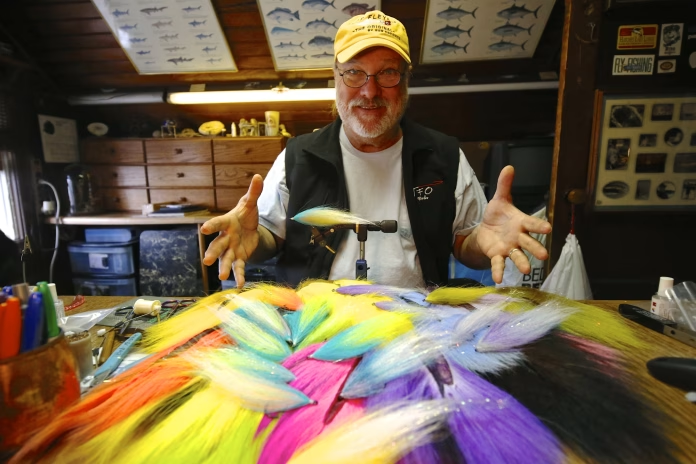
Project Healing Waters (PHW) has teamed up with the family of legendary saltwater fly tier Bob Popovics for a memorial auction. The auction’s proceeds will benefit PHW’s mission of supporting veterans through fly fishing.
The auction starts May 11 at 10am Eastern, and will close on May 16 at 10pm Eastern. All auction items are available to view online.
PHW writes that this auction is a great way to support both Popovics’ legacy, and the mission of PHW that Popovics believed in.
“Celebrate Bob’s life and legacy through this special online auction featuring his hand-tied saltwater flies and personally engraved reels, each a work of art carrying his craft and spirit forward.
“A proud U.S. Marine Corps Veteran, Bob found healing through fly tying after returning from Vietnam. In that same spirit, all proceeds will support Project Healing Waters in healing America’s Veterans through the therapeutic art of fly fishing.”
A great variety of reels and flies are for sale, and each item sold will benefit veterans who take part in fly fishing to deal with the trauma of war.
A core part of fly fishing is the different angling cultures you experience throughout the country. Whether it’s angling communities, specific techniques, or specialized gear, every region of the country has its own stories to tell. Fly Shop Tour, our original series in which we travel the country fishing with local shops, has unlocked some incredible stories and communities that we and other anglers would never know about. This year in Minnesota, on the banks of the AuSable River, we discovered an incredible piece of fly-fishing history: the AuSable River Boat.
The First River Boats
AuSable River boats were born out of necessity sometime from the 1860s to the 1880s. During this time, logging operations were a huge industry along the AuSable River. With little infrastructure, the most efficient way to transport cut timber was down the river. Loggers needed a specialized boat capable of floating down the river with the cut timber. As a result, the AuSable River Boat was born. These long, skinny wooden boats specialized in floating on shallow rivers. Rather than a traditional oar system, these boats relied on a wooden push pole to propel and steer, using the current to their advantage. For shallow rivers like the AuSable, it was a perfect way to travel. Even after logging operations slowed, the AuSable River Boat design was here to stay.
Today’s River Boats
In the world of drift boats and inflatable rafts, the AuSable River Boat still has a stronghold in Michigan. Today’s River Boats range in size from 16 to 24 feet. Depending on their size, they have enough room for one or two anglers and a guide. On narrow rivers, this design is preferred over modern drift boats for their width, or lack thereof. The narrow platform and lack of oars, can sneak through narrow stretches of river drift boats can’t.
Most AuSable River Boats are home-built, following the designs of the original boats. The biggest difference in modern boats from the originals is material construction. While you can still build a boat from classic materials like pine, marine plywood is a much lighter and more affordable material. The end result is a boat that is much more durable and significantly lighter than its predecessors.
Michigan Fishing Culture
There are plenty of modern tools and boats out there for today’s anglers, but there’s something special about using a piece of fly fishing history. AuSable River Boats have been floating the waters of Michigan for generations, and it’s clear why. Their effective tools for fishing and covering water. But above all, it’s a refreshing and relaxing change of pace for those looking to enjoy a day on the water.
It’s no secret that the bigger trout get the more nocturnal they become. Many of a river’s biggest brown trout hunker down during the day and prowl the riverbanks at night, patrolling their territory and looking for an easy meal. While this is true for most states and fisheries, it’s become a core part of Michigan fishing culture. As water temperatures warm during the day and cool off at night, anglers will float the river under the cover of darkness searching for trophy browns. Stripping streamers and swinging mouse flies are popular and proven techniques, but one pattern is often overlooked: the frog. Frog fishing for trout can be exceptionally productive as long as you know how and when to fish these patterns.
Frog Fishing for Trout
Nearly every trout stream in the lower 48 has a population of frogs. Depending on the location, the species will vary, but some of the most common are bullfrogs, leopard frogs, and green frogs. These aquatic frogs have a unique life history, hibernating along muddy banks and deep holes in the winter before becoming active again in the spring. As water temperatures begin to warm, frogs will start to spawn in the spring, laying eggs that will eventually hatch into tadpoles, another great trout food source. By summer, adult frogs are around in numbers, presenting anglers with a unique opportunity to target trophy-sized trout.
Frog fishing shares a lot of similarities with mouse fishing. They both take place at night, have a similar retrieve, and produce quality fish. That said, some rivers don’t have large mouse populations, but if there’s water, there’s a good chance there are some frogs around. The presentation isn’t too complicated. Simply cast at a 45-degree angle towards the bank and slowly strip the fly back as it swings across the bow of a boat. You can fish frogs wade fishing as well, but it’s often best to cast towards the bank and bring the fly to deeper water. Many of the bigger brown trout will cruise the shallows you’d otherwise be standing in at night. Common areas to target are slow-moving pools and soft water where fish will constantly be on the move. That’s not to say a waiting fish won’t take a frog, but more often than not, you are targeting fish actively moving and searching for a meal.
Frog Fly Fishing Gear
The good news is that fishing with frog flies doesn’t require a ton of gear. A standard trout streamer rod will do just fine, something ranging in the 6- to 7-wt class. Since all the action takes place on the surface at night, you’ll want a fairly aggressive tapered floating fly line to aid in turning over bulky flies. One pro tip we learned on the Fly Shop Tour this year was to use a glow-in-the-dark fly line. A glowing fly line gives you a better idea of where your fly is in the water. Leaders typically range from 6 to 8 feet, ending with a 15 to 20-lb section. When you’re fishing at night, fish aren’t very leader shy, so it behooves you to get away with the strongest tippet you can when a big fish hits.
Glow-in-the-dark fly line is a useful addition for any night fishing mission.
The last and most important part of frog fishing is the flies. A quick search for frog flies will yield plenty of results, mostly tailored to bass fishing. These bass bugs often have stacked deer hair bodies or large foam heads. While bass have no problem slurping down these big bugs, you might want to think twice about fishing them for trout. Brown trout don’t have the big bucket mouths that bass do, and while these bass flies will draw strikes, the hookup ratio can be dismal. Instead, opt for flies with slimmer foam profiles, typical of most trout mouse patterns. If you don’t find something you like, try tying your own. This gives you the flexibility to add stinger hooks and maintain a slim overall profile.
Final Words on Frogging
Night fishing for big predatory trout is one of the best opportunities to catch a true trophy fish. While most people rely exclusively on mouse patterns, frogs are an abundant and often overlooked food source. This summer, swap out your brown and grey mouse flies for some frog patterns and see just how effective this technique can be.
Few artists in the fly fishing scene are as recognizable as Paul Puckett. Whether he’s painting realistic fly fishing scenes or turning the fish we love into relatable field notes, his style is instantly recognizable. He even contributed to Flylords’Tarpon Week with a witty depiction of the Silver King and all it does to those who chase them. His originals and prints are sought after by anglers across the country, and now he’s releasing an entire new collection.
Puckett’s newest collection of limited edition prints is set to release this Saturday, May 9th, at 12 pm EST. This new collection is dedicated to saltwater flats fishing, featuring tarpon, bonefish, permit, and redfish, along with depictions of angling scenarios nearly every saltwater fly angler has found themselves in. The kicker is these awesome prints won’t be around forever… They range in availability from just 15 canvas editions to 50 limited edition prints, making these highly sought-after collectibles. The good news is that for those looking to add a Puckett to their collection, you can get 24-hour early access. Unlocking this access is as easy as signing up for Paul’s newsletter HERE. Signing up will give you early access to score a limited-edition print and keep you up to date on future art drops and even originals.
You can view the full collection of Paul Puckett’s newest prints HERE. If you see something you like, act fast; it may be gone before you know it!
In this episode, we head North to one of the most iconic fly fishing states in the country: Michigan. Here, our team partners with Gates Au Sable Lodge and fly shop to hunt for trout under the full moon, and meets with the one and only, Mike Schultz of Schultz Outfitters, in pursuit of some trophy smallmouth in skinny water. Experience Michigan’s finest hard at work, right here, on Fly Shop Tour.
Recent reporting emerging from Montana Public Broadcasting and other outlets has raised alarm bells for those concerned about PFAS contamination in both waterways and fish throughout the state. Montana PBS also raised evidence that officials within Montana Fish, Wildlife, & Parks (FWP) suppressed a report about PFAS contamination since 2024, even though it showed conclusive evidence of those chemicals in fish throughout some of the state’s most popular fisheries.
What Are PFAS Chemicals?
PFAS chemicals are “forever chemicals” that continually persist in the environment. These chemicals are usually water, grease, and stain resistant, so they’ve become extremely popular in both firefighting applications, as well as recreational equipment like waders and wading jackets.
“Often called ‘forever chemicals, these chemicals do not break down in the environment, and the PFAS produced in the 1940s are still in the environment today. They are incredibly pervasive and are found nearly everywhere. They are bioaccumulative, meaning they build up in the bodies of living organisms, causing harm to both human and ecosystem health. In fact, PFAS are so pervasive that research suggests PFAS are likely in the blood of nearly all Americans. We’re still uncovering the impacts of PFAS to human health but high levels of exposure can harm hormone, immune, and cardiovascular systems; cause reproductive and developmental issues; as well as increase the risk of cancer.”
Report Withheld
The report from FWP was deliberately withheld from the public until the Montana PBS documentary was about to be released. Josh Bergan reports that “Despite testing conducted in 2023 by the Montana Department of Environmental Quality (DEQ) and Montana Fish, Wildlife & Parks, neither the full report nor clear consumption guidance was made available to the public until just hours before the PBS investigation aired, apparently as the agencies’ hands were forced.”
This has caused backlash against the department in charge of monitoring, preserving, and managing the fisheries throughout Montana, a state whose identity is tied in large part to fly fishing.
Impact On Fish
PFAS chemicals have persisted in the environment since their invention and use in the 1940s. However, this report from FWP was the first to look at how those chemicals have impacted fish throughout the state.
“That had never been looked at in fish before in Montana,” FWP Pollution Biologist Trevor Selch told KTVH in Helena. “DEQ had done monitoring across the state in the water. And so we used the results they had from that water sampling to kind of follow up with fish testing to see if the fish were safe to eat.”
What they found was high contamination levels of PFAS in fish throughout the Missouri River, Whitmore Ravine, Lake Helena, Prickly Pear Creek, East Gallatin River, Yellowstone River, Fort Peck Reservoir, Nelson Reservoir, Clark Fork River, Flathead Lake, and Flathead River.
The PFAS levels were high enough to cause FWP to issue consumption advisories, telling people to only eat as little as one meal a week of contaminated fish, and to avoid fish over certain sizes entirely.
The fish with elevated PFAS levels were smallmouth bass, pike, rainbow trout, brook trout, brown trout, walleye, lake trout, crappie, bluegill, pumpkinseed, perch, and whitefish.
The Bottom Line
Montana’s fish do have significant PFAS levels, enough to warrant a consumption advisory. What’s most concerning to people in the fly fishing world is FWP sitting on the findings until the PBS documentary forced their hand to release it. That lack of transparency, from a historically respected agency, is alarming.
You can watch the full documentary here to learn more about the PFAS problem in Montana.
“That day we were fishing for resident tarpon. We happened to hit the mother load on a super calm day. Literally the perfect tarpon day multiple eats and landed a couple.
I’m a third generation flyfishing guide. My father and grandfather were tarpon guides so when it comes to tarpon nothing really surprises me I have had many encounters where the tarpon eat right at the boat. Including times where the leader is in the guides so when the tarpon eats and takes off it takes the tip of rod due to knots in leader.
Tarpon are the most unpredictable gamefish in my opinion.”
Angler Story of the Week from Alexander, be sure to follow his Instagram HERE!
The first time I caught a Northern pike, I hated it. This was back when I just started fishing and could barely throw a spin rod. I had hooked into a 24-inch pike on the Raquette River in the Adirondack Park and was immediately grossed out—I didn’t understand the snakey, toothy, slimy creature on the end of my line was actually a prized game fish many anglers purposefully targeted, and, much to my boyfriend’s chagrin, got it out of the boat as fast as possible.
Now, as a more seasoned angler, I dream of catching one of these dragons on the fly. I’ve caught a handful of smaller pike in the Adirondacks that were still wicked fun to pull in on a fly line, but nothing over 24-ish inches. This is very frustrating for me, a gal who knows plenty of people who have caught monster pike on the fly, but just can’t seem to get on one herself…
The author, with a pike on the fly.
My good friends Fred Schroeder, mastermind behind First Cast Flies who fishes Great Sacandaga Lake, and Max Hogg, who guides for the Hungry Trout Fly Shop in Wilmington, New York, both have the pike game undeniable game in—and love to rub it in my face. Come spring and fall, the two of them are always showing off the massive fish they pull up out of the waters around the North Country with giant flies hanging out of their jaws. So, on my never-ending quest to hook into one of these mean, freshwater dragons, I asked them: What are the best flies to catch a big Northern Pike?
Fred Schroeder with a trophy pike.
Both Fred and Max agree that these fish are not picky. “Pike may be sneaky while they hunt, but they’re not interested in delicacy,” says Fred. “Your flies should be loud and erratic, push water, and just make a commotion, whether they’re 5-inches or 14-inches long.”
Max Hogg with a large fall pike fooled on the fly.
Max agrees and says when in doubt, size down. “A rule of thumb I have is they won’t always eat a big fly, but they will always eat a small fly,” says Max. “Now, if you are specifically hunting a 38″+ fish, throwing big flies is the way to do it. But sometimes those giants aren’t in your fishery, or it’s a tough day and you need some pike slime in the boat—downsizing is a great way to hook into some fish.”
Things to Consider When Choosing Pike Flies
Colors:
Like most streamer fishing, the color of your fly will largely depend on 1) the baitfish you’re trying to mimic and 2) the water quality you’re fishing in. If the water is clear, go smaller and natural. If the water is cloudy or tannic, go dark and shadowy. In Northern New York, “fallfish/sucker and olive/yellow/white are my favorite natural colorways,” says Fred. “But the all-time musky classic still holds true for pike—black is king. Black and chartreuse is my personal move, but you can trust all black colorways to perform in every season and condition.”
Movement:
You want your streamers to move, which is why larger, articulated flies that push around a lot of water and wiggle around make good pike snacks. “I want that fly to glide, push water, be loud, and swim,” says Max. Reach for flies made with long, trailing soft fibers that “flow” and undulate like a real baitfish in the water. Long twisty Pacchiarini Dragon Tails are great at adding action and encouraging a fish to strike, too.
And a key tip from Max: Slow down your presentation before changing out a fly—especially on bright, clear days. A long pause, a twitch, or a slow jerk can be really good at getting them to bite.
Profile:
Again, this depends on the bait you’re trying to mimic. “You can answer that question based on the forage in your fishery,” says Max. “Are they eating smelt and alewives or are they eating 2-pound smallies and suckers? If they are eating 5-inch alewives, they won’t touch a 10-inch Buford.”
With all that in mind, there are a few patterns that work better than others. Here are a few flies the pros love to throw when targeting Northern Pike.
Unsurprisingly, the Buford is a top choice for professional pike anglers. This iconic musky fly is beloved for its large, bulky head and long body that mimics a baitfish in the water. “With the big spun bucktail head, and nice, flowy hackle and flash as the tail, these flies swim and push water like no one’s business,”says Max. And despite them looking heavy, they’re relatively lightweight, making them easy to cast and overhand strip back. “Since it is a single hook, you can tie these in some smaller sizes when you want a smaller fly to still push a lot of water,” Max suggests.
Fred and Max both call Blane Chocklett’s pattern “a classic in any pike box”, and arguably, any streamer box. These popular articulated streamers are a must-have for movement, whether they’re tied in brush, feathers, or both.In the water, they look incredibly realistic thanks to that spine of articulated shanks that shimmers and sways on the strip back. “They swim, they jerk, they hang, and the smaller sizes are perfect when fish are feeding on small bait,” says Max.
If you want to get a pike’s attention, the XL Tweaker will do it. This is one of my personal favorite flies, and what I’ve caught most of my small pike on (the red and white are irresistible, IMO). Designed by Fletcher Sams, this big articulated pattern is basically a Frankenstein of all the best pike fly attributes—it pushes a ton of water, moves like it’s alive, and has an irresistible side-to-side shimmy on the strip. Fred calls these patterns in the 5 to 9-inch range a “staple” for luring in big, hungry predatory fish.
“Deceivers are my go-to when pike are on small bait,” says Max. “They’re a perfect fly when you need to downsize.” Originally designed by Lefty Kreh, this classic pattern proves that simple still works. With its slim profile and clean, natural movement, the Deceiver imitates just about any baitfish—from perch to smelt—and has enough built-in flash to catch a predator’s eye without overdoing it. It’s easy to cast, durable enough to survive a few toothy encounters, and swims beautifully even on lighter rods.
These aren’t exactly “traditional” pike patterns, but don’t let that fool you—Max says they still slam. Their slim, weighted heads give them an irresistible jigging motion on the strip, darting up and down like a wounded baitfish. “If I am struggling with pike fishing, I’ll switch to bass and start throwing a clouser—then start catching pike,” says Max. “They’re not flies I carry in my pike box, but pike go crazy for them.”
Fred has been dialing in his own creation over the years to target mean, massive pike and musky, which he’s dubbed “The Rover.” “It consists of a synthetic brush core that’s veiled in bucktail, so most of the water sheds quickly with a false cast,” Fred says. I got out on Great Sacandaga with Fred last month and fished these flies all day on a 10-weight, and they work—I had three awesome follows from HUGE pike on a bright, calm day. Max swears by ‘em, too, “if you want a fly to glide and hang, this is it,” he says. “Fred ties them usually 7″-8″, they’re the perfect big pike fly. Musky also loves this fly.”
Final Thoughts on Pike Flies
Now, any guide will tell you that there is no single fly to rule them all—but a box of patterns you’re confident in certainly helps. “By having a nice selection of flies—where each fly does a different thing—then you are one step closer to dialing in your fishery,” says Max. As for me, I’ll be out there again through November, armed with all these flies and probably still chasing my first real giant.
A few headlines this past week grabbed my attention, and not in the best way. The first was someone’s response to the new TV show “The Madison,” another entry from Taylor Sheridan (creator of “Yellowstone”). The author said that his wife finally understands why he fly fishes, after she watched that show, which stars Michelle Pfeiffer and Kurt Russell. It’s set on the Madison River in Montana.
The other headline was about a luxury ski resort in Utah pulling double-duty as a great fly fishing destination during the summer. Most of Utah’s ski resorts are a stone’s throw from decent fly fishing (I’d hesitate to call it great, and I grew up there), and there’s no shortage of multi-million dollar homes lining the banks of some of the state’s most pressured rivers.
This all sat in the back of my mind as I drove through Bozeman and Livingston this week. I don’t begrudge anyone their success, and I applaud folks who figure out how to live and play in some of the prettiest places in America. But I’d be lying if I didn’t admit I feel more and more like an outsider whenever I visit some of these places, and I’ve lived in the West all my life.
Fly fishing has always been a pastime of the better-off, but in recent years, I feel like the sport has made serious strides in being more accessible. The beginner fly fishing kits these days are leaps and bounds better than what I started out with. There’s no shortage of great instruction on YouTube, in books, or at fly fishing shows. The community as a whole feels more welcoming and accepting of newcomers.
I understand that exotic travel sells, that luxury resorts make a tidy profit, and it makes sense to market your wares to the folks who have the most disposable income. That’s just good business. But these headlines, and that feeling of being an outsider, aren’t one-off experiences. It feels like there’s a concerted effort to show off the luxurious, high-end side of fly fishing, even as the sport is probably more visible and mainstream than it’s been since the ’90s.
To put it another way, there’s been a major shift in the way a lot of folks consume media, especially video content. Creators with massive followings are still doing well, but they don’t have the stranglehold on the ecosystem they used to. Folks want authentic, relatable content, and they don’t care if you have 50 or 5,000,000 subscribers. If you’re telling a story they can relate to, people will gravitate to your content regardless.
I’d argue that we’re losing out on a lot of connections with potential anglers when so much of fly fishing media wants to focus on the sexiest destination, the biggest fish, or the newest gear. And before you ask—yes, I’d rather have more people fishing right now, even if it means my rivers are a bit more crowded, because that means we’ll have exponentially more reach and help when we need to stand up for and defend our fisheries.
Maybe I just saw the wrong headlines, and maybe I’m wrong about the geographic centers of Western fly fishing—Montana, Colorado, even parts of Wyoming—becoming resort towns that cater to the extremely wealthy. I very well could be completely off-base.
Regardless, I think we can all use the reminder that fishing isn’t about fancy lodges or drift boats or five-star meals after a day on the water. There’s an awful lot to love in the small creeks, after-work sessions, the long drives with friends, sleeping in the car because you don’t want to spring for a hotel, and fishing dawn-to-dusk. And it’d be a shame if we lost our focus on what this is all actually about. To borrow a phrase from John Gierach, at the end of the day, we’re all just standing in a river, waving a stick.
Winston’s Air 2 fly rod might be the best the company’s ever built, which is saying something with their pedigree of fantastic trout sticks. The Air 2 is a great blend of power, finesse, control, and just plain fun. So, when they announced a 5-piece version of this flagship, I was surprised and anxious. Winston’s previous 5-piece rods, the LT series, were good. They still sell for a decent price on the used market, but they’re not as beloved as two-piece IM6 rods, or even some B3x models.
Winston was kind enough to send me a 5-weight to review. They also make a 5-piece Air 2 in 4 and 6-weight, both of which are 9 feet long. In keeping with the Air 2 lineup, the 5-piece 5-weight is fast, but it packs plenty of feel so that the rod doesn’t feel overtly quick. It has a crisp, dry fly action that’s perfect for tossing size 20 tricos or size 12 hoppers. It roll casts beautifully, feels wonderfully smooth at every distance, and has that “fun” factor that’s tough to describe, but absent from far too many rods these days.
Winston has it priced at $1,295. That’s a serious chunk of change, but Winston has always charged top dollar. It’s just a shame this rod is likely out of reach for a lot of anglers, because it’s one I think everybody should try at least once.
What I Like
Doesn’t Feel Like A 5-piece
I’ve fished—and enjoyed—Winston’s LT rods, their latest iteration of 5-piece sticks. Those rods aren’t anything to crow about, but they definitely felt like a 5-piece rod. The Air 2 5-piece feels almost smoother than its 4-piece counterpart. It’s certainly a bit slower, which I prefer, and I reckon many Winston aficionados will, too.
I even read somewhere that the 5-piece Air 2 is lighter than its 4-piece version. I don’t know if that’s true, since Winston doesn’t publish rod weights anymore, but if anything, that’s a testament to Winston’s ability to craft and build something that doesn’t feel like a travel-sized rod.
I was so impressed with the rod that I called Hank Haen, Winston’s rod designer, and asked if he’d sold his soul for the secret to the perfect 5-piece rod. It’s honestly that impressive. In fact, I’m cooking up a few excuses I can give when Winston asks for this review sample back, because this isn’t a rod I want to part with. Think they’d believe that I lost it?
Smooth and Responsive
I fished this rod extensively, both on tailwaters and smaller freestones. At regular trout fishing distances (15-60 feet), it’s smooth as silk. It packs all the feedback you could want, so you can dial in your casting stroke to match the rod. I paired this with a Ross Animas reel and Scientific Anglers Amplitude Infinity line.
The only time this rod felt a bit under-gunned was with a larger nymph rig, which isn’t out of the ordinary for most 5-weights. I never tossed streamers with it, but I’d imagine it’d handle size 10 and 12 woolly buggers without too much trouble. If I’m throwing streamers, though, I’m grabbing at least a 6-weight.
The Ideal Dry Fly 5-Weight
Since the 5-piece Air 2 is a tad slower than the 4-piece, I think it’s a slightly better dry fly rod. Both versions are great, mind you, but if I had to pick just one 5-weight to fish dries with, I’d opt for the 5-piece. I keep bringing up how smooth it is, but that’s probably the best way to describe it. This rod doesn’t ask a lot from you as a caster. That’s not to say it casts itself, but if you enjoy tossing dries on longer leaders, this rod’s combination of power and finesse is hard to beat.
Plenty Of Power
Even with a 13-foot leader, a size 14 March Brown, and a size 18 mayfly nymph, the 5-piece Air 2 turned the rig over. When hooking into decent trout, I never felt like I might get pulled around the water. I kept feisty browns away from snags and rocks, and quickly got them to the net.
Again, this wouldn’t be my pick if I needed to nymph a size 8 Zirdle Bug all day (I’d opt for a 6-weight in that case), but for medium-sized nymphing work, this rod will do the job wonderfully.
Build Quality
Winston and Thomas & Thomas build the prettiest production rods on the market. I’m partial to Winston, but I can’t objectively put one above the other when it comes to aesthetics. Something about Winston’s green blank, though, just catches the sunlight in ways other rods don’t.
The cork, reel seat, hardware, and guides are all what you’d expect from an expensive rod. Winston’s cork is consistently among the best on the market, as well, and their grip shape feels great in my hands.
You do get a lifetime warranty with the Air 2. I’ve had some warranty work done on a few other Winstons lately, and their repair department has been a blast to work with every time.
What I Don’t Like
Price
Winston has always charged a premium for its products, and deservedly so, in my opinion. They make some of the finest rods on the planet. Even so, $1,295 for a 5-weight is a lot of money. Plenty of anglers will be priced out of this rod, which is a shame, because it’s so much fun to fish.
If you want a 5-weight you’ll use forever, and love every minute of casting, then the Air 2 5-piece should at least get some consideration, even if you’ve got to pack some cash away for a while to afford it.
Final Word
Winston outdid themselves with the Air 2 5-piece. It’s light, responsive, roll casts like a dream, and feels even a bit smoother than the 4-piece Air 2. It’s everything I want a 5-weight to be, complete with a relaxed action, a crisp finish on the cast, and the best build quality this side of the Mississippi. In fact, I might go so far as saying I like this rod more than my 9′ 5-weight B3x.
I’ve long been a Winston fan, and I own a dozen of their rods. They’ve never paid me for a review, obviously, and some of their rods over the years didn’t quite hit the mark for me. Winston has also never sent me a review model to keep (some rod companies prefer you to keep and fish the rods they send for reviews). I’ve paid for all but one of my Winstons, an 8′ 5-weight IM6 that was a gift from my wife, who was my fiancée at the time.
The point is that, while I love Winston rods, I’m objective about them, too. I know they’re usually not for everyone. The Air 2 5-piece is an exception to that, though. I think it’s so smooth, so fun to fish, so light and lively, that any trout angler would have a blast with it.