
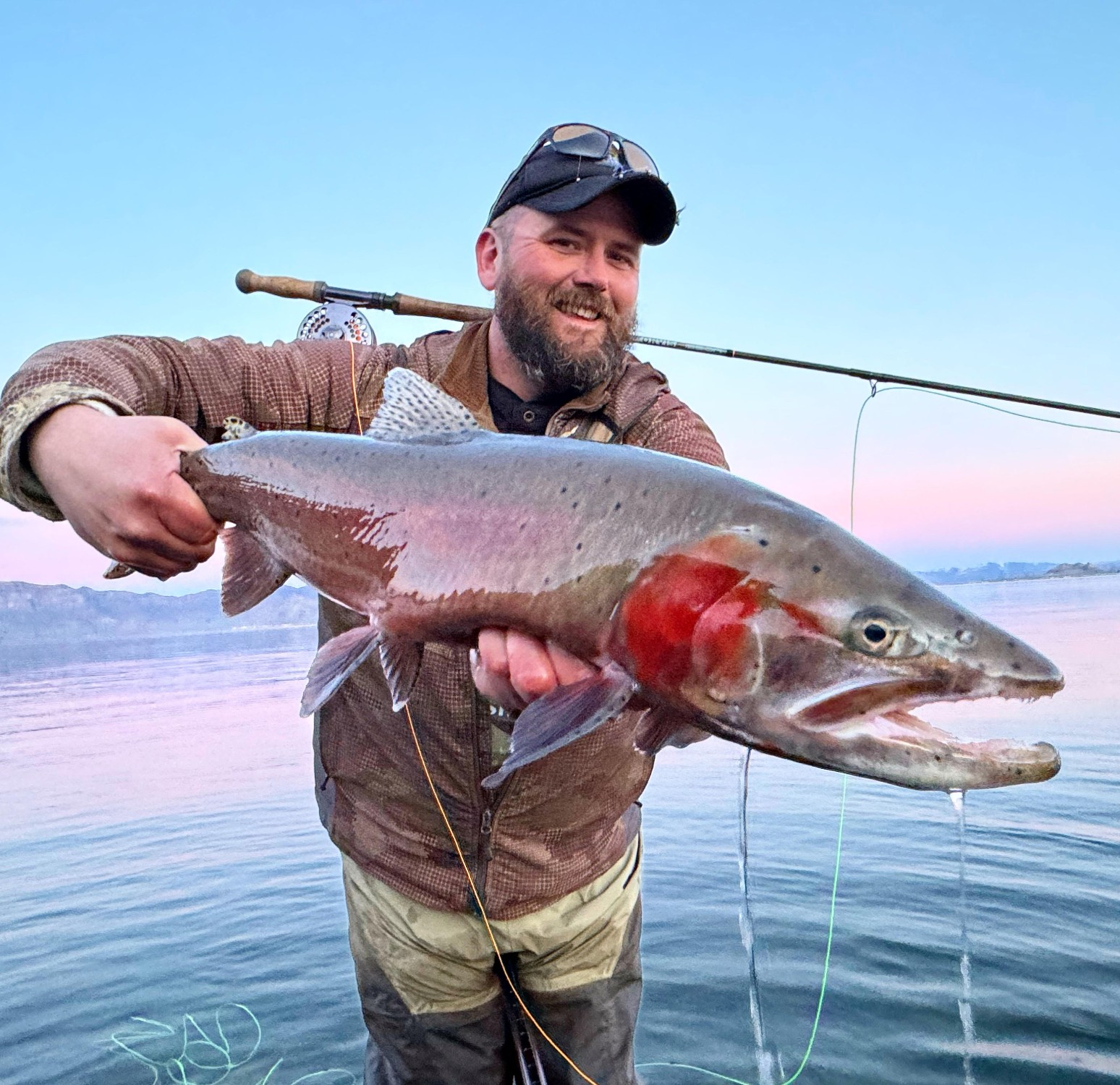

The first time I fished Pyramid Lake, it was entirely by accident. It was the middle of January, and my buddy and I headed out to Idaho on a winter steelhead trip only to discover that the river was frozen solid. Discouraged, we called a few friends in hopes that someone would have a line on some open water, and one of our buddies recommended going to Pyramid since we were close by.
I had, of course, heard of the lake in the middle of the Nevada desert, but it had never really appealed to me. I thought it was a place where anglers stood on ladders for hours at a time trying to catch a big cutthroat under a bobber like they were fishing for catfish on a farm pond. However, by the end of that first trip, fishing Pyramid Lake became an addiction, one that eventually saw me taking a mid-winter trip to the lake’s hallowed waters every single year. It’s an annual adventure that has seen me perfect both my fishing locations and techniques so that consistently catching the mystical giant Lahontan cutthroat in the lake has almost become a guarantee.

Gearing Up
When you go fishing at Pyramid Lake, you need to be loaded for bear. The fish swimming in the lake aren’t your typical 5-weight friendly cutties. Not only can the Lahontans in Pyramid grow to some truly epic sizes (with some being over 20lbs), but the fertile waters of Pyramid Lake give even the smaller trout an uncommon strength. They will easily take you into your backing and spool you out, or they will just effortlessly break off if you go after them on lighter gear.
Fly Rods
Rods for Pyramid Lake should be between a 7-weight and 9-weight range, which provides good leverage for both casting in the wind and handling the big trout. Because reach is often the name of the game, using a 10-foot single-hand rod or even an 11-foot switch rod is also handy. These longer rods will give you both a few extra feet of casting distance and help you maneuver big fish around sharp rocks and steep drop-offs as you fight them.
Leader and Tippet
Your leaders and tippet for Pyramid Lake should likewise be heavy, with 8lb to 20lb fluorocarbon line an absolute must in the often gin-clear water. When nymphing and/or fishing on brighter, sunnier days, lighter 8lb to 10lb tippet will get you into more fish, while heavier 15lb to 20lb line is perfect for both stripping and for fishing on cloudier, stormy days in rough water. Small micro-swivels are also a must for all your leader tippet connections, which help you both fish multiple flies at once and ensure that all your line-to-line connections are as strong as possible.
Flies
Flies for Pyramid Lake are pretty basic. For nymphing, large chironomids ranging in size from size 8 to size 14 in various colors are a go-to, as are large balance leeches. If you’re stripping, small baitifish patterns like the Clouser Minnow and Deceiver can work well, but I’ve personally had better luck on odd patterns like Popcorn Beetles, Tadpoles, and Booby Flies, as well as leech patterns like the Mohair Leech, Bunny Leech, and the classic Woolly Bugger.

Rigging your flies correctly is essential for success on Pyramid, as you want to present all your bugs as close to the bottom as possible. If you’re nymphing, attach a micro-swivel to the end of a 7-foot leader and then tie 3 to 5 feet of tippet to the other end. Add a large adjustable indicator to the top of the leader, which will allow you to make quick adjustments to ensure that you’re fishing the proper depth. Next, tie on two nymphs between 24 inches and 36 inches apart so you can fish in two different areas of the water column at once. Finally, try to set up your nymph rig so that your bottom fly will hover around 12 inches to 14 inches off the bottom.
Stripping flies on Pyramid is a great way to connect with larger fish more consistently, though you must be prepared for some slower days on the water. It’s also best to fish with a sink-tip or even a full sink line that will keep your bugs right on the bottom. Generally, I’ll attach 2 feet to 3 feet of 20lb tippet directly to the end of my fly line and then tie on a micro swivel. Next, I’ll add an additional 4 feet of lighter 12lb to 15lb tippet to the other end of the swivel, leaving a longer 4-inch to 6-inch tag end on the knot. Then I’ll tie a larger, more buoyant fly to the tag end and then add a second smaller or heavier fly to the end of the rig. This will help keep the front end of your set-up a few inches off the bottom as you strip, while the smaller fly or heavier fly on the back can run right along the rocks or sand, directly in the cutthroat’s faces.
Gear
In addition to your fishing equipment, you’ll also want to bring a good pair of insulated waders and several layers of warm clothing to protect yourself from the frigid water. A good pair of rubber gloves is also helpful for touching wet lines and fish. Finally, the infamous ladders will definitely help keep as much of your body out of the water as possible while you’re fishing, so you can stay in the game longer, but they’re not entirely necessary.
Low-Light and Edges
Generally, the cutthroat in Pyramid Lake spend the bulk of their time in 25 feet to 35 feet of water while making periodic trips into the shallows to feed. However, during low-light periods, the fish will come into the shallows more often and stay for longer, making the half-hour before sunrise and after sunset prime fishing times. In addition to the early and late hours, cloudy overcast days can also be very productive, especially when there’s any sort of precipitation breaking up the glare on the surface.

Whether you’re fishing during low-light periods or on the brightest blue sky day, the best place to find fish on Pyramid Lake is always going to be along ledges, edges, and drop-offs. These areas act as transition zones where the trout move in and out of deeper water as they patrol for food. Ideally, you want to cover as many of these edges as possible, as you never know where the fish are going to pop up. If you’re stripping, try to cast at a 45-degree angle along the edge of the drop-off so that your flies will run along the ledge rather than directly over the top of it. If you’re nymphing, you should likewise angle your cast so that your flies drift in the current or wind a few feet over the end of the drop-off so they can float in the deeper water constantly rather than drifting back into the shallows.
Chase the Wind
Wind direction is another major, often overlooked factor to keep in mind for success at Pyramid Lake. Anytime it blows, the wind churns up the bottom in huge, ocean-like waves. These waves push food closer to shore and can cause a trout feeding frenzy, leading to some amazing fishing. Of course, to capitalize on this breezy bonanza, you must be fishing in the right spot.

Ideally, when the wind is blowing, you want to be fishing in the back of any bays or coves that the wind is blowing into. This is especially true anywhere there is a muddy or sandy bottom that puts a bit of color into the water. However, if the wind and waves are so large and strong that fishing becomes impossible—or if a strong Northeastern wind is blowing across the lake to the far shore where fishing is prohibited, you’ll want to prioritize fishing on any points that the wind is blowing past. Often, these points or peninsulas become prime areas for big trout to gather, generally right along the edge of the shallowest water, so they can pick up any food being blown out into the lake.
Any Given Moment

The best part about fishing in Pyramid Lake is that you never know what may happen. Anytime your indicator disappears, or anytime you set the hook on the strip, you could be about to tangle with the trout of a lifetime. It makes every cast you make into Pyramid Lake a special thing because it becomes tinged with the anticipation about what might be swimming just in front of you. From your very first hook-up with a Pyramid Lake trout, it becomes a feeling that sticks to your soul and is guaranteed to always keep you coming back for more.