
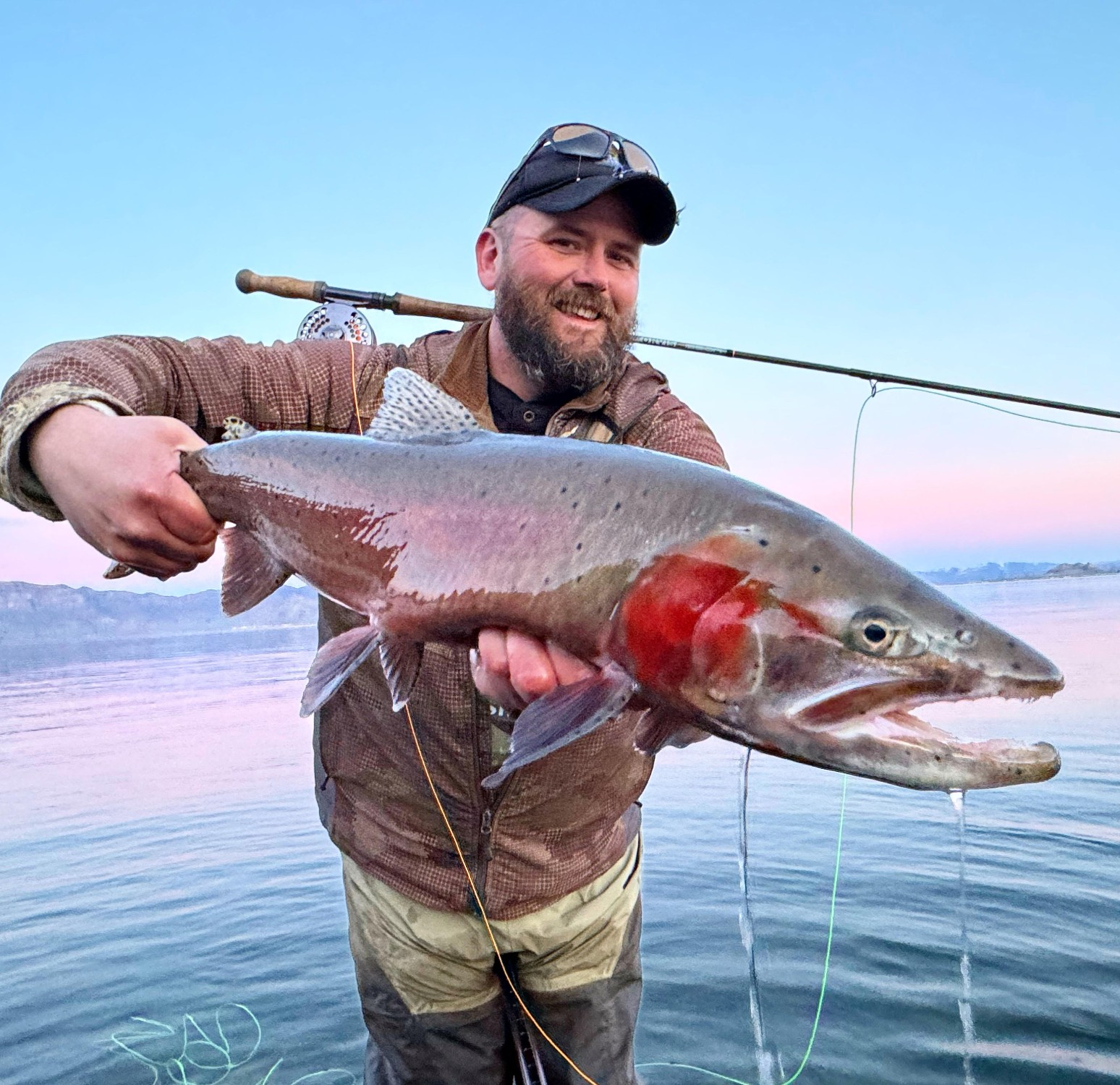

Whether we admit it or not, we’re all a little afraid of the dark. It’s a fear that remains deep in our minds, a remnant from the days when our forebears hid in caves and were protected by the light of their fires. Back then, the darkness was where predators lurked, and over the past couple of millennia—not much has changed. For while the sabretooth tigers and cave bears may be gone from this world, the night still has its own hunters—in the form of giant predatory trout.
Venturing out into the dark to target large trout is a challenge that every fly angler should undertake. It gives you a chance to hook into fish on your favorite trout stream you may never see during the day and probably didn’t even know existed. Yet finding and landing big fish in the dark isn’t like strolling down to the river and chasing risers during the day. To be successful, you must both hunt these big fish while also allowing them to hunt for you.
Gear Up For The Night
Equipment for night fishing is both simple and complicated at the same time. You don’t have to worry about the trout being spooky or leader shy, yet because you’re fishing in the dark, everything has to be done by feel. In addition, no matter how well you know a river, being on the water in the dark is a different and dangerous world, so you’ll want to bring additional equipment to make sure you stay safe.
As you’re targeting large trout with mostly large flies in the dark, there’s no need to worry about throwing perfect loops and graceful casts. So, fish a rod with some backbone. A tip-flex 6-weight or mid-flex 7-weight is ideal for this sort of work because it gives you a lot of leverage while still allowing you to load the rod entirely by feel as you cast.

Pair your rod with a matching reel, and then, if you can, bring both a floating and a sink-tip line. The floating line is ideal for all your topwater fishing, while the sink-tip is great for streamers and nymphs, as it will get your flies down into the strike zone quickly without a lot of guesswork. Finally, since you don’t have to worry about the fishing being shy in the dark, beef up your leaders and tippet into the 2x-0x range. These heavy leaders will both help you handle larger trout and allow you to pull free snags so you don’t have to constantly retie when you can’t see your hand in front of your face.
Outside of your fly fishing gear, a good flashlight and a headlamp are both essential for night fishing. While you don’t want to shine any light on the water when you’re in the process of fishing, having a couple of lights to help get down to the water and to wade to different areas is absolutely vital so you don’t end up stepping in a hole or taking an unexpected swim. Finally, always have a cell phone in a waterproof bag or case and make sure to let someone know where you are before you go fishing, just in case of an emergency.
Find The Right Water
Most anglers tend to think that big meat-eating trout live in the deepest, darkest holes in the river. While this is partially true during the brightness of the day, in the evening you’ll actually find that the biggest trout are usually in the easiest water. Big trout are lazy trout who don’t want to work hard for their meals. So as soon as the sun goes down, they move out of their deep water haunts and position themselves in the shallowest, slowest water they can find.
It’s best to scout the river during the day when you can both see into the water and are unlikely to spook off the big fish you’re after before returning to fish during the night. Start by finding slow-flowing stretches of river with a mix of both shallow and deeper water. Look for areas with shallow bars and humps next to deep drop-offs, along with gurgling back eddies, overflowing dead water, and undercut banks, and you’ll be sure to find the big trout you’re looking for come nightfall.
If you’re fishing in a faster-moving stream, try to target the gaps. Look for chunks of slow water between rapids and areas where rocks, logs, and other structure create pillows of current-free water. Large predatory trout will move into these areas at dusk and stage up to dash to snatch up passing prey in the main current.
Attracting Predatory Attention
There are only a few ways to catch trout at night. In the darkness, when the fish can’t see their targets, they rely on their non-visual senses, like vibration detection along their lateral line system, as well as their hearing. Accordingly, if you want to catch trout in the dark, you’ve got to get their attention.
By far the most productive way to fly fish in the dark is by casting large streamers. Choose patterns with light, bulky heads and a lot of movement that will push water and create vibration beneath the surface. Some of my personal favorite night fishing streamers include Johnson’s Sluggo and the Lynch’s Drunk and Disorderly, which can be jerked, paused, and twitched through the water to gain a lot of big fish attention.
Topwater flies like mouse patterns, skaters, and even poppers are another good night fishing option. These floating flies can be splashed down and stripped and popped on the surface of the water or swung across the surface to create a wake, which will trigger big trout to strike. Mice patterns like Hood Rat and Moorish Mouse are especially effective as they can be swung and stripped with equal effectiveness. Large poppers like Bett’s Bass Bug are also a good option.
Finally, the last way to target big night-feeding trout is by slowly stripping large nymphs along the bottom. This is a more refined and specialized method that can only be done in muddier flats or sandy-bottomed rivers where you’re less likely to get constantly snagged. Use large, attractor nymphs such as Pat’s Rubber Legs, Kaufman’s Stone, and the Zirdle Bug, which are moderately weighted and resemble a variety of crawling prey like stoneflies, hellgrammites, and crayfish, all of which big trout love. Cast your flies and then allow them to sink all the way down to the bottom before retrieving them with long, painfully slow strips or short, minute tugs that will trigger any big, bottom-cruising trout to strike.
Night Time Is The Right Time
The biggest reason we feel fear in the dark is the mystery. It’s instinctive for us to fear what we can’t see, and in a visual sport like fly fishing, casting into the dark feels almost alien. Yet, therein lies the thrill of night fishing for trophy trout. For you know that somewhere in the darkness, something is hunting, making every cast feel like a probe into the void, with both hope and a little bit of fear that something will answer you back.