Tim Romano, the well-known photographer, writer, and editor/founder behind Angling Trade and Flylab, has launched a new venture: Small Craft Sales.
Small Craft Sales is a marketplace for selling anything from float tubes to drift boats, but jet skis aren’t allowed. Romano and his team have spent the past year building this platform, giving any boat enthusiast—fly anglers, whitewater rafter, kayakers—a personalized directory that cuts down on the headache of finding a quality used boat.
“Anglers, whitewater rafters, kayakers, and wooden boat geeks are passionate about their hobbies and know exactly what they want. But finding it through unstructured classified sites can be a headache, and your listing can get lost in the clutter. Plus, these sites make it difficult to find your perfect vessel outside of your local area. Small Craft Sales is here to connect these passionate people and streamline the process of buying and selling small, specialty watercraft,” said Romano.
When you use Small Craft Sales to list your boat, you reach folks who are looking only for a boat. In addition, your listing can be featured both online and in an email newsletter, and on social media.
Small Craft Sales also has the ability to help facilitate delivery of your watercraft throughout the country. So if you find that perfect boat on the opposite coast, they’ll be able to help get it to you.
Small Craft Sales will also be consistently publishing content, including stories, how-tos, gear roundups, and profiles from across the boating world. They want to become not just the go-to classifieds for selling watercraft, but a hub for folks who live to be on the water.
Finally, Small Craft Sales is running a great promotion to celebrate their launch. All listings are currently free through August 1, (prices usually start at $35) and if you make a listing, or subscribe to their newsletter before that same deadline, you’ll be entered to win a $500 gift card to Sawyer Paddles and Oars, and a Yeti Tundra 45 or 65 Cooler (winner’s choice).
You can check out their site, and subscribe to their newsletter, here.
The fly fishing community is a tight-knit family, always supporting its own. Recently, beloved Captain Owen Gayler was diagnosed with stage 4 colon cancer. Gayler is a Texas native and fly fishing guide whose passion for redfish and fishing is infectious. Battling cancer, not being able to guide, and waiting for insurance to kick in have put Gayler and his family in a tough spot.
To offset this, they have started a GoFundMe campaign that the fly fishing community has rallied behind. So far, the community has come together to raise $214,000, just shy of the $250,000 goal. If you know Owen or want to support one of fly fishing’s best, we ask for your help in supporting Owen and his family during this time.
Let’s face it, fly fishing has a steep learning curve, and some of us tumble down it headfirst with a tangled leader and a bruised ego. While there’s no shame in the struggle, there are a few telltale signs that you might not be the river ninja you think you are. If you’ve ever tried to fish a streamer during a mayfly hatch or argued that sling packs are the pinnacle of human innovation, this list might hit a little too close to home. Here are ten signs you just might suck at fly fishing—and hey, we’ve all been there.
1. You fish streamers during a hatch
There’s a hatch going off, trout are rising like popcorn, and what do you do? Tie on a streamer the size of a chipmunk. While everyone else is matching the hatch and hooking up, you’re ripping meat through a dry fly buffet like it’s October. Bold move—but maybe not your best.
2. You put your wading boots on before your waders
You proudly lace up your wading boots, feeling ready to hit the water—until you realize your waders are still sitting in the truck. Now you’re doing the awkward reverse boot dance in the parking lot while your buddies are already rigged up and laughing. Rookie mistake, but hey, we’ve all been there. Once.
3. You let your strike indicator do it’s thing because you think its bottom, so you don’t set
Your indicator twitches, pauses, maybe even takes a dive—and you just stare at it like it’s doing performance art. “Just ticking bottom,” you mumble confidently, as yet another fish spits the hook and swims off. Pro tip: when in doubt, set the hook. Worst case, you look overly enthusiastic. Best case, you actually catch a trout.
4. You wiggle your rod tip to try and get your fouled line untangled
Your line’s a knotted mess, wrapped around itself like spaghetti, and instead of actually fixing it, you go for the ol’ rod-tip shimmy, waving it around like a broken car antenna. Shockingly, the tangle doesn’t fix itself. Who knew? Sometimes, you just have to accept that it’s time to stop dancing and start detangling. (Pro tip: point the rod tip down and tap on the first section of the rod, your line sometimes magically unwraps)
5. You make hero casts in a small stream, but all you really need is a simple roll cast
You’re standing in a stream barely wider than a sidewalk, but you’re hauling back like you’re trying out for a saltwater distance comp. Trees are snagged, your line’s in a bush, and the trout are now somewhere in the next county. Meanwhile, a simple roll cast would’ve done the job—quiet, clean, and effective. But hey, at least you looked cool for a second!
6. You break off three fish and a row and blame it on bad knots
You hook up—snap. Again—snap. Third time’s the charm? Nope—snap. By now, you’re loudly blaming your knots, your tippet, the humidity, and probably your horoscope. But deep down, you know the truth: maybe it wasn’t the knot. Maybe it was you. Or maybe next time…re-tie between fish.
7. Every fish you catch you need a grip and grin
You finally land a fish, nice! But instead of a quick release, it’s lights, camera, ego. You stage the shot, adjust your hat, maybe even pull out a second rod for “aesthetic.” Meanwhile, your buddy just caught three more and moved upstream. Look, we get it, pics or it didn’t happen—but not every trout needs to star in your personal highlight reel.
8. You think a thousand dollar rod will fix your cast
You’ve convinced yourself that your tailing loops, wind knots, and limp deliveries are all the rod’s fault, so you drop a grand on a high-end stick. But surprise: the new rod didn’t come with a new cast. Turns out, no matter how fancy the gear, you still have to put in the practice. A thousand-dollar rod won’t fix a ten-dollar cast.
9. You argue that sling packs are the best pack option
You swear by your sling pack like it’s the ultimate fishing accessory, even though half your gear’s spilling out every time you turn around. Meanwhile, the rest of us are rocking chest packs, hip packs, and backpacks that actually hold everything without the constant struggle. Sure, sling packs look cool, until you’re chasing a fish and it’s bouncing off your shoulder like a rogue cannonball.
10. You swear euronymphing is the only effective way to catch trout
You’re convinced euro-nymphing is the one true path to trout-catching enlightenment, and everything else is just hobby fishing. Dry flies? Waste of time. Streamers? Cute, but why bother? While euro-nymphing is powerful, believing it’s the only way makes you miss out on the full fly-fishing experience, and maybe a few good fish too. Variety is the spice of fishing, after all.
So, if you found yourself nodding (or wincing) at more than a few of these, don’t worry, you’re in good company. Fly fishing isn’t about perfection; it’s about the pursuit, the screw-ups, and the stories that come with them. Besides, for every bad knot, missed hookset, or overhyped gear purchase, there’s a lesson waiting on the next cast. Just remember, it’s not about sucking forever, it’s about sucking a little less each time you hit the water. Tight lines, and may your indicator actually not be just the bottom next time.
Long Haul Gear Reviews are based on time spent in the field, not in the showroom. No gimmicks, no fluff, no marketing hype—just honest takeaways from putting gear through the wringer. When you’re wading through current with a camera in tow, hauling tackle on a salt-sprayed skiff, or hiking valuable gear into the backcountry, a pack that keeps water out isn’t a luxury—it’s a non-negotiable.
Headed out for a day of flats fishing in Ascension Bay, MX. Photo credit: @rymcarthur
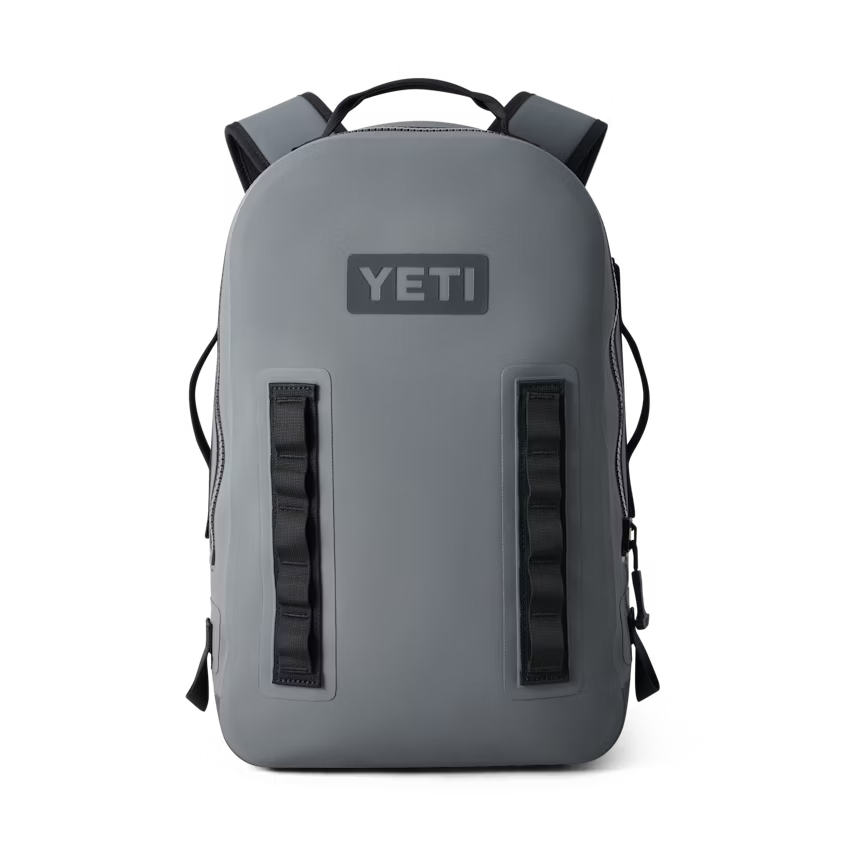
The YETI Panga Backpack 28 hit the market in 2018 as part of YETI’s push into waterproof soft gear. Over the past three years, I’ve had the chance to see whether it’s truly built for the wild. It’s been dragged through tidal marshes, salt flats, and glacial rivers; stuffed into canoes and skiffs; jammed into airplane overheads; and hosed off more times than I can count.
All products featured on Flylords are independently selected by our editors. However, when you buy something through our retail links, we may earn an affiliate commission. Photo credit: @kirkymarks
Pockets: One main compartment, internal mesh pocket, laptop/hydration sleeve
MSRP: $300
Pros:
Fully submersible
Puncture-resistant ThickSkin shell
Three-year warranty
HitchPoint Grid is compatible with attachable accessories
Cons:
Not the most comfortable for all-day wear
Minimal organizational features
Forging our own path in French Polynesia. Photo credit: @kirkymarks
The Skinny:
The YETI Panga 28 is a premium waterproof pack designed for harsh, wet environments. It’s not built for casual commutes—it’s built for situations where keeping your gear dry is essential. Overbuilt, simple, and tough, it starts to justify its price tag if you’re rough on gear or operate in consistently wet conditions.
The pack’s ThickSkin shell is seriously durable and handles fishing-related abuse with flying colors. The internal layout is minimal: a sleeve along the back panel and a small zippered mesh pocket on the front. There are no exterior pockets, but the HitchPoint Grid lets you attach add-ons like the SideKick Dry or Rambler Bottle Holder. The chest and waist straps are removable, and the HydroLok zipper is both waterproof and airtight once sealed.
YETI includes a three-year warranty—and that’s important.
Hunting bones in waist-deep water.
The Time Test:
I’ve used the YETI Panga Backpack for over 3.5 years in demanding environments—from the Alaskan bush to saltwater flats in Ascension Bay to remote atolls in French Polynesia. I’ve waded waist-deep and even swum across channels with it on my back, fully loaded with camera gear and tackle. Not once has it let water in.
The zipper requires occasional lubrication to keep sliding smoothly. YETI includes a small tube of lubricant with the pack, and a quick application now and then keeps the seal working as it should.
Casting to shorelines from a canoe on a rainy day. Photo credit: @brakerbros
Comfort-wise, it’s not ideal for long hauls with heavy loads. While the chest and waist straps help, this isn’t a hiking pack—it lacks ventilation and padded support, which can make it feel hot and heavy over time.
It also isn’t the easiest pack to access while wading. The top-load design and waterproof zipper slow things down, especially when you’re standing in water. That said, the volume and protection make the tradeoff worth it in my use case. I use it mostly on boats and less frequently when wading.
The fish of 10,000 casts… this one probably took 50.
If you’re looking for a pack strictly for wading—and don’t need to carry much—a sling-style option might suit you better. But for bulky items like camera gear, slings fall short. The Panga’s capacity wins out for me.
After about 2.75 years, one of the zipper teeth broke. While the pack still held a seal, I filed a warranty claim for peace of mind. The process was smooth: I submitted a photo and proof of purchase (an email receipt from YETI worked fine). I had the option to send the old one back first or get a replacement upfront with a refundable credit card hold. With some trips quickly approaching, I chose the latter—no issues at all. A brand-new pack arrived with a fresh three-year warranty. That level of customer service is one of the reasons I stick with YETI.
Celebratory cervezas in Ascension Bay. Photo credit: @rymcarthur
My Recommendation:
If you spend serious time in wet, rugged environments and need to protect valuable gear, the YETI Panga Backpack is absolutely worth considering. It’s purpose-built for anglers, photographers, and explorers who can’t risk soaked equipment. After more than three years of use, I can say it lives up to its reputation.
There are trade-offs. It’s not the most comfortable for full-day hauls, and it’s slower to access on the water. But if waterproofing, durability, and carrying capacity are your top priorities, this pack stands in a league of its own. The ThickSkin shell is nearly bombproof, the zipper does its job (with basic maintenance), and the warranty backs it all up.
Several waterproof bag options on a metal skiff in French Polynesia. Photo credit: @kirkymarks
There are workarounds for the bulk if you’re willing to get a little creative. When I wade the flats and only need a few key items—say, for bonefish or redfish—I un-Velcro the SideKick Dry and wear it around my waist with a wading belt. It gives me quick access without hauling the whole pack. Back on the boat or beach, I simply reattach it and I’m good to go. It’s a small adjustment that adds a lot of flexibility.
Mexican sunrise on a windy day. Photo credit: @rymcarthur
At $300, the Panga is an investment—but if you’re hard on gear and constantly dealing with wet conditions, it’s one that pays off. For me, the peace of mind knowing my camera, tackle, and essentials are bone dry is worth every penny.
Article by Flylords Food Editor Kirk Marks, an angler, photographer, and culinary aficionado based in Kent Island, Maryland. Give him a follow at @kirkymarks.
In this installment of Behind the Brand, we sat down with Logan Roberts, founder of Marsh Wear, and an avid tarpon angler. As their name implies, Marsh Wear is rooted in the low country marshes. From flood tide redfish to mallards working overhead, anglers and hunters across the southeast have grown to love this brand. With an ever-growing line of products and gear, they are seeking to bring the marsh to everyone, anywhere. It was time we got a behind-the-scenes look at the Charleston, SC brand, and learned their whole story in this Behind the Brand.
Flylords: Can you tell us a little about your early childhood? Was fishing, hunting, and being outdoors a big part of your upbringing?
Logan Roberts: I grew up fishing with my grandpa in the Charleston Harbor and Folly River. My dad was a surfer, so he also spent a lot of time on the beach. Being outdoors was a pivotal part of my upbringing and definitely contributed to where I am now in my career.
I came up with the idea for Marsh Wear in 2010. I had worked at Haddrell’s Point Tackle, on offshore boats, and ran some inshore charters, and wanted clothing that had a sleeker silhouette and a younger feel than what was available on the market at the time.
Flylords: From that initial point, how did the brand grow? When did you first realize you might have something legit on your hands?
Logan Roberts: The brand grew very organically with the help of a few stores that gave me a shot early. I owe a lot to Haddrell’s Point Tackle, Southern Drawl Outfitters, and Sewee Outpost for getting the brand in front of the right local crowd. As things started to pick up locally, I realized that Marsh Wear had a real shot at growing in other markets.
Flylords: What were some of the most challenging elements of getting Marsh Wear off the ground in the beginning?
Logan Roberts: In the beginning, I was a one-man show and doing all the web design, product design, photography, and trying to handle all the sales, and there just wasn’t enough time in the day. I knew I would need to bring some other people on board to help with stuff like sales, so sales reps were the next step. As a small brand just starting out, getting sales representatives in place was challenging. Despite that, I was able to find some that were willing to take a chance on the brand when sales were minimal and things started to grow.
Flylords: What were some of the early influences surrounding the identity of Marsh Wear?
Logan Roberts: Growing up in Charleston, I was exposed to both hunt/fish and surf. I fell in love with the combination of Folly Beach surf culture and all the heritage hunt and fish aesthetics from old pictures. These guys just had it figured out, enjoying camaraderie in the outdoors and having a blast doing it.
Flylords: As the operation got bigger, what were some of the biggest changes the brand underwent?
Logan Roberts: Inventory was always a battle. Growing at that pace with no investors, it was hard to keep inventory levels healthy while opening new dealers. One second, I would be panicking that we would never sell all this stuff, to having nothing a few POs later, and scrambling to make more. It was quite the roller coaster.
Also, staffing was and will always be a big challenge. I had such a pinpoint focus on what the brand should be. The more people you bring in, the harder it is to keep everyone on the same page with additional views and opinions coming together. Choosing a team of people who believe in the Marsh Wear identity is key.
Flylords: What is a fun/ chaotic memory you have from the early days of the company?
Logan Roberts: I remember my first ever retail order for Haddrell’s Point Tackle, I was so nervous and wanted everything to be perfect for them. I bought nice wood hangers and steamed every single piece so there wasn’t a single wrinkle. I walked everything in as proud as can be and handed it to an employee. He then proceeded to walk me to the back, pulled the pieces off the hangers, folded them all in a big pile, and shoved them in a cardboard box to be put into inventory later. I almost fainted. Lesson learned on that one!
Flylords: What was one of the biggest accomplishments you experienced when growing this company?
Logan Roberts: We are lucky enough to have lots of great sales accomplishments, but some of the early stuff really sticks with me. I remember when we were just starting out, and I saw Bou Bosso was wearing one of our hats, and I thought I had made it. Living for the show, Silver Kings, that gave me the confidence that I was heading in the right direction and could do this full-time.
Presently, I would say being able to employ such a great team of people here in Charleston is a huge accomplishment. Doing what you love for work and creating jobs for people is something I definitely don’t take for granted.
Flylords: Looking at it now, who would you say Marsh Wear is for? Who do you think of when designing new pieces?
Logan Roberts: The cool thing about Marsh Wear is we see all kinds of people gravitating towards the brand. From a 60-year-old bird dog trainer to a high school skateboarder, I think everyone just wants to be a part of something, and people seem to be drawn to our heritage aesthetic.
Flylords: Compared to where it started, did you ever think it would grow into what it is today?
Logan Roberts: Never. I could never have imagined that I would go from selling out of my attic to selling to over 400 retailers and having our own store on King Street—one of the most historic and busiest shopping streets in the South.
Flylords: How do you hope to see Marsh Wear continue to evolve in the future?
Logan Roberts: I love the direction we are headed in and hope we can continue to grow our community and apparel offerings within the core pursuits that make us who we are. It has also been fun gaining some traction in the music scene, as it really unites our customers
Flylords: What’s on the Horizon for Marsh Wear/ what’s coming up that you’re most excited about?
Logan Roberts: We have some amazing products and marketing coming out for Fall ‘25 and SP ‘26 that I can’t wait to hit the market and share with everyone.
It’s also about time for our Holy City Tarpon Tournament and Lady Red Tournament that we put on every year, which are always a blast.
Thank you to the Marsh Wear team for dedicating some of their time to chat with us. If you’re looking to learn more about Marsh Wear, you can check out their website, HERE.
Utah Republican Senator Mike Lee officially announced that he withdrew his public land sale bill from the current budget working through Congress.
The “One Big Beautiful Bill” that Congress wants to deliver to President Donald Trump by July 4th is a budget package, but as we’re accustomed to seeing, a lot of other non-budgetary items have made their way in. Selling public lands to open up housing opportunities in the West and decrease the federal government’s ownership portfolio were the main reasons Lee claimed for introducing his bill into the budget. However, Lee inserted his provision just weeks after a similar (and much smaller-scale) proposal was made in the House of Representatives. That proposal was nixed by all House Democrats and a few Republicans, led by Ryan Zinke of Montana.
Lee’s reason for pulling the public lands bill from this current budget is layered. Since Lee wanted to include this in a budget proposal that’s going through reconciliation, anything included in the proposal has to be directly related to fiscal matters. This allows the Senate to pass legislation with a simple majority—51 votes in the affirmative—instead of the usual 60-vote threshold required in the upper chamber.
The Senate parliamentarian (who is essentially the referee of the Senate and ensures that the body follows its own lawmaking rules) ruled Lee’s original proposal to sell up to 3 million acres of land couldn’t go into the Big Beautiful Bill because it wasn’t budget-related. Lee vowed to rework the bill, introducing one version that would sell off roughly 1 million acres instead.
What’s not clear is if that new version was also nixed by the parliamentarian, if Lee felt the political pressure, or if his official explanation is the actual reason behind public land sales being pulled altogether. But one thing is for certain: the political pressure hunters and anglers put on this proposal was heard!
Lee’s official explanation was that he couldn’t obtain “safeguards to guarantee that these lands would be sold only to American families,” cutting out corporations or foreign governments.
Regardless, it’s a win for anyone in America who enjoys public land. Lee will likely try this again, as selling public lands has been a pet project of his for over a decade.
There’s no shortage of dangerous creatures in the waters of the South American jungle, but one of the most impressive and fearsome is the wolf fish. These prehistoric-looking fish are reminiscent of the bowfin of North America, with bony heads and a mouthful of teeth. They can grow to massive sizes, with some reaching over 80 lbs. Wolf fish are found throughout Central and South America and can live in anything from drainage ditches to larger rivers.
Anglers seek out wolf fish for their aggressive takes and strong fights. Although they used to be mostly caught by accident while fishing for other species, some outfitters now offer guided trips targeting them. They’ll take a variety of flies, from poppers to streamers, and are sometimes so eager to eat that they’ll miss a fly. These creatures are very unique, so with that, here are 7 things you never knew about the wolf fish presented by Scientific Anglers.
1. The Wolf Fish is Not a Single Species
Although generally referred to as the wolf fish, there are actually multiple species with different characteristics. Some of the smaller species max out around 10 inches and feed mostly on small baitfish and insects. The largest, the Giant Wolf Fish, can be several feet long and is known as one of the most voracious predators in the water.
2. They Can “Breathe” Air
Like both the bowfin and the arapaima, wolf fish can “breathe” air to make up for low oxygen levels in the water. When fishing for them, it’s not uncommon to see or hear them come to the surface to gulp air. This clever adaptation allows them to live in places other fish can’t, like murky ponds, swamps, and drainage ditches.
3. They Have Dog-Like Teeth
If you’ve ever seen the dagger-like teeth of a pike or the serrated edges of a shark’s tooth, you know there are plenty of well-equipped predatory fish out there. However, one type of tooth you may not have encountered before is the canine-like tooth of the wolf fish. These thick, boney teeth are perfect for preventing prey from escaping and are followed by another set of teeth in the wolf fish’s throat. For the anglers interested in chasing these fish, a set of pliers and wire leaders is a must. We prefer the Scientific Anglers Premium Figure 8 Wire Leader.
4. Wolf Fish are Frequently Kept as Pets
Since the wolf fish is known for its aggressive demeanor, it’s a little surprising that many people keep them as pets. This doesn’t mean that wolf fish in tanks are tame, by any means. They’ll attack pretty much anything that gets in the water, including hands and nets, making feeding and tank cleaning quite the experience. It’s also essential to keep the aquarium covered since they’ll try to jump out if given the chance.
5. They Have Been Known to Move Over Land
Considering that wolf fish are able to gulp air and often try to escape from their aquariums, it’s not too surprising that there are accounts of them surviving on land for brief periods and moving from one water body to another. This is a useful trait for some species of fish, since it allows them to escape small patches of water that dry up. For people, though, it can be alarming. There’s an account of a woman who was planning to keep a wolf fish after a day on the water, so she killed it and put it in a bag. When she came back later, she found that the fish was actually still alive and trying to escape.
6. They are Edible
Looking at a wolf fish, they don’t look particularly appetizing. Big scales, bony heads, and a drab coloration are a far cry from some of the more ornate species. Despite this, they are edible, and people in Central and South America do eat them. If you ever get the chance to try one, be warned: they have a lot of bones you’ll need to pick out before digging in.
7. Wolf Fish are More Ferocious Than Piranhas
Piranhas are often considered the quintessential predatory fish of tropical rivers. In reality, though, most of their reputation is unwarranted, and they usually feed opportunistically on crustaceans, insects, or even seeds. The wolf fish, on the other hand, lurks in dense vegetation, waiting to ambush prey as it comes past. Although most stories aren’t supported by strong evidence, there have been tales of large animals and even humans being ambushed by wolf fish after getting in the water. Regardless of whether the claims are true, the fact that they exist at all says something about their attitude.
Article from Katie Burgert, you can follow along with Katie on her Instagram @fishuntamed.
Thank you to everyone who entered the Argentina Cast & Blast Giveaway! We partnered with Patagonia Outfitters to put together the trip of a lifetime, chasing giant brown trout and highly sought-after ducks in this two-for-one trip.
The prize package, including fishing on the Limay River and duck hunting at Estancia Santa Rita, as well as over $20,000 in gear, is awarded to:
In this week’s “How to Tie” video feature, Cheech with Fly Fish Food ties a Perdigon style nymph that pairs perfectly with your bushy dry fly of choice this summer, the Ribby Pellet.
Learn About This Fly:
Difficulty: Easy
If you aren’t taking advantage of rising trout this summer, you are definitely missing out. In trout fishing, there are very few sights as beautiful as a trout coming up to sip a dry that is cruising down the river. Many anglers have learned that although tricking a fish to eat on top is the dream, it is not always practical. When you fish on top, you miss other areas of the water column where trout tend to feed 90% of the time, which is why the dry dropper rig has become so popular. The Ribby Pellet is an easy Perdigon style nymph that you can add to the back of a larger dry or hopper, allowing you to be as efficient as possible and trick the trophies only feeding subsurface.
Simple is tied into the DNA of this pattern. The body is composed of thread, which will give you the opportunity to tie a wide array of variations without sacrificing time. Adding a hot spot is a subtle yet effective addition to any nymph that can draw the attention of trout in slightly off-color water and turn a slow day into chaos. The only recommendation I have is to be careful while working with resin for the first time due to it being very messy and difficult to get out of feathers.
As I alluded to earlier, fishing this under a dry fly will undoubtedly give you the biggest thrill. Substitute an indicator for a bushy dry fly, such as a Chubby Chernobyl, and watch your mind be blown at the productivity of the dry dropper. There are several ways to build this setup, but the most common is tying tippet directly from the hook to the eye of the nymph. The Ribby Pellet will turn the heads of trout not looking up this summer, all while keeping your options open with a dry fly on top, truly giving you the best of both worlds!
“There are three things you can see from space: the Great Barrier Reef, the Great Wall of China, and a school of Bumphead parrotfish.” This is always my introductory line to, arguably, the most interesting fish found on the flats of Providence and Farquhar Atolls in the Seychelles. Giant green tails showing at what looks like a mile away, big fish moving slowly in big schools, it’s the recipe for a unique flats experience. They are really easy to see but a lot more difficult to catch. Bumphead parrotfish are space aliens that live underwater.
Tip 1. Stealth and Precision.
After spotting one on the flats, the sheer size will lead you to the proverbial GT mode. You lash out a cast with no thought to presentation and your position in relation to the fish. Bumpies, as we call them, are incredibly intuitive and have a complex social structure, which makes them keenly aware in shallow water. Oftentimes, they’ll pick you out from a distance and keep themselves out of casting range. After chasing them down and finally getting a shot, they explode in unison and spook off the flat. Slow yourself down. With these fish, one accurate cast is always better than 10.
Tip 2. Position, Position, Position.
Your positioning to the school of parrotfish is vital. The ideal scenario for fishing for Bumpies is when they are tailing and feeding directly towards you. This is the best chance of getting the fly to be the first thing they come across, as opposed to the leader or fly line coming in from the side. Once the fly is placed, stay still. They can hear boots shuffling on the bottom and will start to broadside you. If you don’t connect, wait until they have moved a good distance past you and reposition yourself.
Tip 3. This is an eat you’ve never had before.
We have had many “tribal councils” about what the Bumpies are feeding on and why they only come and tail on the flats of Providence and Farquhar Atolls. We, of course, have theories that have proven to be fruitful in getting them to eat a fly. A bumphead parrotfish is not, in a sense, a predator of the fly. They don’t smash it when they see the fly as Trevally would, nor do they move and tail trying to pin it to the bottom as a triggerfish or a bonefish would.
The fly must be in their lane and not moving at all. There is no way that you can move them to induce an eat. A yard might as well be a mile with these fish. It’s akin to the Permit as it needs the fly right in a zone where it can pick it up. The eat is very subtle for a fish of their size, there might be a slight bump or an unnatural tension on the line, but the best way I know when to set the hook is when there is any slight movement of the tip of the fly line.
The set is a small hard strip to try and get the hook to puncture and a lift of the rod (I know, this is a criminal offense in all flats fishing), but as opposed to lifting into a trout it’s a lift using the butt and first section of the rod to drive that hook home and if anything, slide the hook across the infamous beak and get purchase in an overhanging flap of skin on the side of the mouth.
Tip 4. Have Proper Tackle.
Leader: After years of fishing for these brutes, the guides of Flycastaway have formulated the strongest leader possible in fluorocarbon less than 30lbs. A combination of double to single furled butt section and a bimini’ed section of tippet to connect to the butt section, then to an Improved Homer Rhode to the fly, the pulling and holding power of this leader is immensely strong.
Rod: The paradox is seeing a fish so large you might think you need the big gun, 12 weight, but this is way too heavy for these spooky fish. The ideal rod is a 10-weight with a 10-weight fly line or a 9-weight with a 9-weight fly line. The rod’s subtelness presents the fly accurately and quietly to the fish.
Reel: Most reels these days have good enough drag systems to be able to handle these fish, but the reel should be loaded with at least 150 yards of 50lb braid backing. The Bumpies are often found tailing in areas of the flat where, off the edge, there are massive coral gardens. Bumphead parrotfish are dirty fighters, and when they get into these coral gardens, you need backing that can hold up against the coral.
Fly Selection: We almost exclusively use weighted crab patterns that will get down and almost plug on the bottom. Colour is mostly determined by the bottom substrate, darker tans for turtle grass, whites and mottled tans for sandy and broken coral substrate, and, weirdly enough, bright orange for most circumstances.
Tip 5. Win the Fight with Torque
You’re taking a 10-weight to a gunfight. These fish are big and incredibly powerful. If I had a word to describe their physicality in a fight, it would be torque. Parrotfish will blast off straight into the backing once hooked and continually take more line as they fight to get to deeper water. You’re going to see a lot of your backing. They will then hold broadside into a current, forcing you to have to horse the fish back in. They will test your tackle to the absolute extreme, and you have to use patience and intelligent rod angles to win the fight.
There is no easy way with bumphead parrotfish; the fight might take up to half an hour, so you have to stay focused and patient. Part of bumphead fishing is that you’re going to lose a lot of fish. We have worked on a rough ratio: for every four fish hooked, one will come to hand. There are exceptions. We had one client who hooked and lost 11 fish before landing his 12th on the last afternoon. They will test your resolve. Getting them to eat the fly and then getting them to the net is a completely unique experience and one that is never forgotten.
The Potential World Record
Angler Mark Weeks and I were fishing in an intricate lagoon system on Providence Atoll in the Seychelles when a school of Bumpies was spotted moving over an open sand section of the deeper lagoon. Mark was keenly alert and sent a cast barely longer than the leader, landing in front of the school. After letting the fly drop to the bottom, he kept tension as the school moved over the fly.
Mark holding up the World Record Bumpie.
We thought we blew the shot when the school split. Then, with a slight tilt, one fish moved on the fly and almost instantly blasted off into the deep water with the school, Mark holding on tight as it went. Luckily enough, we were able to get onto the skiff and maneuver through a minefield of shallow coral, managing to keep the fish from getting underneath any. After 30 minutes of back and forth, I managed to peg the skiff onto an almost exposed turtle grass finger and jump into the water. I slid the net under the brute and almost forgot to catch my breath looking at the size of the fish.
Mark, an avid member of the IGFA, had his digital scale with him. For the first time, a bumphead parrotfish was weighed, we put it in the net, and it came to 102 pounds of green fury. It proved that we were underestimating the size of these fish by a long way. Mark submitted the record attempt, and we eagerly await the verdict. (Update: since the original article, Weeks’ fish has set the official IGFA record.)
Guide Brenden and Mark with the world record Bumpie.