
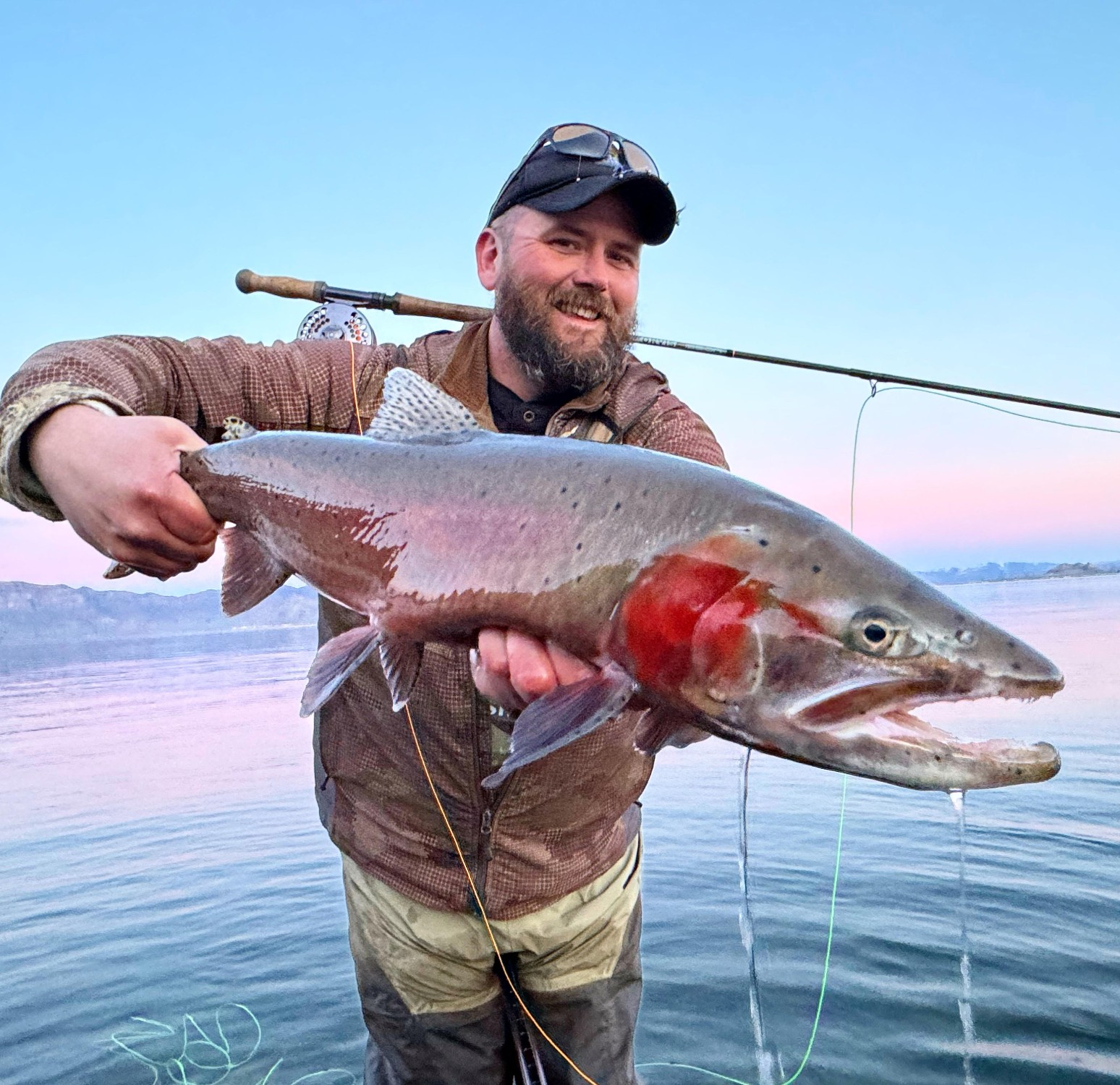

Teddy reached and grabbed the front of the shirt and yanked me forward. “You need to do this,” He practically belched in my face. “Come back and guide for us!”
I wafted a hand in front of my face to wave off the beery fumes and thought about the offer. I was currently in graduate school and living in Connecticut, trying to fulfill a half-hearted ambition to be an English teacher. The only reason I had even come to guide school was that a buddy had offered to pay for my plane ticket and had looked at the trip as a chance to take a break and go fishing in Montana for a week. Yet now I was at a crossroads.
It was the end of the week, and I was packed and ready to go home when my instructor Teddy and the lodge manager Eben had invited me to the bar for a few departing drinks. A few had turned into many, and once I was thoroughly lubricated, Eben had almost casually asked, “You don’t want a job, do you? We need another guide.” That’s when Teddy grabbed me and as I drunkenly looked at him, a sudden and crazy thought came into my mind:
“Sure,” I said. “Sounds good to me.”
You’re Not In Kansas Anymore
The first thing I learned as a new fishing guide was that rivers and streams of Montana are a hell of a lot different from the smaller New England waters I was used to. I had driven back to the West a week later and watched the entire country open up around me, and the first thing I felt was a hard kick of intimidation. The rivers around me were big, and with so many fishy-looking spots, I had no idea where to begin.
Luckily, the crew at Hubbard’s Yellowstone Lodge had no intention of letting me figure it all out for myself. Almost as soon as I unpacked my bags in the bunkhouse, Teddy and another guide named Dave grabbed me and took me down to the river to see what I could do. Dropping me into the rower’s seat of a drift boat, Teddy and Dave took turns barking “Left Oar, Right Oar, TOGETHER!” at me while casually slapping the back of my head as they pulled in dozens of trout while we spun our way downstream. After a couple of river miles, Teddy finally switched out with me, giving me my first chance to fish.
After tying on a large, foam fly (that Dave handed me) I made a long cast towards the bank (where Dave told me to cast) and almost immediately saw a cutthroat inhale my bug. I set the hook hard and felt the line suddenly go slack as my tippet broke. Dave grabbed my fluttering fly line in his hand and looked at my leader.
“What size tippet are you using?” He asked casually.
“6x,” I said, smiling sheepishly. Dave smirked, shook his head, and then handed me a spool of 3x. “You’ve got a lot to learn,” he said as he casually pushed me back to the oars.
Guiding Is Not Fishing
My first clients arrived a few days later. They were a nice couple from New York, who had little to no experience fly fishing. I had spent the past couple of weeks fishing the Yellowstone River and solo rowing to get better behind the oars and had also been all over Yellowstone National Park, so I was confident that I could put them on some trout.
On our first day together, I took them to the Lamar River in the Northeastern corner of the park. I had been there a couple of days previously and had found cutthroat eating hoppers like pigs in an acorn patch. I figured it would be an easy place to start my guiding career and to look good for my new clients. I figured almost anyone could catch trout there.
Three hours later, I was pulling my hair and realizing how wrong I was. My clients couldn’t cast further than ten feet and couldn’t drift a fly more than a few inches, no matter how many times I told them and even then showed them how to mend. When we finally did manage to get a fish to eat, the husband would set his hook so hard he’d practically jerk the trout’s lips off, while his wife barely moved her rod at all, no matter how hard I screamed “SET!” in her ear.

We kept up the shenanigans for a few hours, and just as I had given up hope, the husband finally managed to connect and land what must have been the dumbest cutthroat in the entire river. It was a massive relief, but as we packed up and then drove back to the lodge, the only thing I could think about was that I would be doing it all again the next day.
For the next month, I continued to struggle with trying to figure out how to catch people trout that I could easily catch on my own. Spinning my way down the Yellowstone River, I bounced my boat off rocks as I pointed out rising rainbows and browns. I’d hike into the park, dodging my way around bison while directing my anglers to sexy looking foam piles where cutthroat noses poked up from the depths like Whac-A-Moles. Every day I’d try to find a way to teach new clients to cast, mend, and catch trout, and every day I’d fail in new and different ways.
Somehow, through all the struggle, my anglers would still manage to land a trout or two, and with every success, I felt like I was beginning to figure out the game. Eventually, as I watched my clients hold the fish up for a picture with massive smiles on their faces, I stopped worrying so much about what I was doing wrong and concentrated on what I was doing right.
The Right Stuff
I wish I could say that that first year practically flew by, but it didn’t. Every day I woke up early to meet clients and then lugged my boat down to the river or hiked up some muddy, grizzly-infested creek. I’d do my damnedest to bring a couple of trout to the net, and then I’d stagger back to the bunkhouse, collapse on my bed, and pass out from pure exhaustion. It was hard, brutal work where it felt like every decision I made was the wrong one. Yet almost miraculously, I made it to the end of the season.
On the last day, I packed up my stuff and prepared for the next adventure. I had expected guiding to be some miracle job where I got to fish every day and somehow got paid for it. However, the reality was that it was just like any other job where you woke up every day and went to work. At the same time, as I thought about all the days watching people struggling to cast in the pristine, flowing waters dotted by bouncing bugs and rising trout, something suddenly clicked. Guiding isn’t about being the best angler but being a good teacher and having a desire to share the wealth. As I drove away from the lodge, I looked at the passing river in the rearview mirror and suddenly knew one thing for certain—I would be back next year to share and learn as I went along.