The Silver King has captured the minds of anglers and artists for generations. Paintings depicting tarpon jumping through the air capture the raw emotion and power that any angler who has chased tarpon is familiar with. Of these paintings, one particular one has garnered more fame worldwide than any other. That painting, which lives in the Sistine Chapel, depicts the story of Jonah and the Whale, and was painted by none other than Michelangelo. But how did a tarpon end up on one of the most famous pieces of art in history? The mystery of the Sistine Chapel tarpon is a fascinating story, and while we may never know the exact answer, here is what we do know and our theory on how the first depiction of the Silver King came to life.
In the years between 1508 and 1512, Michelangelo completed one of the greatest pieces of art in history. Commissioned by the Pope, Michelangelo painted the entire ceiling of the Sistine Chapel in fresco style, including his depiction of Jonah and the Whale. The Jonah Fresco, front and center in the Sistine Chapel, shows Jonah alongside what appears to be an Atlantic tarpon. It’s worth noting that this depiction is based on the original version of the story of Jonah, which references a big fish rather than a whale. The fish in question features a large eye, a tarpon-shaped mouth, a silvery color, and fins we can’t help but notice resemble those of the Silver King. That begs the question: How did the first accepted depiction of the Atlantic tarpon end up on one of the most famous pieces of art 500 years ago?
Where Did Michelango Learn About Tarpon
Atlantic tarpon consists of two major populations of fish, the Western Atlantic population and the Eastern Atlantic population. The Western population is what most anglers are familiar with. Ranging from the Carolinas down to Brazil, it’s unlikely Michelangelo knew about these fish in the 1500s. The Eastern Atlantic Tarpon, however, is found along the Western coast of Africa, ranging from Senegal to the Congo. Is it possible Michelangelo stumbled across one of these fish?
Historical records show no indications of tarpon in the Mediterranean, Michelangelo’s home waters, so that is out of the question. However, in 1980, a tarpon was caught off the Atlantic Coast of Portugal. Perhaps tales of stray tarpon in Portugal made their way back to Michelangelo. However, with just one fish caught in the last 40 years, it’s very unlikely.
In a breakdown of the Sistine Chapel Tarpon by Midcurrent author Norman Duncan, he breaks down his theory, which, in our opinion, is the best working theory. The basis of his theory is that market anglers and explorers heading south to Africa likely came across the Eastern Atlantic Tarpon. Like any great fishermen’s tale, stories of giant tarpon made their way back to Michelangelo and perhaps even a physical specimen, inspiring the artwork.
African Tarpon and the Sistine Chapel
The theory of an African tarpon, leading to the inspiration from the Sistine Chapel, has several interesting components. For starters, the world record tarpon was caught in 2003 in Guinea-Bissau, a small country off the coast of West Africa. The fish weighed an impressive 286 pounds, 40 pounds larger than the biggest fish landed in the US. This area of the world is known to hold the biggest tarpon in the world, so it’s not too far-fetched to think explorers came across fish in this class or bigger.
In the 1500s, fishing tackle was far from what it is today, with nets and hand lines being the preferred methods. If explorers captured a 300-pound fish in a net, the ensuing chaos and acrobatics would certainly end up in a fisherman’s tale. Stories of fish bigger than men flying through the air would travel far and wide, and could very well have made their way to Michelangelo. While few fish this size likely made it to the boat, smaller fish likely did, and there’s a good chance some made it back to fish markets for Michelangelo to base his painting on.
At the end of the day, there are no hard facts to prove any of this. The only thing we know is that there is a painting in the Sistine Chapel that bears an uncanny resemblance to a tarpon, and Michelangelo created it. Perhaps it is a tarpon, or perhaps we as anglers want to believe it is. Whatever the case, speculating about how it got there is pretty fun. Drop your thoughts in the comments, and be sure to check out Norman Duncan’s in-depth breakdown.
There are few fish as harsh on gear as tarpon. Blistering runs, acrobatics, and their sheer determination mean your tackle must be up to par. There are two things we rely on most when it comes to tarpon fishing: our rods and reels. As a team, they serve as a link between the angler and the tarpon—the ultimate saltwater gamefish. But individually, they are just as important. Tarpon Fly Rods range in weights from 10-wt to 12-wt, with an 11-wt being the most popular choice.
All products featured on Flylords are independently selected by our editors. However, when you buy something through our retail links, we may earn an affiliate commission.
These rods have to perform under pressure, punch through headwinds, and pull against a 100+ pound fish. On top of that, if they break, your chances of laying hands on a tarpon are gone. To give you the best shots on the flats, we tested tarpon fly rods from a variety of brands with a week of fishing in the Florida Keys. These are the best tarpon fly rods currently on the market.
If you take a look at a guide’s boat in the Keys, chances are you’ll find a Hardy Marksman Z. Since its release in 2024, this rod has become the favorite of guides and anglers, so we had to test it out for ourselves. We tested an 11-weight, the go-to for tarpon rods, but opted for the one-piece model. The one-piece comes in at 8′ 10″ in length, two inches shorter than the industry standard of 9-foot fly rods. This is done by design; many shipping services have 9-foot requirements, so this allows Hardy to ship these rods to dealers and anglers.
The Marksman Z is at home on the flats.
This is the first one-piece rod I have fished, and it won’t be the last. The one-piece design significantly lightens the overall weight and swing weight of the rod. When casting, it feels like you’re holding a 10-wt—an impressive feat considering the Marksman Z family are already some of the lightest rods on the market.
Despite its lightweight feel, the power is there, specifically in the lower half of the rod. On windy days on the flats, I could consistently throw shots into the wind at strings of fish. What I really noticed with a one-piece rod was the accuracy. By eliminating the need for ferrules, the rod blank is perfectly straight. This improves tracking and recovery, allowing the angler to make precise casts. It’s also worth noting that with a one-piece rod, you never have to worry about checking your sections. Just sit on your casting platform and be ready for the tarpon to show themselves.
Some other premium touches that solidify this rod as the best overall include a numbering system on the back of the reel seat. This lets you quickly and clearly identify which rod you are grabbing from the under-gunnel rod storage. Hardy finishes this rod in a matte blue color with titanium stripping and snake guides.
The Helios is Orvis’ flagship rod lineup and offered in lengths and weights from the smallest trout streams to pelagic billfish. For tarpon fishing, we tested the 9-foot 11-weight Helios D. The D stands for distance and is the faster action version of the two models Orvis offers.
An oceanside tarpon landed on the Orvis Helios.
On the water, this rod can cast. In fact, it performed better in the wind than the Marksman Z. However, it did feel heavier and clunkier in our hands than the Hardy. Not by much, but enough that there was a discernible difference. With that added weight came a slightly heavier swing weight. This is by no means a deal-breaker, as you’re not casting all day at tarpon but rather positioning the boat and making shots at specific fish.
The Helios was one of the fastest rods we tested, but it does so with impressive accuracy. This is due to the blank design, which is optimized for recovery. If your casting stroke is slightly off, the rod tip recovery aids in straightening out your line and delivering the fly where it needs to be. For tarpon anglers looking for a premium fly rod with best-in-class accuracy and power, seriously consider the Orvis Helios. It also comes with a 25-year warranty, ensuring your investment will last.
Aluminum reel seat and guides to combat saltwater corrosion
Cons:
Not as sensitive as other rods we tested
If you don’t live near tarpon, then justifying spending $1000 on a rod can be tricky. Luckily, rods like the Redington Predator exist for that reason. The Predator series of rods is built with big fish and big flies in mind. It ranges from 5-wt rods to 14-wt rods and can tackle anything from bass to bluefin. Again, we opted for the 11-wt model as the dedicated tarpon rod.
I first fished this rod when I moved to Florida some five years ago and still reach for it in my quiver. It’s a fast-action rod that can punch through the wind and deliver flies where they need to be. For $350, what more can you ask?
Compared to premium rods, the Predator does lack sensitivity and falls more into the “broomstick” category. That said, with the right fly line, you can reduce this feeling. While a budget-friendly rod, Redington includes the components needed to withstand the salt. An aluminum reel seat and guides eliminate the risk of corrosion. What this rod lacks in sensitivity, it makes up for in lifting power. The stiff butt section helps put the brakes on migratory tarpon, and when used correctly, can tire out the fish in a reasonable amount of time.
Rest of the Best
While these rods didn’t take home our top categories, they were right there in the running. These are the rest of the best, and rods worthy of tangling with the Silver King.
Sage’s warranty department can take some time repairing rods
My first experience with the Sage Salt R8 came with an 8-wt. It was a well-rounded rod that I enjoyed fishing with. But when I got my hands on the 11-wt, I discovered a whole other beast of a rod.
The Salt R8 wasn’t as fast as some of the other rods we tested, but for a reason. This allows you to load the rod for close shots of fish that sneak up on you, especially on low-visibility days. That said, it’s still fast and has no issues throwing long casts when strings of fish are a ways off and closing the distance. The rod also feels balanced in the hand and can be fished with minimal fatigue.
Sage also offers the R8 in a one-piece configuration, the Sage R8 Tarpon One. This limited edition offering is in partnership with BTT and Captains for Clean Water, delivering the same performance but with the added sensitivity and power transfer of a one-piece rod. They can be hard to find, but if you come across one in a fly shop, it’s worth it.
The only reason this rod didn’t land in the top category is due to Sage’s warranty process. Their warranty is lifetime, which is great. The unfortunate thing is that lately, the time it takes to get a rod back can be months. While not a dealbreaker, it’s worth considering when purchasing a rod that has to put up with the demanding nature of tarpon fishing.
Premium quality and components that Winston is known for
Cons:
Expensive
At nearly $1,300, there is no doubt the Winston Air 2 Max falls into the premium rod category. It does, however, deliver the performance and the looks that warrant the price. Out of the box, you get the fit and finish you’d expect out of a Winston. The dark green blank, titanium guides, and aluminum reel seat complement each other in a classic way. But that is the only thing “classic” about this rod. Winston put all of its newest tech in this rod, claiming it’s the fastest, most accurate, and strongest rod they have ever made. While these are bold claims, in testing, it proved to be a stick. Consistently and accurately delivering our flies on demand.
Winston has developed a cult-like following for its signature feel. The Air 2 Max delivers that iconic feel while somehow being a fast-action rod capable of slinging flies in the windiest days. How they did it, we’re not quite sure, but it translates into a phenomenal tarpon rod. That same Winston touch also allows you to subtly land your fly in the strike zone, a crucial and often overlooked part of tarpon fishing.
Maven is a New Zealand-based company, so fly fishing is ingrained in their heritage. We opted to test the Maven Mission 12-weight rod. This was the only 12-weight we tested, and we did so for a reason. Big fish call for a rod up to the task, and the Mission comes with an extended full wells grip. Now, while this isn’t a necessity, it’s a great feature to have for anglers specifically targeting tarpon in the 150-pound range and above.
The Mission is certainly a bulkier rod than the other 11-wts we tested, as it should be. It’s not a rod you cast all day long, but it is a rod you can confidently throw at the biggest fish. It does, however, have ample power thanks to its fast-action design. Most tarpon lines feature short and heavy heads to punch through winds and send your fly where it needs to go. The Mission handles this with ease and consistently delivers some of the furthest casts in the test.
The Maven Mission features premium cork, titanium stripping guides, stainless single foot guides, and a titanium reel seat. In addition, it comes in four unique color combinations, our favorite being the baby blue with off-white thread wraps and orange accents. Maven also has an original owner’s warranty policy for manufacturer’s defects and an affordable repair program.
How We Tested the Best Tarpon Fly Rods
The Florida Keys are the epicenter of tarpon fishing. Every year, starting in April, tarpon begin to show up until they reach their peak in May and June. Thousands of fish make the annual migration to the Keys before heading offshore to spawn, accompanied by thousands of anglers. In May, we headed to the Marathon, right in the center of the migration, for a week of fishing and gear testing.
Working a worm fly to a string of tarpon while testing.
We fished these rods in the wind, up close, and at a distance. The goal was to find which rods excelled and where. We evaluated the rods on the following criteria specific to tarpon fishing:
Accuracy
Distance
Durability
Sensitivity
Lifting Power
Swing Weight
What to Consider When Buying a Tarpon Rod
Pulling on a fish during our rod test in the Florida Keys.
A fly rod for tarpon is a technique-specific piece of gear. They are made to punch through the relentless wind of the Florida flats, deliver a fly with accuracy, and wrestle a 100-pound fish to the boat. That said, there are a number of things to consider when choosing a tarpon fly rod.
Materials
First and foremost, choosing a rod with quality components is a must. Tarpon are powerful fish, and they will put your gear to the test. To make sure your investment holds up to the Silver King, choose rods with premium components. This means titanium or stainless steel guides, an aluminum double-locking reel seat, and quality cork. It also helps to have a rod with a good warranty, in case you do break a rod.
Line Weight
Choosing a line weight for your tarpon rod depends on the type of tarpon you are targeting. For juvenile tarpon in the 5 to 30-pound range, an 8-weight or 9-weight rod will suffice. If you’re targeting migrating tarpon, an 11-weight rod is the rod of choice for most anglers and guides. If fish are spooky or conditions are flat calm, a 10-weight can help you land your fly softer and draw more strikes. Lastly, if you’re specifically targeting giant tarpon, fish 150 pounds and up, opt for a 12-weight.
Length
For a tarpon fly rod, there are two main options for rod length. The first is the industry standard 9-foot fly rod. This is the most popular length by far, and is capable of covering distance, punching through the wind, and getting the fly where it needs to be. The next is 8′ 10″ fly rods. This length is typically found in one-piece fly rods and is done to stay under the 9-foot shipping requirements. You won’t notice much, if any, difference from a 9-foot fly rod, but you will get the added sensitivity and improved casting stroke of a one-piece rod.
Action
Pretty much every tarpon rod on the market is fast action. Throwing flies into the wind requires a fast-action rod that’s able to cut through the wind. With that in mind, there is a fine line between fast action and a broomstick. Look for rods that have a fast but sensitive action. This typically translates to a stiffer butt section and a softer tip, enabling anglers to still effectively feel and fish the fly.
FAQS
Q: What is the best tarpon fly rod?
The best tarpon fly rod is an 11-weight fly rod. This is an all-around setup capable of fighting fish from 60 to 150 pounds. When it comes to exact rods, there are a lot of great rods on the market. In our testing, we chose the Hardy Marksman Z; however, any rod we tested was more than capable of fighting and landing tarpon. Consider your budget, and how often you fish for tarpon before buying a fly rod.
Q: What weight fly rod for tarpon?
The weight rod you choose for tarpon fishing depends on the size of the fish you are targeting. For juvenile tarpon, an 8-weight is the best bet. Anglers looking to target larger tarpon typically opt for an 11-weight rod, although exceptions do exist. A 10-weight rod can be used for particularly spooky fish to land the fly lighter on the water. Lastly, anglers targeting record-sized tarpon, fish 150 pounds and up, should opt for a 12-weight.
Q: How to fight a tarpon on a fly rod?
The best way to fight a tarpon on a fly rod is to use the power in the butt-section. This means to lift with the lower third of the rod. Don’t high-stick a tarpon, but rather light the rod at a slight angle, enabling the rod to bend throughout the blank. This will allow you to pull with maximum pressure against the fish.
Final Thoughts
Tarpon fishing is a demanding and rewarding endeavor. You may get 30 shots at fish a day, yet only one will grab the fly. When the time comes, your rod must be up to the task. In our testing, the Hardy Marksman Z rose to the top as the best overall tarpon rod. The Orvis Helios was a close second, and the Redington Predator was the clear winner for Best Value. The other rods we tested all stood out in their own right and are worthy options for those looking to catch a tarpon.
Tarpon Week is off to a great start, and we hope anglers are learning a lot about how to catch and fight tarpon. But it’s time to jump back into some fascinating science and conservation work by Bonefish & Tarpon Trust. Dr. Aaron Adams is BTT’s Director of Science and Conservation. He is a renowned scientist who has added extensively to the state of tarpon, bonefish, and permit science. If we asked Aaron about all his work and what he knows about these flat species, you would quite literally be reading for all of Tarpon Week.
So, for this interview, Aaron focused on the project at hand: BTT’s Tarpon Isotope Study. This effort seeks to better understand where tarpon are going and what they’re eating to inform future conservation and policy recommendations. Follow along for a fascinating discussion!
Flylords: Aaron, before we dive into some fascinating tarpon science, can you share a little background on how you got into the world of fisheries science?
Aaron: I grew up in Maryland and started fishing at the age of 4 or 5. It didn’t take long for the fascination with fishing to evolve into a lot of ‘why’ and ‘how’ questions, so studying fish came naturally. My fishing informs my science, and science informs my fishing. And both feed my focus on conservation. Plus, as I was growing up, the Chesapeake Bay was collapsing—the fisheries for striped bass, blue crabs, and oysters were in trouble due to pollution, habitat loss, and overfishing—essentially, mismanagement of the resources. This combination of my interest in fishing, science, and seeing the Bay collapse was pretty formative in my career path.
Throughout my career, I’ve lived and worked in the mid-Atlantic, southern and central California, the Caribbean Sea, and both coasts of Florida. Everywhere I’ve worked has been somewhere on the slope from being a pristine environment to a degraded environment. So this is a widespread theme. Local knowledge is an important component in the process of determining the status of local environments and fisheries—anglers and guides are on the water a lot and have a lot of useful experience. Therefore, collaborating with the fishing community to gather the necessary knowledge for improved resource management is a common need and a significant motivation for our work.
Another formative moment in my career was when I was in graduate school getting my Ph.D. I was put in charge of organizing a lecture series that featured guests from the general field of marine conservation. All of the speakers were amazing, but each had one regret—they regretted not speaking up about the decline of the ecosystems they had worked on, instead continuing to focus on the science. That removed any inhibitions I still had about applying science to conservation.
Flylords: You’ve done loads of research and scientific studies on all things bonefish, tarpon, and permit. How has your understanding of these species, and I guess all of ours, expanded over the years?
Aaron: There has been an amazing expansion in our knowledge of these species. When BTT started in the late 1990s, there had been only a handful of studies on bonefish, tarpon, and permit. Although those studies provided a good foundation with essential information, they were basic science—mostly subjects like growth rates and diet. Over the past 20 years or so, dozens of studies have been conducted, resulting in numerous research articles published. So the knowledge increase has been exponential.
All of this information has enabled us to focus on understanding and addressing the major threats to the fisheries and their habitats, both through new research and by applying research findings to policy. This wasn’t possible way back when this all started. Plus, we spend a lot of effort sharing the science results, conservation needs, and other aspects of what we do with the fishing community. The better educated the fishing community, the more likely we are to get better policies and resource management because the fishing community demands it.
Flylords: Ok, the science at hand right now is tracking tarpon and an isotope study. At a high level, can you share some toplines about what you’re doing? And how do these two studies complement each other?
Aaron: The first step was to tag tarpon and track them over multiple years to document and understand their seasonal migration patterns. We used acoustic tags that lasted for 5 years, allowing us to track individuals for multiple years and assess the repeatability of their migration patterns. Do tarpon tend to follow the same migration patterns, or do individuals mix it up from year to year? Overall, there was a lot of repeatability. The tracking study results show that there are three groups, we’ll call them subpopulations, of tarpon. There is a mixing zone in the Florida Keys, where tarpon gather for the spawning season. Then, from this mixing zone, one subpopulation migrates up the Atlantic coast, and another migrates up the Gulf coast. The Mississippi Delta is another mixing zone, where tarpon from the Florida Gulf coast subpopulation mix with tarpon from the western Gulf (Mexico to Texas) subpopulation. This suggests that we need to consider tarpon management at the regional scale, as we are sharing the same fish.
The second step was to determine the types of prey tarpon depend on during their migrations. For example, do they rely on prey from freshwater or saltwater areas? What habitats are most important for tarpon prey? Do tarpon depend on prey from seagrass and marsh habitats, or ocean habitats? Do they change what they eat during their migration? We used Stable Isotopes from tarpon fin tissue to answer these questions.
Flylords: Stable isotope studies were not taught in any of my high school science classes… What does this process look like, and how can you turn around the data to get an idea about what that tarpon was eating?
Aaron: Essentially, you are what you eat. What you eat is reflected in the makeup of your tissue. Specifically, the isotopes (or forms) of Nitrogen, Carbon, and Sulfur are used to determine, for example, whether tarpon are eating prey from a seagrass-based food web or an ocean-based food web, or from a freshwater-influenced environment or the open ocean. This is because the proportions of the different isotopes of Nitrogen, Carbon, and Sulfur differ among these habitats. This doesn’t let us know the specific species of prey tarpon depend on, but does tell us if they are feeding on a type of baitfish that eats plankton in open water (like menhaden) versus crabs and shrimp that live in seagrass beds.
Flylords: Why is it important to know what tarpon are eating?
Aaron: What tarpon eat is reflective of the environments they are in. And the characteristics of the environments influence the prey that is available. For example, tarpon may eat a lot of blue crabs in some areas. These blue crabs depend on seagrass habitats. Knowing that tarpon depend on a seagrass-based food web tells us we need to prioritize seagrass conservation in those regions. And since seagrass health is influenced by changes in freshwater flows (more freshwater means less seagrass), this means that we have to keep an eye on activities that change freshwater flows into coastal areas. The bottom line is that tarpon diet is only as good as the health of the habitats and water they swim and forage in, and the diet information gives us more ammunition for addressing environmental threats, from pollution to overharvest of prey species. In addition, we can get an idea of the foraging hotspots for tarpon, which helps prioritize conservation efforts.
Flylords: What are you learning through the isotope study?
Aaron: Important foraging areas for tarpon are South Florida, the Mississippi Delta region, and the mid-Atlantic coast. So this prioritizes these regions for conservation.
In the mid-Atlantic and Mississippi Delta region, tarpon heavily depend on ocean forage fish like menhaden, which has applications to the ongoing efforts toward better management of the menhaden fishery. In South Florida, they depend more on prey from seagrass beds, which supports our ongoing focus on habitat health in Florida. Juvenile tarpon have a high reliance on prey associated with freshwater inflows, which speaks to the need for juvenile tarpon habitat protection and restoration.
Flylords: It’s no secret, tarpon and many other fish species are showing up in new areas with some increasing consistency…Chesapeake Bay, for one, is one of those regions…this massive estuary also allows a massive industrial menhaden fishery…things like that have to be a concern, right?
Aaron: I remember seeing some angler accounts from many decades ago of fishing for tarpon on the eastern shore of Chesapeake Bay, so tarpon have long relied on foraging in the Chesapeake Bay region. The same goes for the Mississippi Delta area.
Tarpon don’t make these long-distance seasonal migrations for fun; they do it to access areas where they can put the feedbag on and take on a lot of nutrition. As we alter these areas, whether by overharvesting forage fish that tarpon rely on or polluting habitats so there are fewer prey, tarpon will be impacted.
Flylords: Ok, now putting these findings together, what does the future for tarpon look like? Are there actionable findings from these studies that can improve tarpon conservation now and in the long term?
Aaron: There are numerous actionable findings from these studies.
The migration patterns of adult tarpon underscore the need for regional management. The tarpon that are part of the fishery in the Florida Keys are some of the same tarpon that are fished for in other areas, from Chesapeake Bay to the Mississippi Delta. Some states have better regulations than others, so improving lax regulations is important.
The diet of tarpon depends a lot on the amount of freshwater reaching coastal areas, so one of our next steps will be to estimate how changes in freshwater flows due to upland and coastal development are impacting tarpon prey.
Adding tarpon to the list of economically important fish that rely on menhaden will add more weight to improving menhaden harvest regulations.
Flylords: When can people learn more about these BTT studies and then get involved to promote BTT’s conservation efforts?
Aaron: We recently featured the tarpon studies in the BTT Journal in the Fall 2024 issue. That can be accessed online here.
We will be putting out additional information on the tarpon studies this summer. And the projects will be presented as part of the BTT Symposium in November in Fort Lauderdale–learn more about that here. But we’d encourage everyone interested in learning more to explore our website and support our mission however they can.
There are few people who know tarpon as well as Andy Mill. Widely considered the greatest tarpon tournament angler of all time, he has more major tarpon tournaments than anyone else, including five Gold Cups. Doing so took decades of fishing and hard work, and with that comes a lifetime of tarpon fishing knowledge. This spring, we were fortunate enough to join Andy and Nicky Mill of the Mill House Podcast in the Florida Keys for Tarpon Week. Andy generously shared with us how he targets and catches tarpon. These are seven tarpon tips with Andy Mill.
1. Stretch Your Fly Line
Stretch your fly line before fishing to avoid a bird’s nest.
As fly line sits on a reel, it develops a memory, or coils from the reel. When casting at a fish, these coils can tangle, leaving you with a bird’s nest. Before every day of fishing, Andy Mill starts by stretching his entire fly line and laying it in the boat for casting. Straightening the fly line ensures that when fish show up, you will be ready to make the shot.
2. Double Haul
Every saltwater angler needs a good double haul.
Most trout fishermen rarely have to double haul. If you’re new to saltwater fly fishing, practicing and learning how to double haul in advance is a must. The technique of double hauling, manipulating your fly line with your other hand, drastically improves line speed. For far shots or stiff winds, the double haul is the only thing that will get your cast where it needs to be.
3. Set an Anchor
Set an anchor when waiting for fish.
Fishing in the wind or in low light conditions is less than ideal for spotting tarpon. For these instances, Andy Mill uses an anchor system with a quick-release clip. This allows him to anchor his boat in position, wait for better conditions, and look for fish from a distance rather than constantly poling. When he sees fish nearby, he can unclip from the anchor with the quick release and pole after them for better shots.
4. Finding the Line
Watch for fish and find the line they are traveling on.
To get the most shots at tarpon throughout the day, you have to find the line they are traveling on. If you see multiple groups of fish passing through a particular area, position the boat to cut these fish off as they pass by. Once you find the line, it’s important to keep an eye out for where other fish are moving. As tides rise and fall, the line the fish take will also shift.
5. Choosing the Right Fly
Having a variety of flies is important when tarpon fishing.
An important part of tarpon fishing is choosing the right fly. You may think these large fish would eat just about anything, but that is not the case. In low-light scenarios, Andy Mill likes to start with flies that have a bigger profile, like a shrimp fly. As the sun gets higher, he switches to worm flies for oceanside tarpon fishing.
6. Waiting for Light
Andy waits for the right light to see tarpon incoming.
As the sun comes up, different areas around the boat have better visibility than others. Playing to the visibility is ideal, which means fishing on the side where you can see the best. This allows you to see fish from further away and get better shots. As you’re still gaining light, Andy believes that staying on the platform is key to making the most out of your day fishing, especially when fish can appear at a moment’s notice.
7. Feed the Fish Over Dark Bottom
Wait for fish to come over the dark bottom for the best shot at feeding a tarpon.
While sand spots are great for getting an eye on tarpon, they rarely eat over this light colored bottom. Andy is a firm believer in fishing for tarpon over dark bottom. This is where the grass is, and this is where the food sources are. By casting to fish over this dark bottom, you have a better shot at getting an eat from a fish.
Talk to any tarpon angler in South Florida, and the words oceanside and backcountry will be thrown around. The intricacies of tarpon fishing, how many fish you saw, how many you hooked, and the style of fishing can be summed up with these two words. But for someone new to the pursuit, what do they mean, and what are the differences between each style of fishing? Now you can catch tarpon in places throughout the country, but these terms are specific to South Florida, the Everglades, Biscayne Bay, and the Florida Keys. To better understand the nature of Florida tarpon fishing, follow along as we break down the differences of oceanside vs backcountry tarpon fishing.
Oceanside Tarpon Fishing
At a high level, oceanside tarpon fishing takes place on, you guessed it, the ocean. If you’ve ever seen a video of long strings of fish cruising down white sand in crystal clear water, this is oceanside tarpon fishing. Fly anglers target these fish on their annual migration to the Florida Keys down the Atlantic Coast from Biscayne Bay to Key West.
When the migration is on, it’s not uncommon to see hundreds of tarpon a day as they head south in big schools. With so many fish stringing down the coast, you’d think you would hook fish all day, but that is rarely the case. Oceanside tarpon anglers are gluttons for punishment, myself included. Tempting yourself with the visual of schools of 20 or more tarpon sliding past the boat, only to come up empty-handed, is a painful process. So, how do you hook these fish?
Techniques
As tarpon migrate down the Atlantic coast, they run the gauntlet. As soon as they hit the flats of Biscayne Bay, they encounter skiffs, and the number only grows as they head south. Compound this over years and years of migrations on these tarpon have PhDs in avoiding a fly. Add to that these fish are migrating to spawn, and swimming over to eat your fly is not exactly top of mind.
Worm flies are the fly of choice for oceanside anglers.
You’re best bet is to throw worm flies for oceanside tarpon. These little, red worm fly patterns imitate a palolo worm. The palolo worm plays an important role in a tarpon’s migration and spawning routine. After the worm hatch, many tarpon will head offshore to spawn. In other words, tarpon love worms and will eat a worm fly even when the hatch is not going on.
Large strings and daisy chains of migrating tarpon are a common sight on the oceanside flats.
As strings of oceanside tarpon make their way in range, cast the fly in front of the fish with a decent lead. Then place the rod under your armpit and begin a steady two-handed strip. The stripping pattern makes the fly move in a slow and steady pattern, just like real worms move. To improve your chances of hooking a fish, choose a clear tip or all clear fly line. If you make a bad cast or need to cut a string of fish, you have a better chance of not spooking the school.
Backcountry Tarpon Fishing
The backcountry is a general term for the Gulf side of the Florida Keys and Florida Bay, including the Everglades. This mix of islands, shallow lakes, rivers, bays, and channels holds tarpon and ones that are generally much more willing to eat. The only downside is that there are not as many fish in the backcountry, and you have to know where to look.
Channels, edges, and holes are popular backcountry tarpon hangouts.
Compared to oceanside tarpon fishing, where you can anchor up a boat just about anywhere and tarpon will swim by, backcountry fishing is a hunting game. Those who have mastered it have spent decades exploring the endless cuts, holes, and banks, knowing which areas hold fish on which tides. If you’re trying to learn it yourself, the best advice is to spend as much time on the water as possible.
Techniques
As mentioned, tarpon in the backcountry are much fewer and farther between. You may get five shots a day compared to 20 or more oceanside. However, if you do everything right, chances are that a majority of those shots will convert into eats.
Anglers hunting for backcountry fish.
The main thing to look for when backcountry fishing is areas where migrating fish have to come through and laid-up fish. Areas like banks and channel edges will get tarpon migrating down the edges as they make their way south and join up with their oceanside counterparts. Here, you can fish with bigger shrimp patterns and baitfish flies. If you come across a tarpon, get the fly in front of them and strip it, then hold on and wait for the bite. You can still spook these fish, so be cognizant of your leads.
When targeting laid-up fish, shallow water lakes, a hole in a flat, and mangrove edges can hold fish. A laid-up tarpon is a fish that is sitting still, resting usually a foot or two below the water’s surface. These fish are typically found alone, although small groups of two or even three fish are not unheard of.
Larger baitfish and shrimp patterns are the flies of choice for backcountry tarpon anglers.
As they rest, they are in a sleep-like state or trance. That said, one wrong move or loud noise, and they will snap out of it and bolt, leaving you fishless. Stealth is paramount; spot a fish, make a move, and carefully get your fly in position. You want to land the fly as light as possible and about two feet in front of the fish. Then move the fly in front of the fish and wait for the take.
What’s Better
In the debate of oceanside vs backcountry tarpon fishing, there is no one way that’s the right way to fish. At the end of the day, it comes down to personal preference. If you want to see a lot of fish, then fishing the oceanside flats is probably your best bet. For those looking to get away from boat traffic and other anglers, consider fishing in the backcountry and hunting for a few fish. Whatever you choose, it’s still tarpon fishing, and that’s what matters.
In this week’s “How to Tie” video feature, Piscator Flies ties a classic tarpon pattern that every angler should be loading up their flats box with this week, the Black Death.
Learn About This Fly:
Difficulty: Easy
In the spirit of Tarpon Week, I figured it would only be right to choose a fly that tyers of any level could not only tie with ease, but master. There may be no sight that has drawn more anglers to saltwater fly fishing quite like a jumping tarpon. From their immense size to alien like features, they truly are a unique species that have ruined countless marriages and made lifelong memories. Sight fishing for tarpon in Florida is a way of life for many anglers and guides but it is also a rare resource that needs to be protected at all costs. Passion fuels protection and if you want to get more people rallying behind the cause, have them tie the Black Death and chase their first silver king.
For any tarpon fly, the most important aspect is having a hook that is both sharp and strong. Without these, you won’t stand a chance of landing one of these behemoths. A tarpon’s mouth is boney making a powerful hookset, paired with a sharp hook, imperative. From there, the strength of the hook will be tested by the personality of the fish, leaving you at the full mercy of however many jumps and runs they have in the tank. The Black Death has the strength to endure these fish, but you’ll have to make sure the proportions and presentation are good enough for them to eat in the first place.
When targeting tarpon, make sure your knots are strong because they will not show forgiveness once hooked. As the line shoots out of your guides, you’ll also need to make sure to clear it from wrapping around your toes, butt end of the rod, and any other small item that fly line is naturally drawn to. Sight fishing for this species is a privilege and something to be cherished, especially if you are one of the lucky ones that get to feel their power. Only tie the Black Death if you are ready to respect the tarpon and waters they live because there is no room for treating the silver king like anything but royalty anymore.
Some are born into tarpon fishing, and others find tarpon fishing along the way. Monte Burke falls into the latter. Burke is an author and angler who has written profiles on Nick Saban, George H.W. Bush, and other iconic figures. He was a reporter and journalist for 14 years at Forbes and continues to contribute to publications such as Forbes, Garden & Gun, TheNew York Times, and numerous other outlets. Burke has also authored multiple books and is a New York Times bestseller.
Monte Burke, author, angler, and tarpon obsessed.
It wasn’t until he went on an assignment with legendary guide Steve Huff that Burke discovered tarpon fishing and its rich history. He went on to write Lords of the Fly, exploring the early history of tarpon record fishing in Homosassa. Recently, we had the chance to catch up with Monte Burke and talk about tarpon fishing, Lords of the Fly, and his newest book, Rivers Always Reach the Sea. Check out the full interview below:
Flylords: When did you first get into fly fishing?
Monte Burke: My father was a fly fisherman, and more importantly, my grandfather was really into it. He had a little lake outside of Birmingham, Alabama, which he called Lake Tadpole, rather grandly. It was more of a pond, but he would take me out there, and he taught me how to cast with these old cane Orvis fly rods. We’d catch a bunch of little bream, but every once in a while, as I became a little bit better, we’d put on a bigger popper and catch some nice bass.
I was probably seven when I really started getting into it, and then we moved to North Carolina. We lived on a farm, and we had a pond in the back, and if I didn’t have sports after school, I’d go down there and try to catch big bass. Then I started trout fishing and followed the normal evolution into saltwater stuff, stripers, then bonefish and tarpon.
Flylords: When did you first start writing? Do you have any authors or outdoor writers who inspired you to start writing?
Monte Burke: I always wanted to be a writer, but after college, I thought I should be more responsible, so I applied to business school and got in. I was writing a bunch of essays for the application, which is an interesting thing to do at 25 years old, because you take stock of where you’ve been, where you are, and where you want to go. It was during the writing of those essays that I realized I did not want to go to business school and would, instead, try this writing thing out.
At the time, I lived in D.C. and became infatuated with the Letort Spring Run and its glory days with people like Vince Marinaro and Charlie Fox, some of the early innovators in the fly fishing game. I mean, Vince almost single-handedly pioneered fishing with terrestrials on that creek. So, I wrote a 3,000-word story on spec for the Letort and sold it to a magazine for $200. From that point on I said screw business school, I’m gonna do this.
I did everything I could to make myself a better writer. I read everything I could get my hands on, but I never really loved the old school Hook and Bullet style of pounding your chest type of writing. But I did love the people who wrote about fishing in almost a literary fashion; someone like McGuane comes to mind most there. McGuane was a huge influence, and still is. Whether it was bonefishing, tarpon fishing, permit fishing, or trout fishing, he took that writing just as seriously as he did his novels and short stories, and that kind of opened my eyes a little bit to what could be done.
Flylords: Can you tell us about when you first started tarpon fishing?
Monte Burke: I first discovered tarpon fishing after an assignment for Garden & Gun, in which I profiled Steve Huff. I call him the DiMaggio of fishing guides, I mean, he’s a hero to everyone who’s a guide. We spent three days together chasing snook and redfish and had a blast. A few years later, I found myself on Steve’s boat again, working on a story about Carl Hiaasen.
Monte Burke fishing with Steve Huff.
Steve was notorious for not taking on new clients. He even turned down George H.W. Bush. But I boldly called him one day and said, “Hey, if you got an open week, man, I would jump on it.” Steve said to come on down. On my first day of tarpon fishing, I was a nervous wreck, blowing casts at giant laid-up fish. The next day, I calmed down and made a good enough cast to a humongous 140-pound tarpon who took the fly. I fought that fish for way longer than I would today, and after I landed it, I thought I was gonna barf from dehydration, my hand was stuck like a vice grip, and my back hurt. But I couldn’t wait to do this thing again. It was so awesome, and from that point on, I’ve just been a junkie.
Flylords: In your words, what keeps you coming back to tarpon fishing?
Monte Burke: There’s an interesting feeling I have every morning before I go out for big tarpon. The possibility is there that I might look at and cast to a 120 to 150-pound fish. I have a weird combination of feelings; I’m totally pumped, but also wary because I know what it’s going to take out of me and the fish if I hook one. To me, they’re the coolest thing because they are the only thing that we hunt or fish that actually fights back, like, really fights back. You realize you pull as hard as you can; it’s a really physical act. I’ve always loved that.
I love where they live, too, especially in the Everglades. I mean, the Keys and oceanside fish are great. It’s very cool to see them, but they feel like a jungle fish back in the Everglades. I’ve read everything about tarpon, and I’ve never seen a perfect description of what it feels like to hook a giant tarpon. I mean it’s truly an otherworldly thing. Richard Brautigan, the poet, probably got it best or closest anyway. He called it “immediate unreality,” which is my favorite description of that moment of the take.
Flylords: Your book, Lords of the Fly, follows the history of early tarpon record fishing in Homosassa. When did you first discover this story and decide this was the story that needed to be told?
Monte Burke: I first heard about the story when I was fishing with Steve Huff. He’d tell me about his client, Tom Evans, and a place called Homosassa. I didn’t even know where it was, but I loved its cool, poetic Native American name. Steve told me these stories about guys spending all their time there in the late 1970s, chasing fish that were 20 to 30% larger than the ones they’d seen anywhere else.
Lords of the Fly tells the story of tarpon record fishing in Homosassa.
It wasn’t until I did a story on Andy Mill that things started to come together. Andy was insistent that someone needed to tell the story of Homosassa. The guys were getting older, and some had already passed. So Andy gave me Tom Evans’ number, and I drove up to his place in Vermont for a couple of days. Tom is this big, cantankerous guy, and he sat there and told me all these stories, and I remember driving home in a snowstorm, thinking, ‘This is a book.’ It had every big name in saltwater fly fishing, but more importantly, it was about becoming obsessed with something other people really don’t care about, but to these guys, was everything. I love writing about people like that.
Flylords: What was the process like in creating Lords of the Fly?
Monte Burke: For two straight years, I spent a few weeks in May with Tim Evans, who was in his 80s at this point, in Homosassa. I also interviewed Steve, but the exciting thing about the whole process was that it gave me an excuse to talk to other icons. I met with Chico Fernandez, Flip Pallot, and Stu Apte. I’ll never forget knocking on Stu Apte’s door, and we had this great long interview. In fact, the interview went on so long that he took a nap in the middle of it; we had sort of a halftime.
What’s cool about these projects is that they give you license or, really, an excuse to go down rabbit holes that you might not otherwise go down. Sometimes you come up with just dirt in your face and nothing to show for it, but other times you come up with a guy like Bobby Erra, a gangster who was intimately involved in the Homosassa world record-chasing scene and helped found Abel Reels. These crazy characters, that I had never heard of and would not have heard of had I not kept digging, were fascinating. I think I spent about a year researching it, and then another year or so writing it.
Flylords: This book covers many great icons, like Steve Huff. Were there any anglers or guides that really stood out to you, and why?
Monte Burke: It’s hard to narrow down. I mean, what’s interesting about this book is that there are a lot of ways to tell this story. I could have told it through Billy Pate’s eyes. Al Pflueger was still around. And I could have told the story through someone like Stu Apte’s eyes.
I felt like Tom Evans was the most intriguing character because he was the only one really still going down there, all these years later. But also, Tom was the least well-known of everyone there. Billy Pate dedicated his life to record angling, and Al Pflueger, Lefty Kreh, and Stu Apte were professional fishermen at that point. Tom was just an unknown guy from the Northeast who was obsessed with Tarpon. So, to me, he was the most interesting way to tell this story. But meeting all these guys in person and hearing their stories was incredible. I suppose I didn’t really answer your question; it’s like trying to choose which of your children is your favorite – you can’t. You love them all, for different reasons.
Flylords: We noticed on your social media that there are various images of dogs, cats, and even a pig reading Lords of the Fly. Where did this idea come from?
Monte Burke: That was completely out of left field. A friend of mine actually sent a picture of his golden retriever wearing glasses and reading the book. I just posted it because I thought it was funny. Then I put up a picture of my new puppy chewing on the book. Next thing I know, I started getting close to 30 people a week sending me pictures of their animals, whatever they would be, “reading the book.” There was a huge hog, if I remember correctly, and there was a one-eyed hedgehog, and there was a goldfish. In a good way, it got out of control after a while, but I’m not great with social media, and I am uncomfortable with the promotional aspect of the book process. This was a sideways way to help promoteLords of the Fly, which was a little more enjoyable.
Flylords: You’re currently getting ready to publish your newest book, Rivers Always Reach the Sea. Can you give us some insight into what to expect from this book?
Monte Burke’s newest book, Rivers Always Reach the Sea.
Monte Burke: The book contains 31 stories collected from various magazines where I have worked, including Garden & Gun, The Drake, and Forbes. It’s a mixture of profiles and short stories. I was fortunate enough to do a profile on Lefty and spend a couple of days with him. Nathaniel Linville, Andy Mill, Steve Huff, and George H.W. Bush’s profiles are also included. I also share essays from different fishing excursions I’ve been on. There’s a story from a trip to Russia and Labrador. It’s basically as if I took my journal of observations from a fishing life and turned it into a book.
Fly fishing for tarpon means battling the sun, the wind, and the fish. Combine all three and you’ve got a pursuit that can test even the most dedicated anglers. Fortunately, for us, advancements in modern gear can help minimize the strain of standing on a casting platform waiting for tarpon to show themselves. Whether you’re new to tarpon fly fishing or simply want to upgrade some of your tarpon gear, we put together an all-inclusive list of essentials. Check out our full tarpon fly fishing gear guide, and get ready with us for chasing the Silver King.
All products featured on Flylords are independently selected by our editors. However, when you buy something through our retail links, we may earn an affiliate commission.
At the core of every tarpon fishing mission is a rod. The Hardy Marksman Z is our go-to for targeting large tarpon. Its lightweight feel, impressive backbone, and best-in-class durability scream tarpon fishing. This rod can cut through headwinds, deliver accurate casts, and can tangle with the biggest migratory poons. The 9-foot 11-weight is an excellent all-around tarpon stick, and the 8′ 10″ 11-weight one-piece may just be the best tarpon rod we’ve ever thrown.
Not everyone has the budget for a $1,000 tarpon rod, and that’s okay. Thankfully, advancements in blank technology have brought several great budget-friendly rods to the market. One of our favorites is the Redington Predator. At $350, it’s more than affordable and designed with big fish in mind. The Predator has ample backbone to battle tarpon and a fast action feel that saltwater anglers require.
Just as the Marksman Z is our favorite tarpon rod, the Hardy Fortuna Regent is our favorite tarpon reel. This large arbor reel is designed with tarpon fly fishing in mind. It features a single turn drag knob, meaning with one turn of the knob you can use the entire drag range. The Fortuna Regent is also fully sealed, as any good saltwater reel is, has no start-up inertia, and has ample line capacity to handle long runs. It also falls at the lower price end of premium tarpon reels.
Reels are not something you should skimp on when it comes to tarpon fly fishing. Luckily, Redington made the Grande, packed full of high-end features, and put it at a price affordable to all. The Redington Grande has one of the strongest drag systems of any reel we’ve fished and line capacity well above others in its class. Add to that the fully sealed drag, smooth operation, and exceptional styling, and this reel is a winner for any angler.
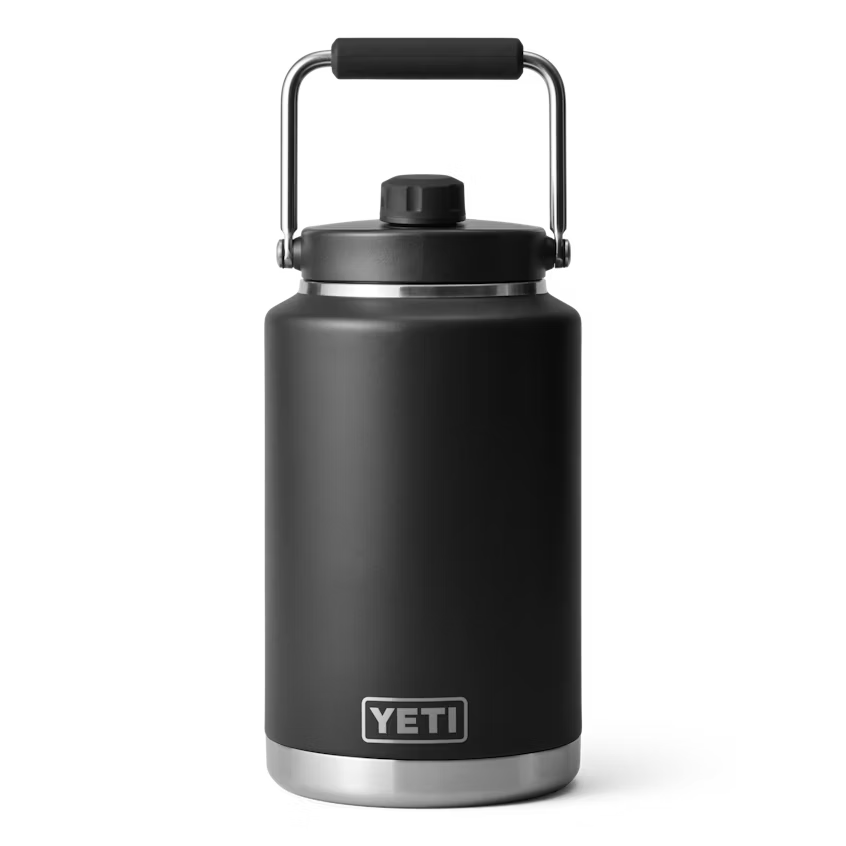
Baking in the sun all day can leave you dehydrated. That’s why it’s important to pack water and lots of it. YETI’s Rambler One Gallon jug is a double-wall vacuum-insulated beast made to keep your water, and lots of it, cold all day. In the hot Florida sun, this is what you want to stay hydrated for a long day of tarpon fishing. We also carry a YETI Yonder Bottle in the skiff. While not insulated, this lightweight water bottle pairs great with the One Gallon Jug, making it easy to top off and sip your water without the inconvenience of drinking from the larger jug.
Andy Mill, with the YETI Jug from our trip to the Keys.
To avoid spooking oceanside tarpon, a clear-tip fly line is essential. The Magnitude Textured Tarpon Clear Tip from Scientific Anglers features a 12-foot clear tip that, when combined with a leader, gives you the stealth needed to make casts to wary fish. This line also features an aggressive taper, perfect for punching through the wind and landing the fly where it needs to be. If the fish are extra spooky, SA offers a full-length clear line as well.
Any tarpon angler would be amiss not to have worm flies in their box. These flies are tarpon crack and work all season long, even when worms aren’t hatching. There are plenty of variations, but Chicone’s Peyote Palolo is a proven pattern. This small worm imitation features a foam tail and brush head that creates a life-like subsurface swimming pattern. Fish it with a two-handed retrieve for the best results.
If you’re looking for a lightweight fishing shirt with classic styling, then consider the Duck Camp Lightweight Fishing Shirt. This button-down technical fishing shirt features cooling technology to keep you comfortable even on those hot, stale days. The shirt is complete with back vents and two large chest pockets, keeping you ready for anything on the water.
Sun shirts definitely fall into the category of essential when it comes to any flats fishing. The Marshwear High Noon Tech Hoodie is one of the lightest we’ve worn to date. The combination of the lightweight knit fabric and exceptional breathability makes it comfortable to wear on hot days with no breeze. They are somewhat snug, so sizing up is recommended if you want a looser feel.
Free Fly may have created the perfect fishing pants with their new Topogrid pant. The fabric on these pants is incredibly light while maintaining impressive durability. But our favorite feature is the new pocket design. The near-perfect upright pockets keep your phone, wallet, and other essentials secure even on rough runs to and from spots.
Any angler fishing the flats is familiar with Buff. These breathable neck gaiters keep the sun off your face and neck, enabling you to fish in confidence, knowing you won’t have to deal with sunburn later. The CoolNet Buff has cooling technology to help stay comfortable in the hot sun. And it helps that this Buff features some sweet tarpon art.
The Costa Grand Catalina sunglasses are a redesign of the timeless classics worn by the likes of Flip Pallot, Stu Apte, and more. These glasses feature the same styling as the originals, but with modern features that anglers have come to expect. Some of our favorite features include built-in sweat channels and removable side shields. The Gold Mirror lenses also do a great job of making tarpon pop on the flats.
Protecting your valuables on the boat is important, especially when you factor in any camera equipment. The new Cayo backpack from YETI borrows the same bombproof design as the Panga backpack we’ve grown to love in a new, slimmer package. For flats skiff where room is limited, the 25L size fits in most hatches and has ample space for all your gear. Its multi-pocket design also gives you options to keep gear organized while staying dry.
Forget your forceps in saltwater, they won’t do much. Instead, a pair of pliers like the Orvis Mirage Pliers gives you the bigger jaws and reliability to be ready in the salt. The jaws feature a lower cutter that eats through mono, fluoro, and even braided lines. The package is complete with a leather sheath that can be secured on a belt, always keeping them an arm’s length away.
The perfect boat shoe should be comfortable, quick drying, and non-marking. The Columbia Castback Shoe fits that bill and more. With a thick, cushioned sole, you’re able to stand on the casting or poling platform all day with minimal fatigue. In addition, the sole is non-marking to avoid annoying scuff marks on the boat. Columbia rounds out this shoe with its Blood ‘n Guts fabric, which, in other words, means it dries fast and resists stains.
Boat Bonuses:
In addition to fishing essentials, these pieces of gear specific to skiffs make the day on the water much more enjoyable.
Line management is crucial in any big game fishing scenario, particularly tarpon fishing. The new stripping bucket from Strip and Feed is the best we’ve tried yet. These sturdy buckets are built to withstand the hard use of fishing and the sun’s damaging rays for years to come. The bucket also features a heavy base that keeps it firmly planted in rough seas. Inside, you’ll find four spikes that work in tandem to keep your fly line from tangling.
Poling a boat is a lot of work, so why make it harder with a sub-quality pole? The new Small Diameter Push Pole from Marquesa Marine is in the running for the best push pole out there. Made of 100% carbon fiber, it’s lightweight and strong. The small diameter also makes it easier to pole a boat all day with less fatigue. If you’re looking for one pole for everything, it’s hard to go wrong with the 24-foot pole.
If you don’t want a stripping bucket but still want line control, the Launch Pad is a great option. This small silicone mat features spikes made to keep your line from tangling, and in the boat. It’s also easy to move to make sure your line is consistently landing on top of the mat.
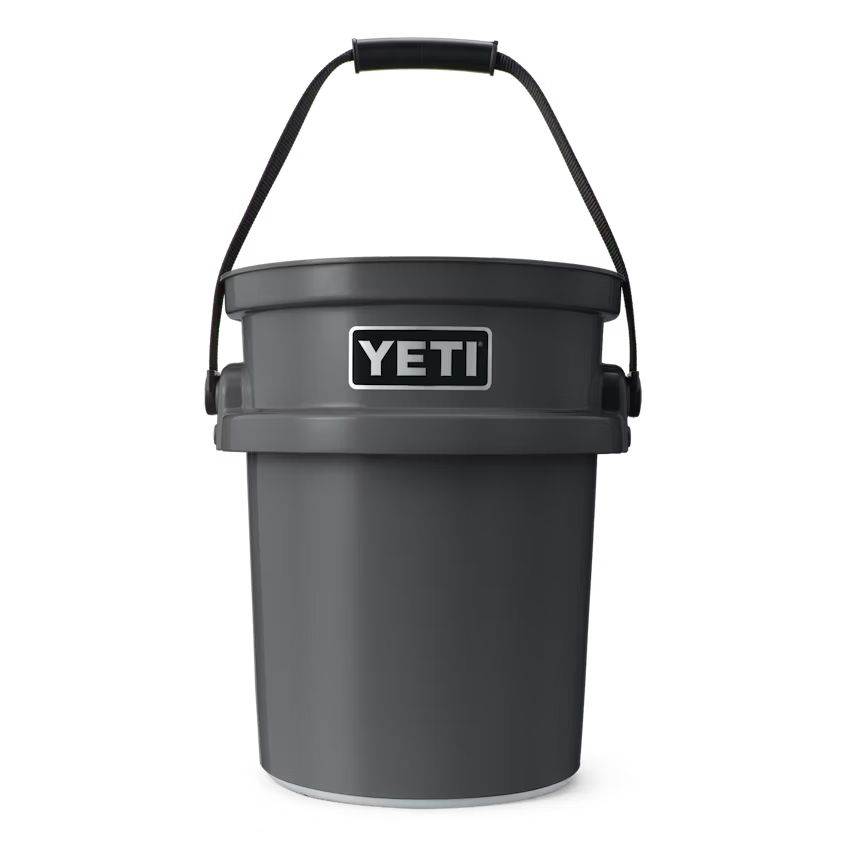
Our last piece of essential gear is a YETI Bucket. This is arguably one of the most versatile pieces of gear, serving as an anchor storage bucket, trash can, or extra storage. With a simple bungee cord, you can secure it to any poling platform, keeping it out of the way until you need it.
Be Prepared
Tarpon are some of the most powerful fish that fly anglers can target. Your gear has to be up to the blistering runs, somersaults, and harsh tropical elements. The tarpon fly fishing gear list we put together features tried and true gear that performs under pressure. We chose premium gear at all price points so any angler in the pursuit of the ultimate flats fish can be prepared.
Welcome back to the inaugural Tarpon Week! In this feature, we sat down with JoEllen Wilson, Bonefish & Tarpon Trust’s Juvenile Tarpon Habitat Program Manager. BTT is deeply engaged in improving bonefish, tarpon, and permit fisheries and habitat through science and advocacy. For a species like tarpon that has enjoyed a great deal of angler-led conservation here in the states, quality habitat is absolutely critical for a healthy population today and long into the future.
It’s no secret that tarpon habitats throughout Florida are under extreme stress from both climate-driven impacts, development, and pollution. That’s why BTT created the Juvenile Tarpon Habitat Initiative. These baby tarpon are the future of the population, but the mangrove habitats they rely on are disappearing at a concerning rate. This BTT initiative seeks to better understand that and turn the tide. Follow along for more on BTT and JoEllen’s critically important work.
Flylords: Introduce yourself! How did you get involved with BTT and fisheries science?
JoEllen: I started working for BTT in 2009 as the first Membership Administrator. Dr. Adams, the Director of BTT at the time, gave a presentation to my college ichthyology class about the need for volunteers. I volunteered with sampling for a few months and joined the organization once the position became available. After a few years as an MA, I was ready to go to graduate school to continue my scientific education, and the next BTT-funded project was juvenile tarpon habitat use. In 2014, upon graduating, BTT re-hired me as the Juvenile Tarpon Habitat Program Manager.
JoEllen Wilson, BTT, finding a baby Tarpon in Coral Creek. PC-FWC
Flylords: So you are leading BTT’s juvenile tarpon habitat initiative–tell us about this work.
JoEllen: When I started the initiative, we were learning the ins and outs of early life history habitat metrics for juvenile tarpon, since it wasn’t well documented in the scientific literature, to create a template of functional nursery habitat. That research led to a framework of nursery habitat conservation measures, including protecting natural habitats and restoring degraded habitats in order of priority. Over a decade later, our main focus is on integrating habitat into fisheries management plans and finding other innovative ways to conserve tarpon nursery habitat.
Flylords: As fishermen, we acutely understand the value of habitat to sustain fish populations and provide actual fishing opportunities. Can you shed some light on the different habitats tarpon utilize?
JoEllen: Tarpon use a coastal habitat mosaic throughout their life cycle, including embayments, backwater coastal ponds, and mangrove-lined tidal creeks as juveniles, estuarine coastlines and rivers as sub-adults, and coastal and offshore habitats as adults. Tarpon don’t mature until about 8-10 years old and live up to 80 years, so the adults that anglers are fishing for are likely decades old. That means that the impact that we’ve seen on juvenile habitats 20 and 30 years ago is just starting to impact the fishery.
Flylords: What about how these habitats are changing? What are the causes?
JoEllen: In Florida, especially, we’ve seen a substantial loss of our marsh and mangrove habitats and even bigger impacts to our water quality. These are effects from nutrient and contaminant runoff, pharmaceuticals leaching from septic tanks in coastal communities, changes in natural watershed flows, and coastal development causing habitat loss. We’ve already lost about 50% of mangrove habitat, which means about 50% of juvenile tarpon habitat.
Flylords: And why are quality habitats so critical to juvenile tarpon? What does the perfect nursery habitat look like?
JoEllen: A tarpon’s reproductive strategy is to produce many in the hopes that a few will survive. They spawn offshore with trillions of eggs, and a small percentage of those will eventually become larvae. The larval stage lasts about 30 days as they make their way from offshore back into the estuaries, and a fraction of those survive. Luckily, juvenile tarpon have evolved to inhabit some of the most inhospitable places with high water temperatures, salinity swings, and low dissolved oxygen levels bordering hypoxia.
But these juvenile tarpon habitats are dwindling because they’re in close proximity to human impacts. We know from previous research that just because we find juvenile tarpon in these habitats, it doesn’t mean they’re functional habitats. Often, we’ll get calls from anglers finding juvenile tarpon in ditches and golf course ponds that larvae can access during storm events, but don’t allow for tarpon to emigrate and rejoin the spawning population. They’re pretty much stuck with limited prey in a confined space. In the early days, we partnered with guides, anglers, and homeowners to identify juvenile tarpon habitats and characterize them as natural or altered. The natural habitats are innately the most productive.
We then recommended the natural habitats for protection and used a ranking system to prioritize the degraded habitats for restoration using factors like feasibility, biology, and connectivity. If we’re going to recommend habitat restoration as a means to combat habitat degradation and loss, we first need to know if it works. BTT tested three variations of juvenile tarpon habitats using characteristics that we observed in natural nursery habitats. We found that a shallow meandering tidal creek system with vegetative edge and connectivity at high tides produced juvenile tarpon with the fastest growth, while the design with constant connectivity and a 2m deep depression had the highest emigration rate.
Flylords: What’s been your/the Initiative’s focus as of late? I know you all have been devoting a lot of time and energy to Charlotte Harbor.
JoEllen: Charlotte Harbor/Boca Grande is known as the Tarpon Fishing Capital of the World, so it makes sense that we’d have a large tarpon conservation effort in this region. BTT currently has six potential juvenile tarpon habitat restoration sites in the area undergoing preliminary design, with permitting and restoration to follow. The other benefit to working in Charlotte Harbor is the many agencies – federal, state, and local – that are willing to partner on tarpon conservation projects. BTT is collaborating with these agencies to create an integrative map that can guide future development in Charlotte County with juvenile tarpon habitat in mind.
Flylords: Tell me more about how this initiative stands to benefit other fisheries or wildlife species?
JoEllen: The benefit of this research is that it is repeatable in other regions for juvenile tarpon and can also be adapted to different habitats and focal species. For example, we’re identifying and quantifying juvenile tarpon habitats, but this same framework can be used for a terrestrial species in upland habitats. Additionally, protected or restored juvenile tarpon habitats also support many other species with similar habitat needs. Like snook, for instance.
Flylords: How can anglers get involved and support this work?
JoEllen: BTT relies heavily on the involvement of anglers and guides to provide knowledge and input on our research. We are still collecting juvenile tarpon locations (tarpon 12” and under) to add to our database, and all sites are kept confidential. We also appeal to residents in coastal communities to be a voice for habitat, which includes converting septic tanks to sewer and advocating for upgrading treatment facilities, foregoing lawn fertilizers, especially in the rainy season, developing in ways that leave natural water flows unaltered, and keeping mangrove habitats intact. Without healthy habitats, we won’t have healthy fisheries.
Tarpon, despite their size, are fragile creatures. Fighting one on the fly and bringing it to the boat is a taxing endeavor. With water quality issues, an increase in angling pressure, and sharks already an issue for tarpon, it’s important to take care of these precious fish. Knowing what to do when the fish is boatside can mean the difference between a healthy release and a belly-up tarpon (and no one wants that). Next time you’re chasing the Silver King, here is how to handle and release a tarpon properly.
Fighting a Tarpon
The first step in safely releasing a tarpon is properly fighting a tarpon. Once you hook a fish, the clock begins. Every minute you spend fighting a tarpon to exhaustion is a minute that leaves them susceptible to predation from sharks. Both bull sharks and hammerheads are known to prey on the Silver King, and a thrashing fish on the end of your line serves as a dinner bell. If you do manage to avoid sharks after a prolonged fight, you leave the tarpon outright exhausted, dramatically reducing their chance of survival. Just because they swim off doesn’t mean they will survive.
The best way to combat both predation and overexhaustion of a tarpon is to fish with the proper gear and fight the tarpon hard and fast. Proper tarpon fly gear consists of 11-weight rods and matching reels. With that also comes using the proper leader. All anglers fishing for tarpon should use a break section or a class tippet of 20-pound or less. This is a lighter piece of tippet or leader material before the bite tippet. If a shark comes after your tarpon, point the rod at the fish and break it off.
An angler pulls on a tarpon with the butt section of the fly rod for maximum fish fighting power.
Lastly, tarpon fly rods are made to put the brakes on these fish. To do so, you have to use the rod to its full potential, meaning utilizing the backbone of the rod. In fly rods, the lower third of the rod is considered the backbone and is where the fighting power comes from. Never high-stick a tarpon; instead keep your rod tip low and pull against the tarpon with the butt section of the rod. When done properly, you can tire out a fish in short order. Keeping fights under 30 to 40 minutes is ideal.
Handling a Tarpon
You’ve survived the jumps, endured battle with a tarpon, and the fish is now boatside, so what’s next? If it’s your first tarpon, chances are you are going to want to take a picture. That’s understandable, but you must follow the proper handling requirements to ensure the fish is released safely and healthy.
Tarpon handling falls into two categories: fish under 40 inches and fish over 40 inches. For these smaller fish, under 40 inches, you can take them out of the water, albeit very, very briefly, for a picture. Handle the fish as little as possible, make sure the camera is ready to go, and quickly lift the fish while supporting its body with your hands (never hold them vertically). The fish should be dripping wet while you snap your photos and return it to the water for a release. Now, while you can take these fish out of the water, it’s best to practice Keep Fish Wet principles.
Even for fish under 40 inches, keeping them in the water as much as possible will ensure their survival.
For tarpon over 40 inches, an entirely different set of rules applies. For starters, never remove these fish from the water. Once they get over 40 inches, the weight of their body out of their water will crush their internal organs, resulting in a dead tarpon. Instead, hold the fish alongside the boat, lean over, and take a quick picture as the tarpon remains in the water and you hold it by the mouth. If you want to know how much your fish weighs, quickly take a length and girth measurement and use the BTT Tarpon Weight Calculator.
Releasing a Tarpon
It’s now time to release your tarpon. To do so, you’ll want to hold the tarpon alongside the boat and allow water to flow over their gills from the head of the fish to the tail. This allows them to breathe and recover before releasing the fish. Never let water run from the tail to the head over the gills; this can actually cause the fish to “drown” and not get the needed oxygen to recover. If you’re in current, hold the fish with its head into the current. For areas with no current, you can put the boat into forward gear and use the least amount of forward throttle necessary to move the boat. Once the fish starts kicking and can swim upright on its own, you can release the tarpon. These release steps apply to all tarpon regardless of their size.