
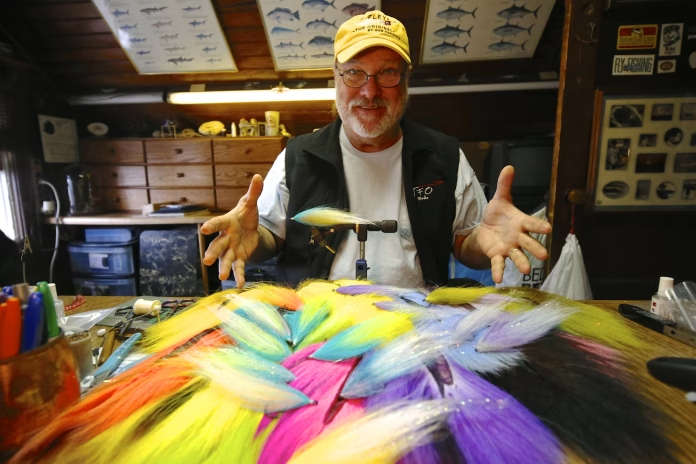
In the final episode of Fly Shop Tour Season 4, we end our Midwestern road trip in the great state of Ohio, where we meet up with the one and only Brian Flechsig from Mad River Outfitters. During our visit, Max and Brian sit down to solve all the world’s problems behind a vise, and later, get into some of the best fishing we’ve ever experienced on the Fly Shop Tour. This isn’t one you’re going to want to miss! Check out the EPIC season finale HERE AND NOW!
Stripping Streames for Great Lakes Steelhead

Call them what you want—steelhead, lake-run rainbows — but migratory Great Lakes trout offer incredible angling opportunities, widely available to Midwest anglers. Steelhead are found in all five of the Great Lakes, and every fall, they make their annual migration into the tributaries to spawn. As the temps drop, anglers head to the river in search of their own sliver of chrome, employing various methods to catch them. But one often overlooked method doesn’t get enough attention: stripping streamers. When done right, it can result in hard grabs from hot fish and ensuing battles no angler will pass up. After fishing with the Mad River Outfitters team on the Fly Shop Tour, here are a few tips we picked up to catch Great Lakes steelhead on streamers.
1. Strip, Strip, Strip

Stripping flies for steelhead is a lot different from traditional two-hand swinging. Rather than a slow swing through a pool, you want your fly moving, and depending on your fishery, how much it’s moving matters. In our case, fishing the Ohio tributaries, the fish wanted the fly moved fast and constantly—pauses in the retrieve turned the fish off. Regardless of where you fish, experiment with the retrieve until you find what they want.
2. Find Fresh Fish

Finding fresh fish is critical when stripping streamers. Fish that have just entered the system are much more active than stale fish that have been in the river for a while. These fresh fish are more likely to chase down and actively eat a streamer. Depending on the river, look for weather events like rainstorms and monitor gauge stations for a bump in flows. Oftentimes, the bump in flows can trigger a fresh push of willing and aggressive fish from the Great Lakes.
3. Fish the Slow Water
While it’s easy to overlook slow-moving frog water, this is your best bet for finding fish to chase and eat a streamer. The tricky part can be finding fish in long stretches of slow water. Since there are no features, like a pocket or soft edge, that will hold fish, they look for cover like an undercut bank or an overhanging tree. Even the smallest structure can hold fish in long stretches of slow-moving water.
4. Target Early Season Fish

Similar to finding fresh fish, fishing the early runs of Great Lakes steelhead will result in more streamer eats. This is especially true if you’re fishing one of the Great Lakes with salmon runs. As salmon enter the river, steelhead will shift their focus to eating eggs. Fishing for the first runs of fish makes your streamer offering a lot more tempting to a hungry steelhead than a fish that’s been gorging on eggs.
Gear Review: Mountain Hardwear Stretchdown Light Pant

Oftentimes, the fly fishing world gets caught up with the latest and greatest gear from its core brands. These brands, like Orvis and Simms, to name a few, have made it their mission to deliver premium products designed specifically for anglers. While that leads to some excellent products, the marketing hype around fly fishing often overlooks other adjacent brands making exceptional gear. One such brand is Mountain Hardwear, a hiking and camping brand whose products fit seamlessly into the angling world.
Mountain Hardwear isn’t exactly known as a fishing outfitter, but believe me when I say the brand builds one of the best cold-weather layers in my winter fishing wardrobe. Engineered to be exceptionally warm, stretchy, and especially durable for a down garment, the Stretchdown Light Pant offers, in my opinion, unmatched performance, longevity, and versatility.
Mountain Hardwear
Stretchdown Light Pant

Key Features:
- 700-fill RDS®-certified down insulation
- Stretch-woven fabric provides durable stretch
- Elastic binding on cuffs to seal in warmth
- Price: $290
Pros:
- Narrow baffle size supports low-profile, easy layering
- Inherent durability, stretch, and insulation make this a super versatile pant
- Aesthetically sharp
- Available in both men’s and women’s sizing
Cons:
- Price
- Can be tedious to wash
- Limited color selection
How We Tested
I unknowingly began testing for this review about four years ago when I first picked up a pair of Stretchdown Pants and instantly fell in love. While there was no specific protocol for testing this garment, the sheer amount of hours I’ve spent fishing and running around in my Stretchdown Pants has been notably more thorough than almost any testing criteria I’ve ever followed. In short, the proof is in the pudding—I’ve tested countless garments in this vein over the past four years, and nothing has yet to replace or outlive my Stretchdown Pants.

Over the past four years, I’ve donned the Stretchdown Pant while camping, made it a travel staple for any trip I expect to combat the extreme cold, and above all else, have worn the hell out of it while winter fishing. My pair has, at this point, come along on countless fishing trips both near and far, and is performing just as strongly as it did off the rack.
While I most frequently utilize these pants as an insulating layer beneath the protective shell of my bibs or waders, they’ve also seen plenty of mileage worn on their own. My Stretchdown Pants have been my first line of defense against many different unforgiving outdoor environments and weather forecasts, and they’re still in service. Let’s get into it.
The Good
Warmth
Equipped with 700-fill RDS®-certified down insulation, Mountain Hardwear has properly prepared the Stretchdown Pant to ward off truly frigid conditions. Combine the ample natural down insulation with the elastic binding at the ankle cuffs, and you’ve got yourself a pair of pants that traps your body heat while simultaneously eliminating the entry of chilly drafts.
Stretch
You might already own a nice pair of down pants, but can you do karate in them?? Arguably, the feature that sets this garment the farthest apart from the competition, Mountain Hardwear has engineered the Stretchdown Light Pant with a degree of stretch you’ll be surprised by.
While utilizing these pants for fly fishing applications will rarely demand you to test the limits of the ultra-engineered Stretchdown™ construction, remember that these pants are designed with rock climbing in mind, so they’re more than willing to be twisted, bent, and contorted in every direction possible. At the very least, you won’t have to worry about busting a seam or tearing any stitching when you bend to lace up your wading boots or clamber out of the river up onto the bank. More active winter anglers who log lots of miles hiking into their favorite honey holes will very much find a friend in the stretch fabric here.
Durability + Lifespan
My winter wardrobe has seen quite a few down garments come and go over the last half-decade, and my Stretchdown Pants remain a staple despite the duration of their service. Built with 20D Durable Stretch Doubleweave fabric, the shell of these pants is notably tougher than what you typically see in down garments.
That being said, this is still a down garment at the end of the day, so the outer material of the Stretchdown Pant is still quite susceptible to punctures and tears; so treat it as kindly as you can.
Packability + Bulk & Layering Ability
Other endearing qualities of the Stretchdown Pant include its ability to pack compact and lightweight, as well as to layer nicely under a shell, or over a base layer (or both).

Weighing in at just 13.1 ounces (size medium) and inherently compressible due to the fact that it’s a down garment, you can easily squeeze these pants into an already full pack, so there’s no excuse not to bring the Stretchdown Pant on virtually any chilly day-trip or international fish mission.
Mountain Hardwear’s Stretchdown™ construction weaves the baffles from a single stretch fabric, resulting in narrower baffles for low-profile, easy layering. It’s easy to tell the moment you put these pants on that they are designed for high-speed/low-drag, so they work very well when worn beneath waders or bibs, while still retaining just enough room for a base layer underneath.
Aesthetics
Somehow, some way, Mountain Hardwear has engineered a down pant here that you can get away with wearing around town, to the fly shop, base lodge, and beyond. While I love the unparalleled warmth provided by down pants, the Stretchdown Pant is the only pair I feel confident enough to wear out in public without feeling like a total dweeb.
I think the Strechdown Pants avoid the aesthetic awkwardness typical of most down pants for two reasons: the slim profile, and lack of glossy sheen/shine on the fabric. Not only do these pants wear slimmer and more reminiscent of regular pants, but they also don’t catch and reflect the light like the outer shell of most down garments. Elastic binding at the cuffs also adds to the Stretchdown’s look, almost creating a kind of tapered, jogger aesthetic, which I, for one, am a big fan of.
Pockets
Let’s not forget the benefit of a solid pocket schematic. While I dominantly wear my Stretchdown Pants underneath my bibs or waders, I also frequently don them over a base layer for regular cold-weather wear. Designed with two open-top soft-brushed hand pockets and two hook-and-loop-secured rear patch pockets, there’s a stash spot for all your typical on-hand essentials.
The Bad
Price
At almost 300 bucks, this is certainly an investment purchase. Truth be told, you could pivot those fishing funds towards a new pair of waders, a reel, or a complete merino base layer set, to name just a few ideas. If you’re planning to wear the Stretchdown Pant solely as an under-wader or under-bib pant, there are options that are both more affordable and better suited to the task. The same goes for those seeking an insulated pair of general-purpose outdoor pants—there are cheaper, more rugged options on the market.
The value of the Stretchdown Light Pant lies in its ability to adapt to many different cold-weather scenarios, so anglers who purchase this pant to check multiple chilly boxes will find it’s more than worth the price. In summary, even if you’re on a tight budget, these pants are totally worth it if you plan on utilizing them to their fullest potential. As solely an under-wader pant, I’d recommend directing your budget elsewhere.
Washing
Like all down garments, the Strechdown Light Pant poses a bit of a hurdle when it comes to washing. I do my best to run mine through the wash as minimally as possible, but cleaning your outdoor garments is obviously inevitable. While we recommend using a laundry soap specifically designed for washing down garments, you may still have to go up against the Stretchdown Pant due to its construction. Because the pants use a continuous grid rather than individual pockets of down insulation, the fill tends to clump, so you may find yourself tediously redistributing it. Mountain Hardwear’s choice to stuff the Stretchdown Pant in this manner has a lot to do with the pant’s inherently awesome degree of stretch, so it’s a necessary evil that dramatically boosts mobility at the cost of added maintenance.
Lack of colors
Alright, a lack of color selection is hardly a reason to bash the Stretchdown Pant, but considering this garment is so versatile in its applications and suitable for around-town wear, it’s a shame there aren’t more aesthetics available to personalize your look. If you’re not a fan of camo or the stone green colorway, you’re out of luck.
Final Word
The key takeaway here is once again, versatility. While I recognize that the needs and preferences of no two anglers are the same, it was immediately obvious to me that the Stetchdown Light Pant was the superior option for my needs as both a fisherman and an outdoorsman in general. While I’ve added many base layers, under-wader pants, and cozy sweats to my winter wardrobe, I’ve yet to find a garment that offers this level of adaptability. A true cold-weather chameleon, Mountain Hardwear drives a hard bargain with the price point of the Stetchdown Light Pant, but we’re here to tell you that these pants have legs.
The Spring Collection: The 5 Best Streamers for Spring Run Off and How to Fish Them

As an admitted streamer junkie, I fish with big bugs all year long. I sink streamers into deep holes during the dog days of summer, cast and rip them through big water in the fall, and even slowly work them along the bottom during the winter. Yet, when someone asks me what my favorite time of year to fish streamers is, there’s no question that it’s spring.
A lot of fly anglers dislike the gray, dirty water of the early season. Yet, when the water is high and colored up with run-off from snow melt and torrential rains, big trout are meat-hungry and hurl themselves on streamers with reckless abandon. It’s a time of year that provides both consistent action as well as some truly big fish. However, to capitalize on the spring streamer bounty, you need to fish in the right places with the right techniques and above all—use the right flies. Spring streamers need to be big and juicy-looking, while still providing the right action for the different water conditions you may encounter. So whenever and wherever I’m chasing trout in the spring, these five streamer patterns are always in my box.
Coffey’s Sparkle Minnow
Coffey’s Sparkle Minnow

The smallest streamer on the list, Coffey’s Sparkle Minnow, still packs a big punch. It’s especially effective during the earliest part of the spring, when runoff has just begun, and the water hasn’t quite shaken off winter’s chill. Trout are sluggish during this time of year and will push into extremely shallow water to look for a meal that both stands out in the slightly cloudy water and that they won’t have to work hard to catch. The Sparkle Minnow just checks all these boxes.
With a body made of Wing-n-Flash and a brightly colored marabou tail, the Sparkle Minnow is a perfect wounded/dying baitfish imitation. It has a large conehead, which makes it sink fast, and is ideal for casting into the shallow, sandy flats along bank edges where early spring trout first begin to show up. I prefer to fish it with a couple of quick strips and then long pauses that allow the fly to sink all the way to the bottom, where it can click and bounce along the rocks. This action calls in slow-moving trout and gives them plenty of time to both see the fly and decide to strike.
Mike’s Meal Ticket
Mike’s Meal Ticket

Once run-off begins in earnest and the water gets high and discolored, trout push up into the soft water right against the bank and other structure to look for big meals that are within easy reach. Catching fish during this time requires a fly with a big profile that makes an impression, so it will get a quick reaction from the fish. Nothing is better for that sort of work than Mike’s Meal Ticket.
Invented by infamous big bug tyer Mike Schmidt, this largish streamer comes with heavy dumbbell eyes, rubber legs, and a lot of flash. Yet the fly maintains a sleek and easy-to-see profile as soon as it hits the water. It’s the perfect pattern for smacking along the edges of undercut banks, pitching under bushes, and dropping into the center of big boulder gardens, log jams, and other cover where big trout hold during high water. The Meal Ticket is not a fly that you want to work and strip all the way back to the boat. Instead, splash it down and twitch it a few times, and if it doesn’t get absolutely smashed within a few seconds, move on and drop it into the next likely looking spot.
Double Deceiver
Double Deceiver

As run off begins to subside slightly so that the fish have a bit more room to move, big trout begin hunting along bank edges for baitfish and small trout that have been swept up by the current. Once this happens, start fishing streamers that can be drifted and twitched downstream to offer them an easy meal. My favorite pattern for that kind of presentation is the Double Deceiver.

Essentially a beefed-up classic Deceiver fly, the Double Deceiver is a large baitfish pattern made up of two hooks and a bucktail body with long schlappen tail feathers. The pattern is neutrally buoyant, so that it only sinks a few feet below the surface while creating a long and very realistic-looking profile and a lifelike swimming action. My favorite way to fish DD’s during the spring is to cast them a few inches off the bank and then make one or two strips so that the fly is right on the edge of the main current. Then, I’ll make a slight downstream mend and allow the fly to dead drift downstream while making the occasional twitch or jerk with my rod tip to imitate a wounded baitfish and an easy target.
CJ’s Sluggo
CJ’s Sluggo

When run-off has begun to die down and flows close to normal, the water usually remains extremely stained. In these conditions, big trout will often begin to chase and roll on streamers without actually striking them. It was the kind of thing that used to drive me crazy and almost caused me to put my streamers away and start nymphing (yuck). Yet, as luck would have it, I finally found a streamer pattern that changed these chases into hard grabs—CJ’s Sluggo.

In stained, post-heavy run-off water, big trout will chase almost anything, but really need a target they can line up on before they’ll eat, making the Sluggo the perfect weapon. Invented by Chad Johnson, who guides the fabled waters of the White River in Cotter, Arkansas, the Sluggo has an articulated body similar to a Double Deceiver, which presents an appealing and meaty profile for big hungry trout. However, the real magic of the pattern is in the fly’s head, which is made of stacked and contoured deer hair. Designed for sharp turns when it’s stripped hard and then paused, the thick head of the Sluggo causes the fly to turn sharply sideways, offering any pursuing trout the perfect broadside shot. Once I start having a lot of follows without a lot of grabs, I’ll send in the Sluggo by stripping it hard and fast off the bank and then suddenly pausing it mid-river, where it almost always gets the trout to commit.
Dolly Llama
Dolly Llama

All these streamer patterns have their place and are incredibly effective during specific conditions. However, if I had to pick a Swiss-Army style streamer pattern that will work fairly well during the spring in almost any water condition, it would be the Dolly Llama. Designed in Alaska during the late 90s to target big hungry rainbows, char, and even salmon, the Dolly Llama just screams “eat me” at big spring trout.

Tied with a heavy cone head, a shaggy rabbit zonker body, and a long strip of gaudy flash, the Dolly is a great fly for both banging against overflowing banks and for stripping through heavy run-off where trout hold in deeper pockets of slower-moving water. The rabbit strips also give the fly a very lifelike, undulating motion beneath the surface, making it ideal for swinging through the pillows of slower-moving currents that are surrounded by faster flows. While the Dolly isn’t always the most consistently effective spring streamer, I’ve found it to be dependable, as it will usually get a tug or two when nothing else seems to be working.
Spring Fever
After a long winter of slow and sluggish fishing (or hiding on your couch watching fishing videos), fishing streamers during the spring is a fantastic way to cut loose and shake off the cobwebs. The trout are usually hungry, and casting a big fly for a long length of time is the perfect way to get the blood flowing and to start your fishing season off with a bang. Plus, when you fish with the right streamers, the action can be hot enough to make you forget those beautiful, clearwater days of summer and make fishing in the dark, dirty water of spring your favorite time of year.
Aguas Arriba: A Different Current in Fly Fishing

For nearly two decades, a fly fishing show out of Argentina has been building something most of the mainstream hasn’t fully seen, largely because it’s existed outside the channels that define modern fly fishing media.
Aguas Arriba now available on Waypoint TV and YouTube, first aired in the late 2000s on ESPN, before social media, before algorithms, before fly fishing became content. Co-founders Fran Mariani and Pablo Rodrigo Perez weren’t chasing distribution or audience growth. They were trying to share something they already loved.
“We loved what we were doing, and we wanted to promote it,” Fran said. “At that time there was no YouTube, nothing. The best way was a TV show.”
So they made one. At the time, it wasn’t just early, it was essentially the only show of its kind in the region, and it still is.

Built to be Understood
That origin still shapes everything about the show today. Each episode runs roughly 24 minutes, a format that now feels almost out of place. It moves at a slower pace because it was never designed to be consumed and forgotten; it was built to be understood.
The intention was always to teach, to document, and to give people time to take in what they were seeing. In contrast to the fast, short-form content that dominates media today, Aguas Arriba creates space. You settle into it, learn something, and stay with it longer than you expected to. That pace is intentional because the stories come from places they’ve known their whole lives.
“We show places we’ve fished since we were kids,” Fran said. “We know them. We really know what we are talking about.”
And when they step into new water, that approach doesn’t change. They don’t arrive with answers. They listen, rely on local knowledge, and let the place shape how it’s fished. That humility carries through everything they produce.
Pablo Rodrigo Pérez and the Recognition Gap
At the center of it all is Pablo Rodrigo Pérez, a name that, for most U.S. anglers, doesn’t carry much recognition. But it probably should.
Pérez is a second-generation angler, taught by his father Benito Pérez, one of the early pioneers of fly fishing in Argentina. He has spent decades guiding, teaching, and shaping the sport across the region. He is a certified instructor through Fly Fishers International, a master instructor, a longtime shop owner, and a mentor to hundreds of anglers entering the sport each year. But credentials alone don’t fully capture it.
“He knows more than anyone,” Fran said. “And he’s a super humble guy.”
Part of that depth comes from the environment he was raised in. For a long time, much of the technical knowledge available to anglers came from the Northern Hemisphere, often applied to very different ecosystems. Pablo’s father helped shift that, developing one of the first bodies of work focused on Southern Hemisphere entomology and building a more accurate understanding of the insects, conditions, and behaviors anglers were actually encountering.
That foundation shaped how Pablo approaches the water today. His knowledge is built from the ground up, specific to the places he fishes and teaches. It’s also part of why his influence hasn’t translated cleanly to a global audience. Much of that work has remained local, embedded in the development of the sport rather than broadcast through the channels that typically define recognition.
Fran put it plainly, “He would be like a legend if he was born in the U.S.”
Instead, his impact has taken shape on the ground, helping build fly fishing across Latin America, even if much of that work hasn’t yet reached a broader audience.

Building the Sport From the Ground Up
In much of the west, fly fishing is mature. It has infrastructure, access, and a deeply established culture. In much of Latin America, that foundation is still being built.
“All Latin America, except Chile and Argentina, is underdeveloped in terms of fly fishing,” Fran said.
Rather than seeing that as a limitation, they’ve treated it as a responsibility. Through their academy, clinics, and partnerships, they are actively introducing new anglers to the sport and shaping how it evolves. Education is central to that effort. They produce structured courses, teach casting and entomology, and train instructors who eventually go on to teach others.
At the same time, they’ve started to rethink how the industry connects with anglers. Fran described it as a “cardumen,” a school of fish moving together, an idea that reflects how they’ve built everything around community rather than individual recognition.
“It’s like Montana 100 years ago,” Fran said, describing low-pressure water, vast open landscapes, and fisheries that haven’t been heavily trafficked. “You fish alone. Amazing people. Amazing food. Amazing places.”
The goal is not just growth, it’s transformation. “If we can evolve traditional fishing into a more conscious way of fishing, that’s better for the resource,” he said.

Coming Into View
For Fran, this isn’t just about expanding into the U.S. market. It’s about closing a gap that has existed for years.
“We’ve been doing this for ages,” he said. “Building from the foundations of the sport. And it’s not being seen in the U.S.”
That gap creates opportunity in both directions. There is value in bringing more visibility to what’s happening across Latin America, while also reaching growing audiences in the U.S. that remain underrepresented in fly fishing media.
What Aguas Arriba offers is not a new version of the sport, but a different perspective on it, one that has been developing in parallel, shaped by different conditions and histories. It comes from time on the water, not just filming it, but understanding it, refining it, and passing it on. Knowledge built over decades, rooted in place, and shared in a way that still feels true to where it came from.
Underneath all of it is something Fran describes simply as “Fish Simply,” a way of approaching the sport that prioritizes doing things the right way, choosing people carefully, and building something that lasts. That idea runs through everything they’ve built, from the show to the way they teach and approach the water.
Aguas Arriba offers a chance to expand how we think about the sport, to look beyond what’s familiar, and to become more connected, more aware, and more global anglers.
Check out Aguas Arriba and see it for yourself.

Maine Fly Fishing Only Law Challenged In Supreme Court

Maine’s supreme court has agreed to hear challenges against the state’s fly fishing only regulations, which were the subject of a recent lawsuit. Plaintiffs who want the fly fishing only regulations overturned succeeded in appealing a lower court ruling that sided with keeping the state’s current regulations in place.
Why The Fight?
Some of Maine’s wild brook trout and landlocked salmon fisheries are under fly fishing only regulations to help reduce fish mortality and protect fragile populations, according to the state. However, when Maine’s legislature passed a constitutional amendment in 2021 that guaranteed a right to food for all citizens, the plaintiffs decided that the constitutional amendment should override any gear restrictions on harvesting fish.
The couple, a family with the last name of Legendres, says that fly fishing is only accessible to those in a higher income bracket. Therefore, fly fishing only regulations in Maine unfairly target and “discriminate against working-class people.”
When the Legendres filed their initial lawsuit, plenty of anglers within Maine spoke out against their logical fallacy, including Bob Mallard.
The Ruling
Since a lower court sided with the state, the Legendres have challenged it to the state supreme court, which has agreed to hear the case. Whether the court agrees to a full hearing, or simply sides with the lower court ruling, remains to be seen.
The Fight
Some of Maine’s best native brook trout waters are currently under fly fishing only regulations to preserve and protect this native species. One family—Joe and Samantha Legendre—has filed suit against the Maine Department of Inland Fisheries and Wildlife to remove those regulations and allow any fishing tackle to be used statewide. Not doing so, they argue, runs afoul of the Right to Food law, which was passed in 2021.
Bob Mallard, a former fly shop owner in Maine, rebutted that point by recounting his own experiences there in the state.
“My fly shop customers were mostly working-class people, and certainly not what you would call wealthy,” Mallard wrote. “They worked in the woods, trades, retail, services, and the two local paper mills. Many were self-employed. They fly fished because they enjoyed it. And most ice fished during the long Maine winter, while many did at least some level of spin fishing.”
Mallard also didn’t mince words when offering his opinion on Maine’s Right to Food law, either.
“When a law is passed that doesn’t address any real issue, as was the case regarding Maine’s Right to Food law, I always worry how it will be used up the road,” he said. “In this case, the first thing that came to mind was fishing and hunting. Unfortunately, my concerns proved correct as the law has now been used twice to try to undermine Maine’s hunting and fishing laws. And if it is not abolished or amended to provide absolute clarity, it will inevitably be used again.”
The Best Saltwater Wading Boots of 2026

Wading boots are an essential part of fly fishing. They are responsible for getting you to and from where you are fishing, providing traction on slick surfaces, and supporting your feet for a long day on the water. Saltwater wading boots provide the same benefits and have an added level of protection against corrosive saltwater compared to regular wading boots. They aren’t glamorous and certainly don’t get the same love as rods and reels. Nonetheless, they are an essential piece of saltwater fishing gear that every angler uses. Taking the time to find the right footwear will have your feet thanking you in the long run. With that in mind, here are some of our favorite options, from fishing sand flats in the Bahamas to rock jetties in New England.

Best Saltwater Wading Boots of 2025
- Best Overall: Orvis Ultralight Boot
- Best for Waders: Simms FreeSalt Boot
- Best for Wet Wading: Orvis PRO Approach Saltwater Hiker
- Best Budget: Frogg Toggs Aransas Surf and Sand Shoe
- Best Wading Shoe/Lightweight: Korkers All Axis Shoe
- Best Sneaker: Simms Flats Sneaker

How We Tested:
In order to narrow down our favorite wading footwear for the salt, we tested an array of different products across multiple fisheries and fishermen. From chasing bonefish and permit on Mexican sand flats to striped bass from Cape Cod jetties and salt marsh habitats, we hit all the bases. The big three factors for scoring unsurprisingly included performance, comfort, and durability. The rigors of fishing in saltwater environments are especially hard on your gear and your body, so we gave each boot’s comfort rating and overall fit and feel a lot of weight here.

An average day of flats fishing while field testing gear in Mexico entailed 15-20 miles of walking, so wading boots that didn’t feel anything short of great underfoot were quickly cut. The abuses of the saltwater theatre while testing in the Northeast were equally punishing, demanding our saltwater wading boots to go up against slick rock scrambles, pounding surf, and mucky estuary bottoms. We didn’t go easy on our wading footwear, so we feel confident we weeded out each pair’s advantages and shortcomings.
Not to be overlooked, we found versatility in function to be one of our top criteria for testing. Saltwater wading boots that are perfectly tailored to your specific angling style and fishery are wonderful, but wading boots that hit all the bases for multiple habitats and types of angling endeavors are even better. We found that the advantages of some boots transcended quite a few fly fishing styles, so points were awarded accordingly.

Best Overall: Orvis Ultralight Boot
Best Overall
Orvis Ultralight Boot

Key Features:
- 100% recycled ripstop polyester upper construction with laminated TPU mudguard
- Non-removable EVA insoles and EVA midsoles
- Stud-compatible Michelin® rubber outsoles
- Breathable, quick-draining Ariaprene® tongue retains less water, and dries faster than the previous generation Ultralight Boot
Pros:
- Versatile choice, great for pairing with waders or wet wading
- Lightweight construction keeps the spring in your step at just 40.5 ounces per pair
- Available in women’s sizing
Cons:
- May allow fine debris to enter the boot if wet wading without a gravel guard
The Orvis Ultralight Boot is our pick for the best overall boot, thanks to its exceptional versatility in numerous saltwater wading contexts. Built with a 100% recycled ripstop polyester upper construction and laminated TPU mudguard, these boots are impressively durable for their weight (40.5 ounces per pair). They might not be as durable as heavier wading boot options, but you’ll no doubt be impressed with their integrity and lifespan, as long as you’re not consistently using them in absolutely punishing environments, such as oyster beds and hard coral.
I was a huge fan of Orvis’s last iteration of the Ultralight Boot, and the newer model is truly enhanced. They retain less water and dry faster than the previous generation. They also feature a new sole compound and lug shape for better grip and self-cleaning properties. The boots utilize closed-cell foam in the sidewalls (previous generation had open-cell foam) that is thinner, less absorbent, and wraps the ankle comfortably while providing better impact protection.
As a northeast angler who targets striped bass from rock jetties and gnarly shore structure, I love that the Ultralights are stud-compatible for some added traction. The Michelin® rubber outsoles are killer on their own, but having the option to add studs takes the versatility of these boots to the next level. When wearing the Ultralights without waders, a 3mm neoprene sock is perfect for wet wading endeavors.
Best for Waders: Simms FreeSalt Boot
Best for Waders
Simms FreeSalt Boot

Key Features:
- Dual-density EVA midsole
- Non-marking, boat-friendly, gum rubber outsole is stud compatible
- Neoprene lining ensures easy on and off, added insulation, and premium comfort
Pros:
- Built with non-corrosive, saltwater-friendly materials throughout the boot design
- Design is ideal for scenarios demanding extra ankle support and overall durability
Cons:
- Not an ideal wet wading boot due to the inherently higher weight (54 ounces)
Some saltwater anglers find themselves in areas like the northeast with cold water and slick rock faces. In these scenarios, wet wading is oftentimes not an option. Enter the Simms FreeSalt wading boot, a wading system designed specifically to be worn with waders in the salt.

This burly boot is designed with slick and cold conditions in mind. The non-marking outsoles offer plenty of traction and can be paired with Simms Hardbite cleats/studs or Alumibite Star Cleats for added grip. High, sturdy sides provide exceptional ankle support for rock jetties and precarious wading conditions where you need to endure the pounding surf. The Neoprene lining goes on to add some insulation benefit when water temps are chilly, and also assists with easy on and off action. Like any wading boot Simms makes, the FreeSalts are designed with comfort in mind. A dual-density EVA midsole offers plenty of cushion and support to fish all day with minimal fatigue.
If you find yourself in a scenario in which you’d like to wet wade, this boot can do that, too. Just make sure to add a neoprene wet wading sock to effectively simulate the neoprene booty found in waders. If you want to utilize the FreeSalts out on the boat, the gum rubber outsole is conveniently non-marking and boat-friendly (as long as you haven’t equipped them with studs).
Best for Wet Wading: Orvis PRO Approach Saltwater Hiker
Best for Wet Wading
Orvis PRO Approach Saltwater Hiker

Key Features:
- Unique boot/bootie hybrid design employing traditional laces with a zippered gravel guard
- Abrasion-resistant PU cast exterior and tough rubber toe ensure high durability
- Easy-grab heel loops on lace cover and liner heel for easy on and off
Pros:
- Provides far superior ankle support when compared to traditional neoprene booties
- Designed for barefoot comfort, so no wading socks required
- Great for conquering especially suction-prone environments such as mud flats and estuaries
Cons:
- Gravel guard has a tendency to trap shell bits when wading in deeper mud
- Designed exclusively for wet wading, so the sizing won’t allow you to pair these with waders
Orvis set out to design a wet-wading boot capable of handling any warm saltwater fishery with the Approach Pro Hiker Salt. After putting these feature-rich booties to the test in the Bahamas, Orvis achieved this in a lightweight and comfortable package. Perfect for the flats fisherman who crushes miles, anglers who put in a lot of steps per day will find a friend here.
Unlike traditional neoprene flats booties, this unique wading option is designed to offer maximum support. This is achieved with an inner laced boot extending over the ankle and an integrated outer gravel guard to keep sand away from your feet. The result is a much sportier and snug feel than traditional booties. This makes the Approach PRO Hikers surprisingly just as suitable for clambering on sketchy rock jetties as they are for traversing sand and mud flats. The combination of inner boot body and outer gravel guard furthermore very effectively protects your feet from debris, so no more pouring out pesky sand midday (the one exception we found was in deep mud where shell fragments occasionally sneak in).
When it comes to traction, Orvis has employed an exclusive, non-marking Michelin® outsole for killer grip on both wet and dry surfaces. The soles are totally boat-friendly, so you won’t scuff or mark up the bow when you’re jumping on and off the flats skiff. The outsole also feels inherently more robust than your average bootie, so you can comfortably walk over uneven, hard surfaces without any pokey pressure underfoot.
Best Budget: Frogg Toggs Men’s Aransas 3.0 Waterproof Surf & Sand Shoe
Best Budget
Frogg Toggs Aransas Surf & Sand Shoe

Key Features:
- Zippered closure featuring a full gusset
- Reinforced toe and heel cap for added durability
- Adjustable ankle-tension strap
Pros:
- Affordable price point
- Pack compact for travel
Cons:
- Offers little ankle support
- Expected lifespan is not terribly long if you’re hard on your gear
Fly fishermen seeking an affordable and reliable option for casual saltwater wading should consider the Aransas 3.0 Surf and Sand Shoe. While this option might not offer the same level of premium support, comfort rating, and long-term durability as higher-quality boots, that doesn’t mean it’s not a perfectly suitable choice for the right wading contexts.
Built with a 5mm neoprene upper and a high-density front zipper featuring a full gusset, the Aransas is designed to form a snug fit around your ankle and block out debris. The lack of laces means you won’t feel quite as snug and supported in there, but an adjustable ankle-tension strap at least enables you to cinch these booties down fairly well. The rubber outsole provides solid traction on wet and dry surfaces, but we don’t recommend these booties for use over hard surfaces. This recommendation has more to do with support than it does traction—the inherent design of the Aransas Shoe just doesn’t feel as solid underfoot while traversing uneven, rocky, or coral-ridden terrain. Frogg Toggs has named this wade shoe the “Surf & Sand Shoe” for a reason—it thrives when worn on sand/mud flats, and while fishing uniform coastlines.
If you wet-wade over mostly friendly, even terrain, you will find the Aransas 3.0 hits all the necessary bases without breaking the bank. Not to be overlooked, these are awesome booties for kayak missions, shore fishing, and all sorts of outdoor light-duty, so the versatility here extends beyond saltwater wet wading applications.
Best Wading Shoe: Korkers All Axis Shoe
Best Wading Shoe
Korkers All Axis Shoe

Key Features:
- OmniTrax® Interchangeable Sole System allows you to select from multiple outsoles and customize your traction based on your needs
- EVA midsole provides solid rebound and shock absorption
- Mono-mesh side panels block sediment and effectively vent to keep feet cool on hot days
- Underfoot sole plate for added protection from rocks, coral, and uneven terrain
Pros:
- Extremely lightweight at just 30 ounces per pair
- Very versatile option suitable for all sorts of salt and freshwater wading/fishing scenarios
- Interchangeable soles enable you to experiment with different traction options, and also to replace your favorite outsole when it eventually wears out
Cons:
- Lack of ankle support
- No integrated gravel guard or gusset to exclude finer debris and sediment
Korkers is known for building innovative wading solutions, and the All Axis Shoe is no exception. Similar in looks to a regular sneaker, this shoe is designed specifically for wet wading and is a versatile fishing footwear option.
Featuring mesh sides for low total weight, ample air circulation, and quick dry times, the All Axis Shoe is a very bare-bones, high-speed wading option for those anglers who put in a lot of steps each day and want to remain nimble on their feet. An EVA midsole provides solid rebound and shock absorption, while an underfoot sole plate adds protection from rocks, coral, and uneven terrain.
Like other Korkers, this shoe comes equipped with the OmniTrax® interchangeable sole system, so you can choose your outsole based on the day of fishing ahead of you. We found that we prefer the Trailtrac sole for maximum versatility. It’s great for getting in and out of boats and fishing various bottom types. If you find yourself most frequently wet wading over hard bottom, more thoroughly studded options are available. Korkers even offers their Kling-On Deck Gum Sole as an option here if you want your wet wading footwear to instantly double as deck shoes.
Beyond the All Axis Shoe’s versatile soles, these sporty wet wade shoes are also compact and lightweight (30 ounces per pair). This makes them a stellar choice for both quick grab-and-go missions as well as international trips. The utilized materials here are furthermore hydrophobic, so the All Axis Shoes dry that much faster when it comes time to stuff them back in your pack. The combination of its lightweight design, quick-drying features, and comfortable fit makes this a great option to simply keep in the boat or truck. If you find a particular flat or piece of water that looks good, slip them on, and you’re ready to wade.
Best Sneaker: Simms Flats Sneaker
Best Sneaker
Simms Flats Sneaker

Key Features:
- Traditional lace-up closure with reinforced eyelets
- Rigid, reinforced TPU upper with an emphasis on support
- Non-marking, gum rubber outsole provides wet/dry traction
- Molded rubber toe and heel cap for added integrity
Pros:
- Neoprene liner ensures all-day comfort
- A highly versatile option great for the rocks, the flats, and the boat
- Provide excellent ankle support and rigidity for especially challenging wading environments
Cons:
- The sneakers are purpose-built to be stiff, so there’s a break-in period
- Not compatible with studs
- Tall uppers and heavier weight (45 ounces) mean these aren’t especially packable for travel
- May allow fine debris to enter the boot if wet wading without a gravel guard
Flats fishermen who demand a high level of integrity and support from their wading footwear should consider the Simms Flats Sneaker. Built for maximum sure-footedness over dodgy uneven terrain, this purpose-built workhorse is ideal for navigating the most pokey and unforgiving flats.
Simms describes the Flats Sneaker as “combining rugged puncture resistance for sharp, rocky terrain and a sneaker-like fit for effortless on-the-go comfort and support,” and we couldn’t agree more. This is a high-speed wading option that offers the durability and support of traditional boots, along with the sportiness of an agile sneaker.

The former model of Flats Sneaker featured wonderful performance, but fell short regarding integrity. I’ve seen more than a couple of pairs of Flats Sneakers delaminate at the sole and blow out firsthand over the years; yet my angling companions would return to the same model of footwear due to its performance during its lifespan. If you fall into this category, the new Flats Sneakers feature reinforced soles and seams. Designed with a reinforced TPU upper, non-corrosive hardware, and molded rubber toe and heel caps, Simms has engineered the Flats Sneakers with a longer lifespan and overall integrity in mind.
We recommend these sneakers for wet wading applications, but if you size them accordingly, we don’t see any reason they won’t wear just fine with waders. Simm’s Guide Wet Wading Sock pairs wonderfully with the Flats Sneaker, but if you already have a favorite sock for wet wading, chances are it’s a great match as well.
What You Need to Know About Saltwater Wading Boots:

Saltwater wading boots endure more than most wading boots. Corrosive conditions, varying bottom types, and harsh UV rays mean the boot must be built to withstand these conditions for seasons to come. When looking for a good boot, it’s important to consider where you fish, how you fish, and the needs of your feet.
Where You Fish:
Depending on where you fish, your footwear needs may dramatically change. Anglers in the northeast face slick rock jetties and cold water. For these scenarios, a boot made to use with waders, with lots of traction and good ankle support, is a must. On the other end of the spectrum, tropical anglers should look for lightweight wet-wading boots that keep sand and debris away from their feet. Consider the conditions you’ll be facing before deciding on your saltwater wading boot.
How You Fish:
Determining the needs of how you fish is equally important when deciding on your preferred boot. If you are a mobile angler who likes to cover water, finding lightweight boots with plenty of foot support is essential for long days on the water. In comparison, anglers who fish from a boat and occasionally get out to wade a flat should look into a sneaker style they can throw on and take up a minimal amount of space.
Boot Fit and Features:
Every angler has different requirements for how a boot fits. It’s important to consider this when buying a saltwater wading boot. If you need good ankle support, look for boots with high and stiff sides for maximum support. On the other hand, anglers who like to cover water should look for lightweight boots. These often have less support but are less taxing when covering miles. Boot fit and feel vary across brands, so when possible, try them on in person to narrow down the best option.
FAQs:
Q: When should I wet wade?
The best time to wet wade is when the water temperature is tolerably warm and pleasant to be in without waders. As soon as I can comfortably stay in the water for the entirety of a fishing day, I far prefer to be wearing board shorts and booties rather than waders and boots. While wet wading requires a few more pieces of gear and apparel beyond your footwear, such as submersible storage and full coverage sun garments, it’s liberating to be free of your chest waders.
Scenarios such as flats fishing typically demand a lot of steps per day, so ditching the waders and utilizing a streamlined wet wading system can make your high-mileage angling endeavors a lot more enjoyable.
Q: Do you wear socks with wet wading boots?
Thin neoprene or wool socks can be a great option for pairing with flats sneakers or wading boots if they’re not designed for barefoot comfort. I personally prefer to wear a wool or wool/synthetic sock with my wet wading footwear because they are much thinner than even the thinnest neoprene options, and therefore allow me to purchase my footwear true to size. If you want to utilize a wading boot for wet wading applications that you would normally pair with waders, a 3mm neoprene sock is typically an effective way to match the fit and feel you’re used to.
Final Thoughts:
Saltwater anglers love their gear, and an essential piece of the kit is a quality wading boot. Whether fishing for striped bass in the surf or wading a flat for bonefish, every angler has their own saltwater needs. When looking for the best boot available, it’s crucial to consider where, how, and what you are fishing for. These conditions will ultimately determine the best boot for the job. Once you’ve narrowed your options, it never hurts to try them on when you can. The result will be a comfortable boot ready to tackle many seasons to come.
The World’s Most Realistic Squid Fly

A Note from Nick (@sandbar_flies):
“I wanted to tie a match the hatch style squid fly with wings that imitate a real squid. I named this fly the Love Machine because when put in front of a fish they can’t resist.
This particular trip i was able to test it out on redfish from the skiff and by foot in the surf. It doesn’t take much stripping of the fly line to get the wings moving. With a constant under arm strip the fly tracks in a straight line with wings fluttering but if stripped normal it will dart back and forth.
The reaction from the fish has been absolutely wild! The fly is now being used in the Florida Keys for tarpon and the north east for stripers.“
Angler Story of the Week from Nick, be sure to follow his Instagram HERE!
The Drift: Thankful For Muddy Water

There’s this frenzied energy in the air, this mad dash in trout towns all over the country – get to the rivers, and fish them hard, before runoff hits and we’re confined to lakes until the end of June. Usually, this is right about when that fervor hits its peak. The Mother’s Day Caddis Hatch is the unofficial kickoff of the best of pre-runoff fishing, when every day might be your last on the creek for as long as a month, depending on how the snow melts.
That’s not to say you can’t fish high, off-color water. You can, and some of the best days I’ve had on my local creek are when the water is just on the edge of too dangerous to wade. But there’s almost always a good chunk of time when you either can’t wade thanks to the high flows, when every pocket disappears, and when the water gets so dirty you wonder if the fish actually are eating down there like everyone claims.
In a normal year, we’d be at the peak of the rush to get it while the gettin’s good. With virtually no snowfall, a record-warm winter, and persistent high temps that have melted a ton of snow prematurely, it’s almost like everyone’s holding their breath. I’ve been on the road a lot lately, and every trout town I’ve visited has felt the same. Folks are fishing, but almost as though they’re looking over their shoulder and waiting for something bad to happen.
That’s because there’s little-to-no evidence that we’ll have the usual spring runoff we’re used to, at least here in the West. I took my daughter and parents out for a walk at a nearby stream last week, where you can see some old petroglyphs, wildlife, and get away from the noise of town. The stream was lower than I’ve ever seen it, crystal-clear, and when my daughter wanted to play in the water, far warmer than I expected. This time last year, it was higher, off-color, and the fish were clearly stacked in every bit of calm water along the banks.
Even my local creek, a dependable freestone that tumbles from a lake at almost 10,000 feet, isn’t running high like normal. Places I can never wade at this point in May are almost bare of water.
Then, just yesterday while I was driving my parents to the airport, I crossed a major tributary of the Yellowstone River. It was high, muddy, and looked almost like it does every year at this time – a mess that doesn’t look like the great fishery it is. When we crossed the Yellowstone itself, it was swollen, dark, and angry.
In a normal year, to see the rivers down in the valleys high and muddy, I’d feel a stab of sadness that the pre-runoff fishing was over.
This year, though? I’ve never been happier to see muddy water. Any sign of normalcy amid this drought is welcome.
Own a Piece of Fly Fishing History in Project Healing Waters Popovics Memorial Auction
Project Healing Waters (PHW) has teamed up with the family of legendary saltwater fly tier Bob Popovics for a memorial auction. The auction’s proceeds will benefit PHW’s mission of supporting veterans through fly fishing.
The auction starts May 11 at 10am Eastern, and will close on May 16 at 10pm Eastern. All auction items are available to view online.
PHW writes that this auction is a great way to support both Popovics’ legacy, and the mission of PHW that Popovics believed in.
“Celebrate Bob’s life and legacy through this special online auction featuring his hand-tied saltwater flies and personally engraved reels, each a work of art carrying his craft and spirit forward.
“A proud U.S. Marine Corps Veteran, Bob found healing through fly tying after returning from Vietnam. In that same spirit, all proceeds will support Project Healing Waters in healing America’s Veterans through the therapeutic art of fly fishing.”
A great variety of reels and flies are for sale, and each item sold will benefit veterans who take part in fly fishing to deal with the trauma of war.
You can view the auction items here.