In this week’s “How to Tie” feature, Howard Croston with Fulling Mill ties a grease fly that traditionalists are going to despise, Croston’s Chenille Worm.
Learn How to Tie This Fly:
Difficulty: Easy
If you want to catch more fish, I have a few suggestions for you: worms, worms, and more worms. Regardless of the species you target, most fish will regularly feed on worms and gladly take a well presented offering. Trout in particular will be fooled by patterns resembling this favorite food item year-round, but after rain or warming conditions, you should especially gear up. One of the easiest ways to increase productivity on the water is to add a worm to your typical double nymph rig, and Croston’s Chenille Worm is just the fly for that job.
There are few flies that require as little time and skill on the vise. All you’ll need to tie this pattern is a few minutes, a hook, bead, thread, and chenille of your color preference. For novice tyers, this is the perfect fly to get your addiction started as you’ll be able to master and tie batches of in a timely manner. Make sure to add variation in color and size to Croston’s Chenille Worm to cover all your bases for whatever flavor trout are in the mood for that day.
Fishing this pattern in a double nymph rig will catch trout any time of year and unlike some worm flies, won’t fall apart after a few eats. During warmer months you can also add it as a dropper under a large dry or hopper pattern to make for an entertaining session on the water. Worms are scoffed at by traditionalists, but do not let that stop you from taking advantage of a natural food item. With such few materials and time necessary to tie, there is no excuse for not having an arsenal of Croston’s Chenille Worms in your fly box this winter.
Fishing big rivers can be really intimidating. Check out this video from Orvis Guide to Fly Fishing to help improve how you approach fishing big rivers.
Flats fly fishing in the Bahamas, especially for bonefish, is a multi-million dollar industry. But a growing presence of anglers on DIY or self-guided trips has some guides in the country asking for legislation that protects the famous flats from anglers who don’t pay to hire a guide.
Eyewitness News from the Bahamas talked to multiple fly fishing guides who spoke in support of the crackdown.
“Put wardens out there, put it out to the public, and when they see (self-guided flats fly fishing) going on, they can report it,” said guide David Tate.
Tate specifically called out homeowners in Grand Bahama who advertise their places as the perfect launching point for DIY flats fishing.
“They rent their properties out to people who come in and fish on their own without hiring a guide,” Tate said. “When you get there (to a flat) with people who pay, and you meet these guys just walking over the flat, too, who are not paying.”
Bahamian government officials are seemingly on the guides’ side, as they’ve promised a regulatory body to protect Bahamian guides from foreigners who seek to “exploit flats fishing,” per Eyewitness News. No timeline has been given for when that body might be formed, or what authority it would have.
These issues were brought up at the 8th Annual Bonefish & Tarpon Trust Science Symposium, which was held November 7-8, 2025.
You can view the entire TV report on this issue from Eyewitness News here.
Long Haul Gear Reviews are designed to give you information on how well a product performs after rigorous, long-term use in the field. I want to make sure, especially given the prices of new gear these days, that you’re getting as much information as possible before parting with your cash. In this review, we’re looking at one of my favorite pairs of waders ever—the Backeddy from Skwala.
Photo: Alex Stulce
The Backeddy Waders aren’t an ultra-light option, but they’re not a bomber-style piece, either. They occupy some middle ground that’s big on storage, flexibility, and movement, without adding the bells and whistles that push this $699 wader into the $800 to $900 range.
I’ve had my Backeddy waders since their release, and have put roughly 65 days of use into them. They’ve come with me across the West, on hikes and float trips, and all over my local rivers. Of the waders in my stable, they’ve received the most consistent use over the past two years.
Storage space, including Skwala’s unique side-dump pockets
Extremely comfortable and durable
Integrated kneepads
Cons
Large chest pocket isn’t fleece-lined
The Skinny
The Backeddy waders are an impressive piece of gear. They’re exactly what you’d expect from Skwala: mostly over-engineered, with more features than you’ll likely ever need. These waders move with you while on the water, so you’re not fighting anything other than your poor diet choices when bending over to tie your boot laces, or scrambling across boulder-strewn banks.
They’re made with the same fabric as Skwala’s RS waders, which are their top-tier, bomber-style product designed for the most abuse. The Backeddy waders also feature a unique shoulder strap system that ditches traditional buckles in favor of a magnetic tongue-and-groove clip that’s surprisingly sturdy. Unless I snag my shoulder straps on something, I haven’t had these magnets come loose. They’re also quicker to remove than buckles, and even most zippers. Lowering the chest of these waders to take a streamside bathroom break might be quicker in the Backeddy waders than in any zippered wader I’ve ever used.
The chest pocket is huge, and there’s another zippered pocket on top and inside the wader, as well. On either side are the “side-dump” pockets Skwala introduced on their tactical hoodies, and these things are phenomenal. They fit water bottles, cans of Diet Coke, fly boxes—really, they fit almost anything.
Photo: Alex Stulce
The built-in kneepads are a fantastic feature, as well. They make kneeling to release a fish, snapping a photo, or sneaking up on a hole much more enjoyable. In theory, the kneepads should help the knees last longer, which are a high-wear area for a lot of waders.
The Time Test
Photo: Alex Stulce
I’ve had these waders for about two years now, and they’ve seen roughly 65 days on the water. These Backeddy waders have gone through approximately 30 miles of hiking in medium-to-rough terrain (scrambling over boulders, busting through brush, or long hikes where the inside leg seams rub against each other for long stretches without a break).
Through all of that, they haven’t sprung a leak. They are showing signs of wear, especially along the seams, but they continue to keep me dry. I have washed them, and reapplied some waterproofing spray, per Skwala’s instructions. But I’m not easy on my gear, and these waders spend a good deal of time bundled up into my bags as I criss-cross the Rockies. I’m satisfied with how well they’ve held up, and I have no worries about them as we head into winter.
The only real knock I have is that Skwala opted not to line the chest pocket with fleece. For a wader designed for use in all weather and environments, it’s frustrating not to have a real handwarming pocket on this wader.
Skwala opted not to add the fleece because they wanted the Backeddy to be streamlined through the chest, offering maximum breathability. They told me that adding fleece to the large chest pocket (and this thing is huge. You could fit a Thanksgiving dinner in there) would mean another layer of adhesive and material, which would inhibit breathability.
Personally, I’m fine with that compromise, but I’m also not running a wader company. I don’t think it’s a big enough “problem” to knock these waders off my list of favorites, though. No piece of gear is perfect (although an argument can be made for the 8’6″ 4-weight Winston B2T), and even the thousand-dollar waders aren’t perfect.
My Recommendation
The Backeddy waders are my second-favorite wader right now, behind the Patagonia Swiftcurrent Traverse Zip-Fronts. For whatever reason, those Patagonia waders fit me like a glove. Maybe they have slightly-dumpy mannequins to use for size models, or maybe I just got lucky; either way, those waders are the most comfortable I’ve ever worn.
The Backeddy waders, though, are dependable and reliable. They’ve become like my wife’s little Ford Focus. We’ve had it since we got married (and she had it for years before that). It’s nothing fancy, but it has Bluetooth and a moonroof. It gets 40mpg, it’s great in the snow, and it fits our daughter’s car seat. I know that car will get us where we need to go, and I love it for that.
I know the Backeddy waders will always feel great, look good, and move with me on the water. I know I have the comfort of knee pads, and a chest pocket large enough I could use it to smuggle half of Costco’s merchandise past their receipt-checkers. They’ve held up extremely well to abuse, and I can rest easy knowing Skwala will take care of me if something happens. I haven’t had to use their warranty on the Backeddy waders, but on other products, and it’s been a fantastic experience every time.
So here’s the short of it: if you want some top-tier waders, but you don’t need a zipper, and you want the most pocket space in any pair of waders on the market, buy the Backeddy waders. They’ll be up for whatever adventure you decide to take.
A tiger trout from Utah's Uinta Mountains. Photo: Spencer Durrant
Unless you live in Montana, chances are most of the trout you’re chasing either came from a hatchery, or are a few generations removed from fish that did. Of course, all the rainbow, brown, and brook trout here in the Rockies were originally bred in hatcheries, even if they’ve managed to establish wild, self-sustaining populations in some areas.
There’s this romantic ideal in fly fishing of chasing wild trout, often in tucked-away valleys and sweeping cirques, surrounded by more moose than humans. That still exists in pockets, but even those high-country fisheries aren’t immune from the influence of stocked fish. The reality is that we depend a whole lot more on stocked fish than we’d like to admit, or probably even realize.
Consider the many streams strewn throughout the Flaming Gorge National Recreation Area. They all dump into Flaming Gorge Reservoir, and they’re all located in the historical native range of Colorado River cutthroat trout. Cutthroat trout are in those streams, but brook trout have enough of a foothold that fisheries managers continue to poison streams, clear them of nonnative fish, and re-stock them with cutthroat raised in hatcheries.
The Green River is supported with heavy stocking of rainbow trout. Photo: Spencer Durrant
The Green River—below Flaming Gorge Dam—can’t even sustain rainbow trout. Every rainbow trout in that prized fishery comes from a Utah Division of Wildlife stocking truck. The brown trout are self-sustaining, as are the whitefish (and the few pike that have taken up residence). In 2025 alone, Utah stocked approximately 12,000 rainbows in the state’s premier trout fishery.
Here in Wyoming, things aren’t much different. There’s some natural recruitment on my local tailwater, but rainbow and cutthroat trout are stocked frequently to keep fish numbers high. Wyoming’s famed golden trout fishery is almost entirely sustained by fish dropped from helicopters, as there are very few self-sustaining populations of those fish anywhere outside their native range in California.
One of the most scenic spring creeks I’ve ever fished only has trout in it because there’s a national fish hatchery located there. The fish are escapees from the hatchery, so there is some wild reproduction, but again—they’re all originally hatchery fish.
A hatchery-raised rainbow trout from the Green River. Photo: Spencer Durrant
Even the stream I grew up fishing had hatchery trout in it. I suspect there’s some natural reproduction in that creek, but it got a regular infusion of a few thousand rainbows before Memorial Day every year.
I’m sure some of these fisheries are stocked because they wouldn’t exist otherwise. With how poorly most anglers practice catch-and-release, and the hordes of guides who only focus on numbers of fish in the net instead of teaching their clients how to be anglers, there’s got to be a significant amount of fish mortality after each fishing season.
This might be a chicken-or-the-egg discussion, but is it possible that our general inability to be happy with what we have has led to increased stocking? And with more fish in the rivers, we’ve come to expect 20 or 30-fish days as the norm, instead of 10-15 fish? So fisheries managers, who are all paid with tax dollars, are tasked with supporting both what the public demands, and what’s best for the fisheries. That means a lot of stocked fish to keep anglers happy, and in many places, coolers full.
We know hatchery fish have negative impacts on their wild counterparts, especially where steelhead and salmon are concerned. It’s less pronounced with trout (and less studied) but likely still prevalent. But many of our fishing opportunities wouldn’t be possible without hatcheries.
It’s been in vogue lately to talk down on hatchery trout, and there’s a push to make wild, native, and small trout the “it” thing in this sport. While I agree that more people should care about and fish for the few native fish we have remaining, we can’t just ignore how important hatchery-raised trout are.
A Lahontan cutthroat trout from Pyramid Lake. Photo: Spencer Durrant
This Lahontan cutthroat measured a bit over 26 inches long, and it was the first fish I caught from Pyramid after a half-dozen trips there. It was almost certainly a hatchery fish, or the immediate descendant of one.
Tiger trout are an entirely manmade creation. They’re gorgeous, mercurial, taste great, and grow quickly. Without hatcheries, we wouldn’t have them stocked by the thousands across the Rockies.
A tiger trout from Utah’s Uinta Mountains. Photo: Spencer Durrant
And how many kids end up like me, with their first trout experience coming at a pond stocked with fish that seem, to a child’s eyes, impossibly large and elusive?
Spencer’s first big rainbow trout was a hatchery-raised fish. Photo: Spencer Durrant
I caught this fish late at night with my buddy Nick. He’d caught one this size the day before. Like kids will, we shot back to the lake the next day, and fished until I finally hooked the big one. This fish was a broodstock rainbow that had finished spawning in a nearby hatchery. Instead of letting that fish go to waste, it was stocked in a pond so a kid like me could experience the thrill of a big trout.
Hatchery fish have their problems, sure, but we can’t overlook their role in fly fishing.
Scott Fly Rod Company has been building rods right in Montrose, Colorado, for over 45 years. From fast-action saltwater rods to delicate dry fly rods, and everything in between, Scott has established itself as a legacy fly rod manufacturer dedicated to making the best rods for anglers everywhere. Today, Scott adds to their legendary lineup with the new GT Series, a trout-specific rod inspired by the fabled G Series. For more information about the new GT Series, view the full press release below:
Scott Fly Rod Company Announces GT Series Fly Rods
The Scott Fly Rod Company is pleased to announce the introduction of their new GT series of fly rods.
The new GT Series fly rods from The Scott Fly Rod Company.
MONTROSE, CO (November 14, 2025) — No other rods match the legacy and longevity of the Scott G Series-rods that are filled with firsts, fished the world over, and passed down through generations. We’re proud to unveil the all-new iteration of this iconic rod series-the Scott GT.
New GT rods are lighter and sportier than their predecessors yet still possess smooth progressive actions, tremendous feedback, and incredible tippet protection that have kept dedicated anglers fishing the previous three versions of these rods for almost 50 years.
GT rods feature innovations that push them to the forefront of performance while retaining the most cherished attributes of G series rods.
The first is centered around wall thickness and our X-Core design approach. GT rods are the first series to feature our newest version of X-Core design principles, producing the thinnest walled blanks we’ve ever created. We’ve incorporated new multi-modulus lay ups combined with our ARC2 multi directional fibers to increase recovery and line speed, giving the rods greater stability and accuracy.
We also redesigned the signature Scott hollow internal ferrule. The ferrules are now up to 20% lighter and flex in tandem with the blanks more than ever before.
Bringing together new thinner walls with new ferrules creates blanks with incredible transmission of feel. The most nuanced movement of a fish or detection of a strike can be felt. What isn’t felt are the ferrules connecting each section, making these 4- and 5-piece rods feel almost like they’re one piece.
We also created a new model lineup. These new length-line weight configurations are designed to showcase what we think are the best characteristics of G series rods. Most have never been offered in any iteration of the G series.
But they wouldn’t deserve the G series badge if they were just about the latest tech. We also pushed ourselves to make these some of the most artful and soulful rods we’ve ever crafted.
GT rods feature milled aluminum reel seats with type 3 hard coat and beautiful cocobolo wood inserts. They also feature titanium framed Zirconia no tangle stripping guides complimented with Snake Brand Universal snake guides. The little touches, like measuring wraps and alignment dots, are all there too.
Each GT rod is handcrafted in our shop in Montrose, Colorado and is hand inscribed and given an individual serial number.
Available from 7’ 4” to 9’ 8”, in four and five-piece configurations for 3 weight to 6 weight lines, MSRP $1095.00
In fly shops now. Visit your nearest Scott authorized dealer to cast one today or go online to www.scottflyrod.com to learn more.
About Scott Fly Rod Company:
Since its founding in 1974, the Scott Fly Rod Company has been dedicated to handcrafting the ultimate fishing tools from start to finish. Based in Montrose, Colorado, Scott has a history of innovation, dedication to performance, and a commitment to protecting the environment while also supporting local fly shops. For more information about Scott Rods, please visit their website and follow Scott on Facebook, Instagram, and Twitter.
My Fish Conservation class (at Colorado State University) was fortunate enough to receive a rare permit to sample the confluence of the Fall and Roaring Rivers in Rocky Mountain National Park. During our electrofishing survey, we caught and processed (measured and weighed) around 200 fish, but this absolute stunner of a Brook Trout/Char stole the show. Its beauty demanded a closer look in our viewing box, and I just had to get a video.
After watching this video the next day, I decided it was too incredible not to share! When the post started to gain some traction, I seized the opportunity to add some educational context and answer questions in the comments. The post took off, and it’s been so much fun using that attention as a chance to spark interest in fisheries science!
Angler Story of the Week from Daniel, be sure to check out his Instagram HERE!
The Colorado River cutting through the Grand Canyon, NPS/M.Quinn
For anglers visiting and fishing throughout the west—particularly in Utah, Wyoming, Colorado, Arizona, and New Mexico—the current fight over Colorado River water is something worth paying attention to.
For over a century, the water in the Colorado River has been managed by the Colorado River Compact, an agreement between Upper and Lower Basin states on how to share and manage the river that now supplies water to more than 40 million Americans. The Colorado and its tributaries are also responsible for irrigating crops and providing some of the most outstanding fly fishing anywhere in the world.
In the face of drought, rapid population growth, and increasing demands on the water, a new deal needs to be struck in order to ensure there’s enough water for all the states that depend on it. Utah, Wyoming, Colorado, Arizona, Nevada, New Mexico, and California all receive water from the Colorado River, and the country’s two largest reservoirs—Lake Powell and Lake Mead—were created to help store and manage this resource.
The seven states that receive water from the Colorado are trying to reach a new agreement on how that water will be distributed. Those states recently missed a deadline for that agreement to be in place, which means the federal government could intervene and force a plan on the states if they don’t secure a deal soon.
However, all states have agreed to continue meeting until they have a “framework solution” in February 2026, according to KSL.com.
“We were able to have enough of a framework put together that the federal government agrees with us that the framework can be continued to be refined in order for us to have a deal by the middle of February,” Gene Shawcroft, chairman of the Colorado River Authority of Utah, told KSL.
Two-thirds of Utah’s population relies on the Colorado River, even as its instream flows have dwindled in recent years. Senior water rights holders like California continue to draw large amounts of water without reductions, while states like Arizona and New Mexico have already agreed to dramatically limit their water use.
As this agreement continues to be hammered out, the fisheries below Flaming Gorge Reservoir, Lake Powell, and Navajo Reservoir may be impacted. The Green River (below Flaming Gorge) and the San Juan (below Navajo) are two of the premier trout tailwaters in the world. The trout fishery below Lake Powell is also renowned for its sight-fishing opportunities.
Welcome to the Gunny Gorge Giveaway, where one winner will receive an all-inclusive multi-day guided fly fishing trip with RIGS Fly Shop on the Gunnison River in Colorado. This stretch of the Gunnison River is one of Colorado’s most pristine and scenic areas to fish, thanks in part to conservation partners like Trout Unlimited. Enter below and learn more about Trout Unlimited’s efforts to protect this world-class fishery.
Just below the Black Canyon, the Gunnison River slows and deepens into a stretch known as the Gunnison Gorge. Here, clear water winds through desert cliffs, and wild trout still thrive. It’s one of Colorado’s most iconic fisheries and a place where local partners and volunteers have worked for years to keep the river healthy.
For decades, a push-up dam called the Relief Ditch sat within the Gorge. It blocked fish movement and required heavy equipment to reshape the channel every year. That cycle of disturbance chipped away at habitat and river stability. Local landowners, agencies, and conservation partners came together to change that. With planning and support from the Gunnison Gorge Anglers Trout Unlimited Chapter, they replaced the temporary dam with a permanent structure that delivers irrigation water efficiently while keeping the river connected. The new diversion allows fish to move freely, stabilizes the streambed, and reduces the need for in-stream work.
It’s a practical fix that made a lasting difference. Trout now have access to more habitat, and the surrounding reach is healthier and more resilient. The project also became a model for collaboration, showing that conservation and agriculture can work side by side.
The Gunnison Gorge Anglers continue to care for this canyon through riparian planting projects, cleanup days, and volunteer efforts that support the long-term health of the river. Their members partner with Colorado Parks and Wildlife and the Bureau of Land Management to monitor habitat and support one of the strongest trout populations in the state.
The Gorge is a reminder that wild places don’t stay that way by accident. They stay that way because people care enough to protect them, improve them, and pass them on.
Give back to the rivers that give us so much. Support Trout Unlimited today.
If you want to experience the Gunnison Gorge for yourself, enter the Gunny Gorge Giveaway!
Buying gifts for an angler in your life can be tricky. In an effort to take out the guesswork this holiday season, we at Flylords put together a list of our favorite products. From apparel, accessories, gear, and a few stocking stuffers, we’ve got you covered. This list contains the best products of the year that, if we are stoked on, so will your angler. So check out our holiday fly fishing gift guide and take the stress out of this gift-giving season!
Disclosure: The article may contain affiliate links that may result in commission at no additional cost to the reader.
The issue with most fishing pants is that they look and feel like fishing pants. CHIEF answered this problem with the QuickDraw Pants, a technical piece of fishing apparel that looks and feels like everyday wear. These pants feature a tapered design and quick-drying materials, making them perfect for everything from wet wading to a trip into town. Available in three different colors and 33 different sizes, there’s a comfortable and stylish pair of pants for any angler.
The Forloh Down Vest is a staple in our cold-weather fishing gear. Its proprietary Thermoneutral technology regulates body temperature, keeping you warm when you need it and shedding excess heat in the afternoon. A DWR coating wicks water off the vest. Best of all, it is sourced and made 100% in the United States, including the down in the vest.
Versatile gifts are always great, and the Marsh Wear Sullivan Tech Hoodie fits the bill. It is soft, lightweight, and can be worn in a variety of conditions. From morning floats to a casual hoodie around town, this piece does it all. Available in seven colors, it’s perfect for anglers looking to up their wardrobe on and off the water.
If you’re shopping for an angler who spends any time in Florida, the tropics, or hot summer days, then Duck Camp’s newest performance hoodie should be on your radar. The Rockport Hoodie is Duck Camp’s lightest sun hoodie and is the best option we’ve found for those hot, tropical, sticky days. When other sun hoodies feel heavy and hot, this rapidly sheds moisture, keeping you dry and protected from the sun.
Wild Rye’s Payette Jacket is your go-anywhere, do-everything insulated layer. Wind-resistant, PFAS-free water-repellent, and designed by women who get it—it’s your year-round MVP. Light enough to stash in a pack but warm enough for blustery transitions, it’s the ultimate midlayer for winter ski tours, shoulder-season hikes, or chilly mornings along the riverside. Synthetic recycled Primaloft Gold insulation retains warmth even when wet, middle-of-the-road fit layers easily under a shell, or works as a standalone on dry days.
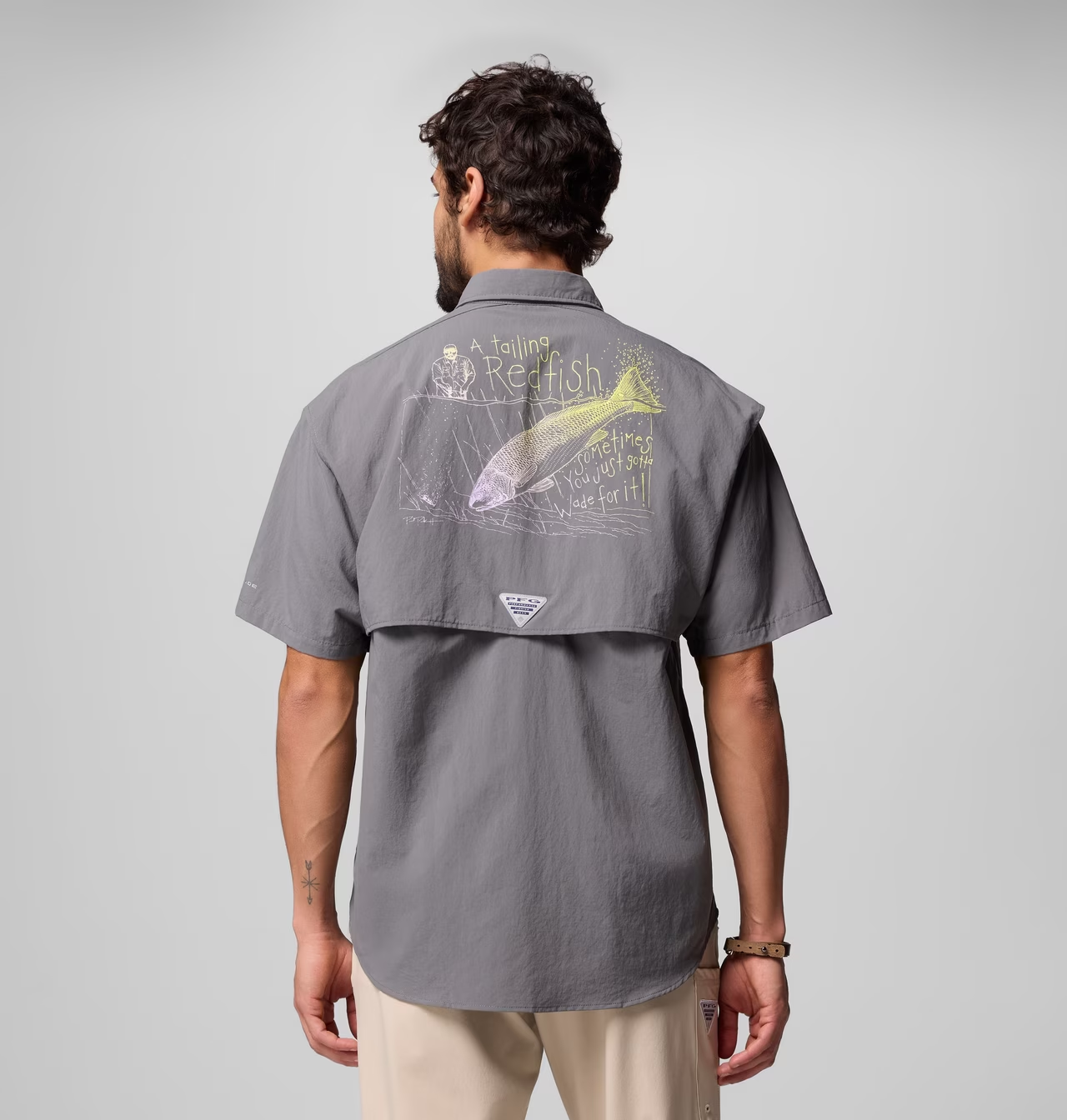
Columbia’s legendary line of Bahama Shirts just got a major upgrade thanks to artist Paul Puckett. Paul’s artwork featuring tarpon, redfish, and largemouth bass graces the back of three unique shirts. If you love fly fishing and fine art, then this is the shirt for you.
If you’re looking for the perfect mid-layer, the Gridback Fleece Anorak Hoodie from Free Fly might be it. Made from a rugged and weather-resistant outer layer and a soft fleece inner layer. Together, the two combine to create a versatile layer for fall and spring fishing. This layer also doubles as a great layer off the water and around town.
With winter fishing in full swing, a good pair of under-the-wader pants is a must. They prolong your days on the water and keep your legs warm and comfortable, even when the water temps say otherwise. The Patagonia R2 TechFace Pants look and feel like sweatpants from the outside but offer a grid-fleece interior that keeps your legs warm. They also feature tapered ankle cuffs to ensure your pants don’t slide up when putting on waders.
Poncho Outoors has recently cornered the fishing shirt market by building comfortable, performance-oriented shirts. The Original is a testament to that statement. It’s lightweight and breathable with classic styling. Additionally, the shirt offers UPF 50 protection and is quick-drying. For anglers who prefer a classic button-up shirt, there’s no better option.
Every fly fisherman needs a good belt. They keep our pants riding at the right height and let us attach tools like pliers for quick access. Yet, of all the gear we used, belts are often the most overlooked. I know I’ve bought my fair share of random belts on the road over the years. In an effort to fix that issue, we switched to Zilker Belts, blending style and functionality in one comfortable package. The Sagebrush Belt features premium Argentine leather and western-inspired stitching for a belt you won’t forget to pack. It’s also compatible with custom belt buckles, in case you really want to set yourself apart from others on the water.
Every angler needs a go-to fishing Tee, and why not make it one from your favorite fly fishing publication? The newest Flylords Logo tee blends classic styling that any bass fishing fanatic will love. For more options, check out our full store HERE.
Tutlebox’s newest speaker delivers the same great sound quality and rugged reliability in a package fit for any angler. The new Ranger Speaker is available in 6 different color options, and even comes with a magnetic back to easily mount to anything metal. Unlike other waterproof speakers, a Turtlebox does not sacrifice sound quality, producing crisp and loud tones. Whether on the boat or at a backyard BBQ, a Turtlebox will set the tone (pun intended). Best of all, this size speaker can truly travel wherever the fishing may take you.
A good knife is something all anglers need, and one that blends classic aesthetics with a modern look is a sure winner. The Benchmade Successor is a modern slip joint knife that comes with a leather pocket sheath. For those wanting a vintage-looking knife with modern materials and function, this is the knife for you.
Every angler should own a pair of deck boots, and the HUK Rogue Rave Boots are the best we’ve found. They have a comfortable fit, come in a wide range of sizes and colors, and above all, are durable. I still have a pair from 4 years ago that are going strong after countless days on the water. Whether for poling a skiff, home chores, or casual wear, these versatile shoes will get their use.
Costa’s new Fly Line glasses are specifically designed for fly anglers looking for reliable and reasonably priced sunglasses. They are available in either glass or poly lenses, with the glass costing a bit more and featuring a large fit. The 8-base wrap creates full coverage around your eyes to block out the maximum amount of sun. Lastly, the arms come with built-in loops to attach old fly line as a lanyard so everyone knows you’re a fly angler.
The Skwala RS Wading Boots are the most comfortable boots we’ve worn. So much so, they took home our Gear of the Year award for wading boots. Skwala took the time to reimagine boot design from the ground up. Gone are the stiff midsoles and flat insoles, replaced with flexible materials molded to the shape of your feet. The end result is a boot any angler can comfortably wear for years to come.
Fly tying is an expression of your inner creativity, just as your tying setup should be. The Abel Vise Base gives fly tyers the ability to customize their vise setup with plenty of color options. On top of that, this base has adequate storage to keep hooks, beads, and other materials organized.
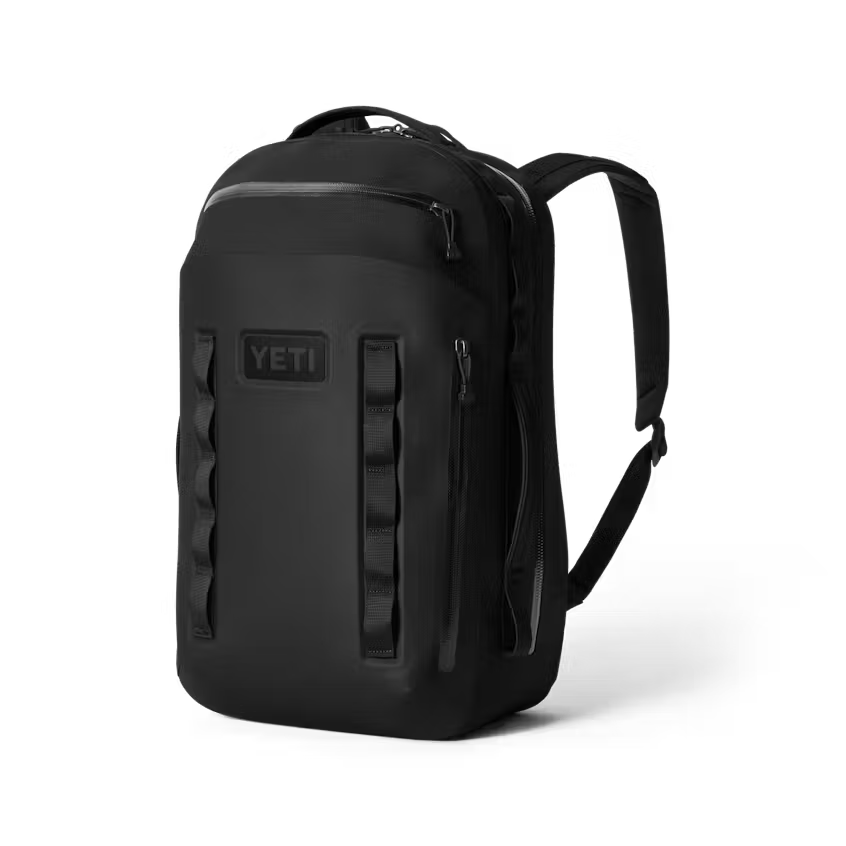
For years, the YETI Panga Backpack has been our go-to for weatherproof fishing backpacks. Now, YETI has added to its lineup with the Cayo Backpack. This pack is designed with plenty of internal organization, unlike most packs on the market. In addition, it features a breathable backpanel and a comfortable fit. It’s available in three sizes and features waterproof materials and zippers. It does have a slot for a water bladder hose, so it is not fully submergible.
For over eight decades, Shinzo Tamura has combined light and flexible frames recalling iconic sunglasses shapes, with the world’s best polarized lenses made by TALEX. Designed to protect your eyes, keep you healthy, and suppress the strongest reflection, allowing you ultimate vision into the deepest water. Shinzo Tamura’s Joto is one of our classic frame styles that recalls the timeless feel of the 1960s and 1970s, ensuring clarity, comfort, and style while pursuing for fish!
Do you want to really surprise your angler? Hardy’s newest reel, the Averon, should do the trick. Available in sizes 3000 to 9000, there is a reel for just about any fishing scenario. These modern-styled reels look and feel great and are perfect for balancing today’s modern rods. It’s paired with a powerful drag system and can be fine-tuned to expertly fight the fish you are after.
You don’t need a thousand trout reel; in fact, rarely, if ever, will you see your backing while fishing for trout. Instead, opt for a reliable and good-looking reel like the Orvis CFO. This reel is inspired by the classic CFO released in 1874 and features modern machining. The CFO is a click-pawl reel, which sounds incredible, but it does feature a small knob ever so slightly to increase drag pressure. For $350, there aren’t many better-looking and better-performing options on the market.
Fishpond is known for pushing innovation, and its Thunderhead Chest Pack is no different. It is a fully waterproof and submersible chest pack, keeping the essentials close by. The chest pack is sized perfectly for quick trips to the river or a minimalist approach. Anglers can store fly boxes, indicators, and floatant in the main pocket, and a tippet bar keeps everything within hand reach. When fish are rising in front of you, it’s easy to change flies and make an approach without fumbling for a bag on your back.
The newest series of rods from St. Croix features some specialty rods that any diehard predator angler should add to their quiver. Specifically, the Tannic Musky & Pike series of rods has been a team favorite this year while fishing in the Midwest. The extended cork and rear casting butt allow you to throw large flies, figure eight at the boat, and stop big fish in their tracks. If you know an angler who’s constantly tracking the moon phase, and toughing it in the worst conditions for the fish of 10,000 casts, then this is the rod for them.
Good waders are expensive, but they don’t have to be. The Grundéns’ Vector Waders are built with a durable 4-layer nylon material capable of withstanding sticker patches and day-in and day-out abuse on the water. These waders feature large chest storage pockets and built-in knee pads to round out the package. If you know an angler looking for a new pair of waders, don’t think twice about the Grundéns Vector Waders.
Every now and then, we find a piece of gear that we didn’t know we needed and now will never leave home without. The Simms Taco Wader Bag is that piece of gear. This bag unzips to act as a floor mat to put on and take off waders. Once you’re done fishing, the waders store inside the bag for easy travel, while keeping other gear dry. For anglers with waders lying around, this is the best gift you can give them.
Every angler needs a Neck Gaiter to keep the sun’s harmful UV rays off their face and neck. The Insect Shield series from Buff offers 50 UPF protection as well as built-in insect repellent. In the summer months when mosquitoes terrorize the rivers you frequent, this piece of gear will become a staple. It also comes with epic brown trout artwork we can’t resist.
If you’re looking for the perfect stocking stuffer, check out Puffin Drinkwear’s Adventurer coozie. The Adventurer, modeled after a fishing vest, will see its fair share of use chilling beverages for any angler.
Gyotaku is a traditional method of printing fish with ink. As fly anglers, we do our best to practice catch and release, but even the most seasoned anglers will inevitably kill a fish. With this kit from Iko Print, you have a tool to remember your catch forever. Simply cover the fish with the supplied ink and lay down the provided paper to have a memory that will last forever.
While not technically a physical product, an onWater subscription is the gift that keeps on giving. It is an online mapping tool that shows anglers access points and public and private borders, allows them to plan float trips, and much more. A year-long subscription will pay dividends for anglers looking for any advantage they can get.
Casey Underwood makes incredible fish artwork, and the Trout Pack of stickers is just what anglers need to personalize their gear. This pack consists of six different trout decals perfect for adding to a water bottle, cooler, or drift boat for the upcoming season. Throw these in a stocking, and they won’t go to waste.
Inspired by the outdoors and the American West, Seager is right at home on the bank of the river. The Seager Wilson Snapback is a classic-looking hat with Western inspiration for anglers looking to up their hat game. The Wilson comes in several colors, with something for everyone.


 It’s a practical fix that made a lasting difference. Trout now have access to more habitat, and the surrounding reach is healthier and more resilient. The project also became a model for collaboration, showing that conservation and agriculture can work side by side.